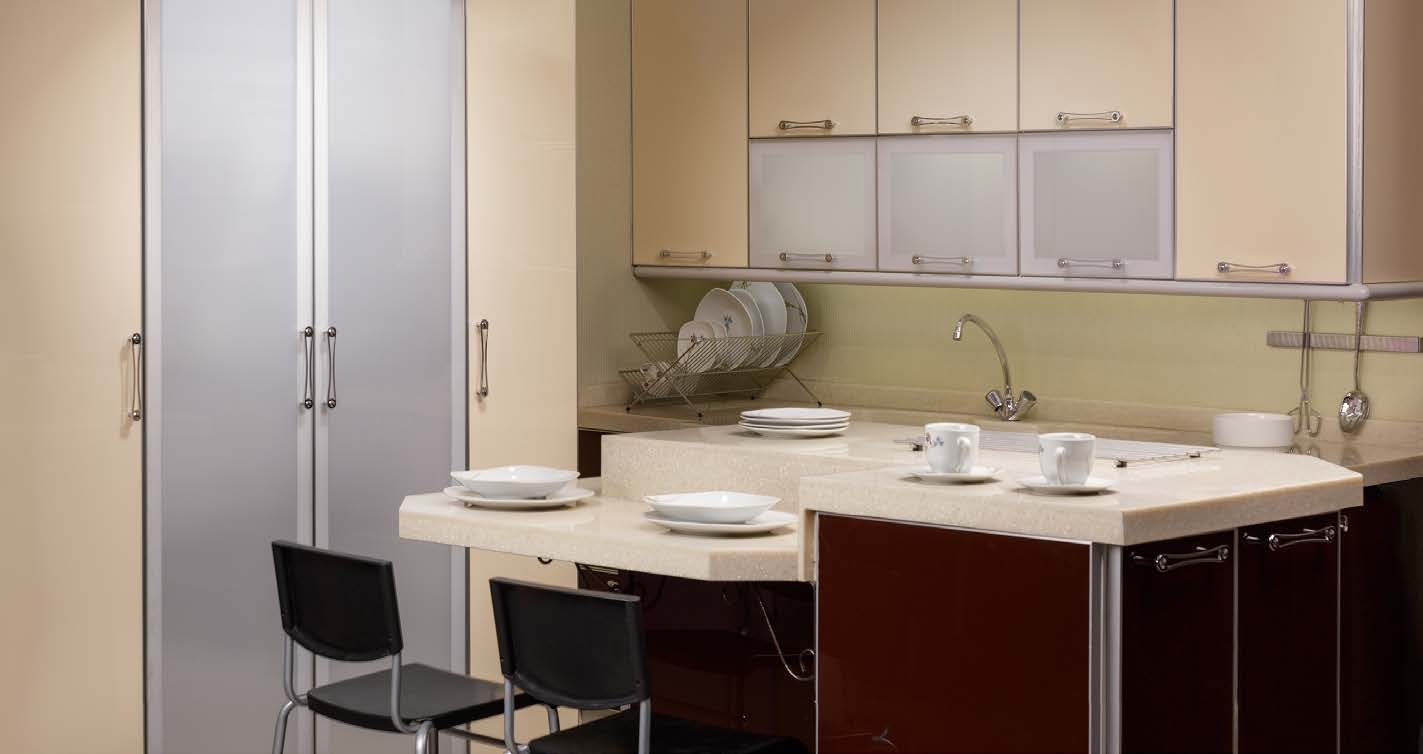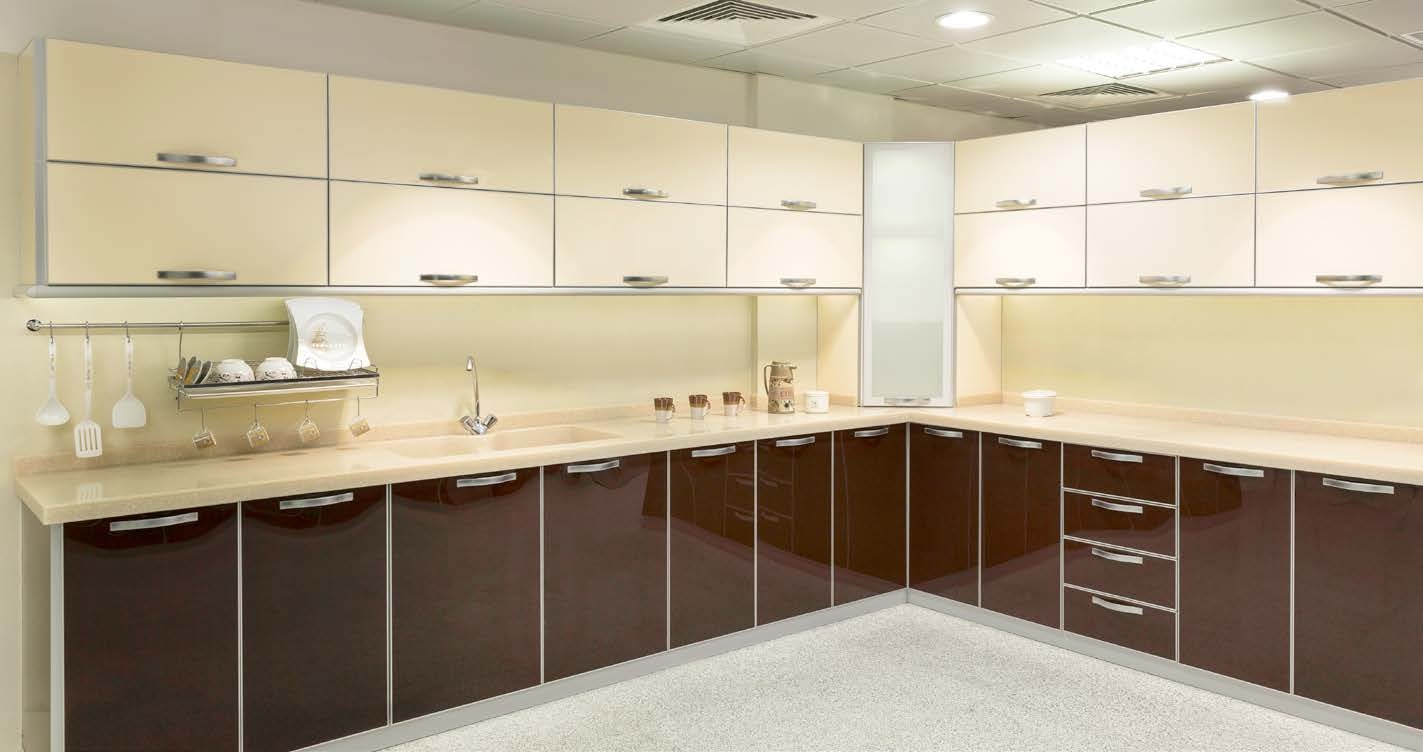
Acrylic is the material people come to us for when they have seen a kitchen somewhere and cannot stop thinking about it. That deep, wet-looking gloss — where the colour seems to sit inside the door rather than on top of it — is acrylic. And the reason it looks that way is genuinely physical, not a matter of taste: acrylic has depth that paint and film cannot produce.
We manufacture acrylic kitchens in our own Riyadh factory and install them with our own crew in Riyadh, Al-Ahsa, Buraydah and Hail, with a written ten-year warranty.
What acrylic actually is — and the difference from “high gloss”
An acrylic door is a board — MDF or HDF — with a solid acrylic sheet pressed and bonded to its face under heat and pressure. The acrylic is a real polymer sheet with thickness, typically 1 mm or more. Light enters it, travels through it, reflects off the colour layer and comes back out. That round trip is what your eye reads as depth.
Now compare it with what is often sold alongside it:
- High-gloss foil or PVC film. A thin plastic film wrapped over the board. Shiny, but flat — there is nothing for light to travel through. It also lifts at the edges over years of steam, which acrylic does not.
- Gloss lacquer / spray paint. Paint polished to a shine. It can look excellent when new, and it scratches and yellows. It also cannot be polished back by the owner.
- Gloss laminate. Legitimate and inexpensive, and visibly shallower. We sell it and say exactly that.
- Acrylic. A solid sheet with real thickness, UV-stable, and — the point almost nobody mentions — polishable. A light surface scratch in acrylic can be buffed out. In film, lacquer or laminate it is permanent.
So the question to ask any supplier is not “is it high gloss?” — everything is high gloss. It is: “is it a solid acrylic sheet, and how thick is it in millimetres?” Anything under 1 mm starts to reveal the board beneath at the edges as the years pass.
Why acrylic suits Saudi kitchens
- It is unaffected by steam and humidity. The acrylic face is a sealed polymer; moisture has nothing to attack. This is a real advantage over foil-wrapped doors, which are the most common failure we are called to replace.
- The colour does not fade. Acrylic sheet is UV-stable. A kitchen with sun reaching it keeps its colour, where gloss lacquer yellows.
- It is repairable. Fine scratches polish out with the right compound. We supply the compound and show you how.
- It reflects light. In a small or dark kitchen this makes a measurable difference to how the room feels — for the same reason glass does, at a lower cost.
- Nothing stains it. Non-porous, so turmeric, tomato, coffee and oil all wipe off completely.
- Edges can be colour-matched. Good acrylic doors get a matching 1–2 mm edge band bonded with heat, so the door reads as a single solid slab rather than a sandwich.
Who should choose acrylic — and who should not
We recommend it if:
- Your kitchen opens onto the living room. This is acrylic’s home. It reads as furniture, and it is the most photographed material we build.
- You want gloss but tempered glass is beyond the budget — acrylic delivers most of the visual effect for meaningfully less.
- Your kitchen is small or has limited natural light.
- You want a colour that will still be that colour in ten years.
- You like a completely flat, frameless door face — no frame, no shadow line, no panel. If you find the visible frame of an aluminium door unappealing, this is your material.
We do not recommend it if:
- Fingerprints will bother you and you want a dark colour. Read the drawbacks section below before you decide — there is a solution, and it is not “just be careful”.
- You want warmth and grain — that is natural wood.
- The kitchen takes industrial-level punishment — a production kitchen or a small restaurant. There, saj steel or aluminium is the correct answer.
- The budget is genuinely tight. In that case an acrylic and formica combination gives you the gloss where it is seen at 25–40% less — and it is the option we recommend most often in the whole factory.
And the drawbacks? Four, stated plainly
- Fingerprints on dark gloss. Real, and we will not pretend otherwise. On black, navy or graphite acrylic every fingerprint shows. On white, cream, light grey or beige they are practically invisible. And there is a genuine solution people rarely hear: matte acrylic — the same solid sheet with a satin surface. You keep the depth and the UV stability and the polishability, and fingerprints disappear entirely. For a family kitchen in a dark colour, this is what we recommend.
- A deep gouge cannot be polished out. Light scratches buff away; a real cut through the acrylic into the board does not. The practical answer is that a single door is replaceable, and we keep your colour reference on file so a replacement matches.
- Cheap acrylic delaminates at the edges. Thin sheet, or an edge band applied with cold glue instead of heat, will lift at the corners after a few years of steam. This is a specification failure, not a material failure — and it is the single thing to check hardest in any quotation.
- It shows dust in a way matte materials do not. In Riyadh this is worth knowing. A gloss kitchen looks spectacular the day it is cleaned; a matte kitchen looks the same on day four. Neither is wrong — decide which trade you prefer.
None of these are reasons to avoid acrylic. Three of the four are reasons to read the specification, and the fourth is a matter of temperament.
How to tell good acrylic from bad — seven checks
- Ask for the sheet thickness in millimetres. 1 mm minimum. “It’s thick, don’t worry” means it is not.
- Look at the door edge from a shallow angle. You should see a colour-matched band bonded seamlessly. Any dark line, any glue bead, any slight step — that edge will lift within a few years.
- Press your thumbnail into an offcut. Solid acrylic resists; a thin film dents and shows the mark.
- Hold a sample up to a window and look into it, not at it. Real acrylic has visible depth — you can see the colour sitting below a clear layer. Film has none.
- Ask what board is underneath and how thick. MDF or HDF, 18 mm for doors, and moisture-resistant board in every wet zone. The acrylic is the face; the board is the kitchen.
- Ask whether scratches can be polished. A supplier who says yes and hands you the compound is selling acrylic. One who changes the subject is selling film.
- Open and close a sample door ten times. Soft-close should be silent and smooth from the first centimetre. Any clack means the hinge is underrated for the door.
Do these checks with us as readily as with anyone else. We are not asking for trust — we are asking you to compare specifications.
Acrylic kitchens we built ourselves
Not stock photography. Each image is an acrylic kitchen that left our Riyadh factory and was installed in a client’s home — judge the finish, not the wording.
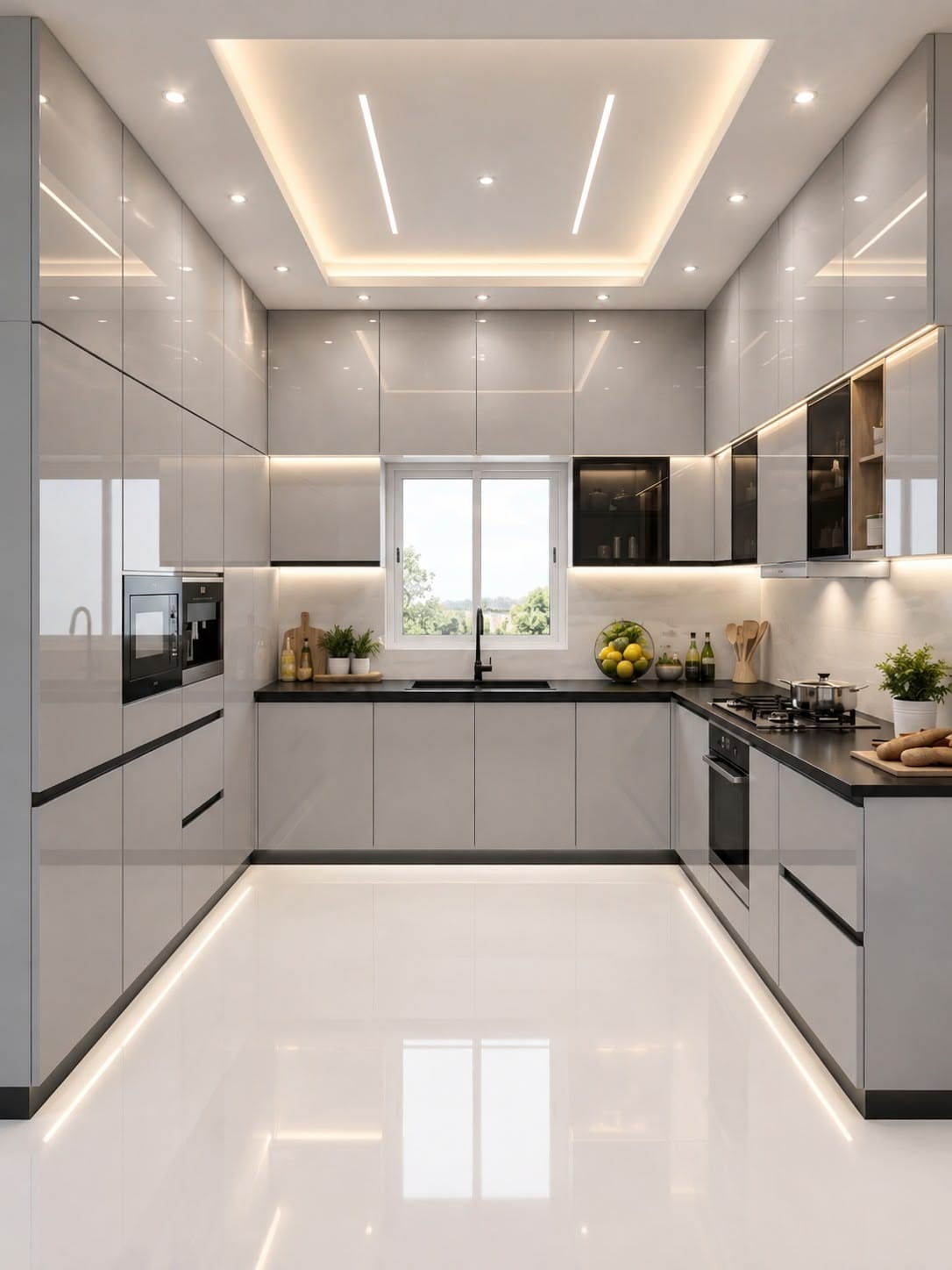
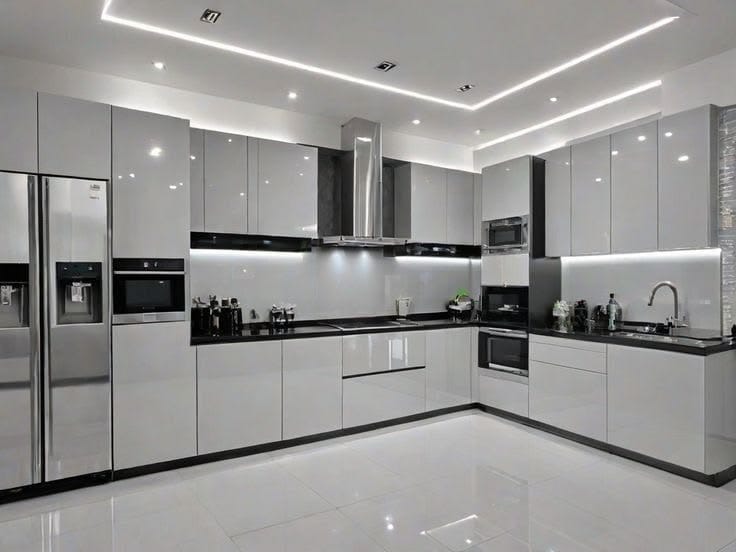
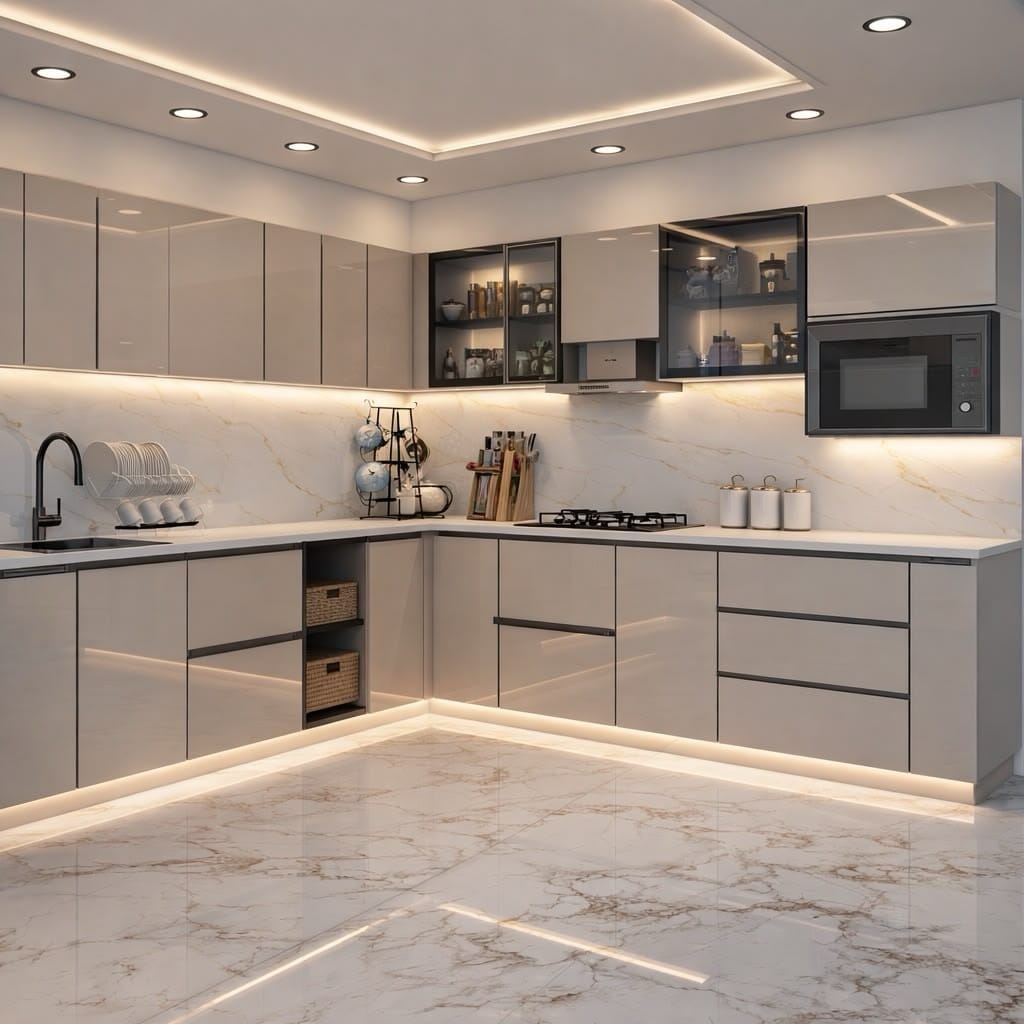
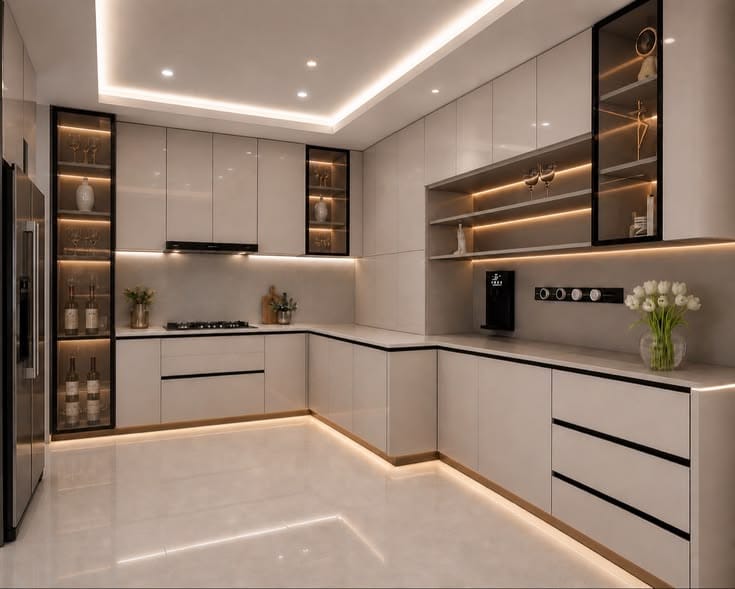
Ask for the full album on WhatsApp and we will send acrylic kitchens at sizes and budgets close to your own project.
Colours and finishes
- Gloss whites and creams. The safest and most popular choice, and the easiest to live with because fingerprints barely register. Brilliant white, warm white, cream, ivory.
- Gloss light and cement greys. Contemporary, calm, and more forgiving of daily use than white.
- Gloss darks — navy, graphite, black. Dramatic and genuinely beautiful, with the fingerprint cost described above. If you want dark, choose matte acrylic instead and get the same drama without the daily wiping.
- Matte / super-matte acrylic. The most underrated product in the Saudi market. Solid acrylic sheet with a satin surface: no fingerprints, no glare, and many are anti-fingerprint coated. In our opinion this is the most intelligent choice available in the gloss category, and almost nobody asks for it because almost nobody is told it exists.
- Metallic and pearl acrylics. Champagne, bronze, pearl grey. A subtle shimmer that suits open-plan spaces well.
- Two-tone schemes. Gloss white uppers with a deep colour below, or the reverse. Very effective, and it halves the fingerprint problem by putting the dark colour where hands are lower down and light hits less.
A design note that matters more than any colour choice: acrylic depends on light. Under-cabinet LED lighting is not a decorative extra here — it is what reveals the depth you paid for. Without it, gloss acrylic looks like ordinary paint and the premium disappears. Choose warm-white LED; cool white makes gloss look clinical.
And one rule we give every client: no more than two colours on the doors. A three-colour kitchen looks busy no matter how good each colour is on its own.
Mixing acrylic with other materials
The smartest use of a kitchen budget is rarely one material everywhere. What we build most often:
- Acrylic uppers with formica lowers. The uppers are at eye level and get touched least; the lowers take knocks, water and hard cleaning. This saves 25–40% against full acrylic and is frequently more durable. It has its own page: acrylic & formica kitchens.
- Acrylic doors with formica internal carcasses. Nobody judges a kitchen from inside a closed cupboard, and formica interiors resist pan scratches better.
- Acrylic island with matte units around it. The island is the centrepiece of an open-plan kitchen — make it the exception.
- Acrylic doors with a tempered glass splashback. The two glossy surfaces read as one continuous material, and the splashback wipes clean in a single pass.
- Acrylic with timber accents. One warm element — a shelf, an open unit, a breakfast bar top — stops a gloss kitchen from feeling cold.
- Sink units in aluminium, everything else acrylic. Metal where the water is; gloss where the eye is.
Where the price differences come from
| Line item | The cheap shortcut | Our specification |
|---|---|---|
| Face material | PVC film sold as “acrylic” | Solid acrylic sheet, stated in writing |
| Sheet thickness | Under 1 mm, unstated | 1 mm and above, stated in millimetres |
| Edge band | 0.4 mm, cold glue, mismatched | 1–2 mm colour-matched, heat-bonded |
| Board type | Ordinary particle board | MDF/HDF, moisture-resistant in all wet zones |
| Door thickness | 16 mm | 18 mm |
| Carcass backs | 3 mm sheet, pinned on | Faced board, finished both sides |
| Hinges | Generic, no soft close | Soft-close, weight-rated, warranted |
| Drawer runners | Plastic roller | Full-extension telescopic metal |
| Legs and plinth | Timber sitting on the floor | Adjustable plastic legs, raised plinth |
| Lighting | Not mentioned | A clear line item in the quote |
Two rows deserve emphasis. The edge band is where acrylic kitchens visibly fail — a 0.4 mm strip on cold glue lifts at the corners and there is no repair for it. And a timber plinth resting on the floor is the commonest cause of early kitchen failure in Saudi homes: one mopped floor or one small leak and it absorbs water, swells, and takes the unit with it. Every unit we build sits on adjustable legs behind a removable plinth.
Compare tables of line items, not final totals. Acrylic is the category where the word on the quotation and the product in the door diverge most often.
Our process — eight steps
- A call or WhatsApp message. City, property type, approximate size, and the budget you have in mind. Free and non-committal.
- The measuring visit. A technician measures walls, corners, sockets, water and gas points and the extraction position himself — and notes where daylight falls, because that decides whether gloss or matte will serve you better.
- Free 3D design with the actual colour, plus a physical acrylic sample to look at in your own light. Gloss photographs differently from how it lives.
- Revisions. Unlimited at this stage — changing a drawing is free, changing a manufactured door is not.
- An itemised quotation. Sheet type and thickness, edge band, board type, hardware, worktop, lighting, lead time and warranty.
- Manufacturing in our own factory. Acrylic bonding is a pressing process with a temperature and a dwell time; it is not a hand-glued job, and it is not something we subcontract.
- Installation by our own crew across all four cities.
- Handover and inspection with you, the polishing compound, and the ten-year written warranty certificate.
Caring for an acrylic kitchen
- Microfibre cloth and a mild glass cleaner. Microfibre specifically — it lifts rather than smears, and smearing is the whole problem with gloss.
- Dry with a second cloth if you want a perfect face. On gloss this is the difference between clean and immaculate.
- No steel wool, no abrasive powder, no scraper. They will dull the gloss permanently over a patch, and a dull patch in gloss is more visible than a scratch.
- No acetone, no thinner, no chlorine bleach. Acrylic is a polymer; solvents attack it.
- Light scratches: use the polishing compound. Small amount, soft cloth, circular motion, then buff. This is acrylic’s privilege — use it rather than living with the mark.
- Do not put a hot pan on an acrylic surface. It tolerates ordinary kitchen heat but not the base of a pan straight off the flame.
- Run the extractor every time you cook. Acrylic itself is unbothered by steam; the board and the edge band behind it are not.
- Check the hinges every six months. A quarter turn with a screwdriver keeps the door square and stops the edge rubbing.
With that routine an acrylic kitchen from our factory still looks new at ten years. The material does not degrade on its own — it degrades with solvents, abrasives and neglected edges.
Common mistakes we see in acrylic kitchens
- Buying film and believing it is acrylic. The most expensive mistake in this category. Ask for sheet thickness in millimetres.
- Choosing black gloss with small children. An entirely predictable source of daily irritation. Matte acrylic in the same colour solves it completely.
- A 0.4 mm edge band. The corners will lift. This is not bad luck; it is arithmetic.
- Skipping the lighting. The most common regret we hear. Gloss without light is money spent and not seen.
- A worktop from the same laminate as the carcasses. The worktop takes knives, heat and standing water. Quartz, granite, solid surface or steel.
- No moisture-resistant board under the sink. The face is sealed; the cut edges inside the cabinet are not. This unit needs the right board and a drip tray.
- No ventilation gap around a built-in oven. Trapped heat damages the adjacent unit and can affect the edge bond nearest to it.
- Worktop height set by habit. The standard is 85–90 cm, but someone who stands in the kitchen for hours deserves a height chosen for their own build.
Accessories: where the daily experience is decided
An acrylic kitchen with excellent hardware is more pleasant to live with than a timber kitchen with poor hardware — because what you touch every day is the hinge, the runner and the handle, not the face.
- Soft-close hinges, weight-rated. Non-negotiable. Repeated slamming is what loosens an edge band at the corner.
- Full-extension telescopic runners. You see the back of the drawer. Roller runners open halfway and jam within a year.
- Handleless push-to-open or recessed grip rails. Aesthetically the best match for acrylic — a completely flat gloss face with no interruption — and they also reduce fingerprint clustering around handles.
- Rotating corner baskets. The corner is the worst space in any kitchen; this one part makes it real storage.
- Warm-white LED under the wall units. In an acrylic kitchen, treat this as part of the kitchen rather than an extra.
- Integrated waste bin and in-drawer organisers. Inexpensive, and they change how the kitchen feels every single day.
How the price is calculated — the linear metre, unpacked
Kitchens are priced by the linear metre, not the square metre. A linear metre normally covers the base unit, the wall unit above and the worktop. An L-shape with three metres on one wall and two on the other is five linear metres. What those metres cost moves with:
- Doors versus drawers. A drawer needs a runner and a box. All drawers can run thirty per cent above all doors at the same length.
- Handleless systems. Push-to-open mechanisms and recessed grip rails are priced per door.
- Corners and columns. Special pieces, and ideally a rotating basket.
- A third upper row. More storage and more cost — and ask whether you will reach it without a chair.
- Built-in appliances. Each needs a precise housing and ventilation.
- Colour. Standard whites and greys are stocked; metallics, pearls and super-mattes are special order and priced accordingly.
- The worktop. A separate line, and the spread between options can be a third of the kitchen’s cost.
Which is why we will not quote a final figure by phone. An indicative range on the phone; a precise itemised figure after measuring. Anyone quoting firmly before seeing your space has priced the weakest specification or intends to raise it later.
What our quotation includes — and what it does not
Included: the measuring visit, 3D design, an acrylic sample, carcasses and doors, solid acrylic faces with colour-matched heat-bonded edges, soft-close hinges and telescopic runners, handles, delivery, installation, post-installation adjustment, polishing compound, and a ten-year written warranty certificate.
Not included — quoted separately, only on request: the worktop, sink and tap, extractor, hob and oven, LED lighting, plumbing and electrical work inside the wall, the wall splashback, and removal or relocation of an old kitchen.
Ask every other quotation for the same breakdown. A “cheaper” offer that excludes delivery and installation is usually the more expensive one once you add them back.
An honest comparison with our other materials
| Material | Look | Durability | Price | Best for |
|---|---|---|---|---|
| Formica | Practical, neat | Good with the right spec | Lowest | Tight budgets and rentals |
| Acrylic + formica | Partly glossy | Very good | Low–medium | Best value for money |
| Saj steel | Metallic, modern | High | Medium | Longest life at the lowest price |
| Aluminium & alumetal | Modern, versatile | Very high | Medium–high | Heat, humidity, heavy use |
| Acrylic | Deep gloss, frameless | Very good — and polishable | High | Kitchens open to the living room |
| Tempered glass | The most refined | High | High | Small spaces, premium look |
| Natural wood | Warm, classical | High with care | Highest | Villas and classical taste |
There is no best material in the abstract — only the one best suited to your space, your usage and your budget. If you want depth, a flat frameless face and colour that will not fade, acrylic is the answer. If you asked us which gives the best return per riyal, the honest answer is the acrylic and formica combination — and we will say so even though it is the smaller invoice.
Layouts and spaces
- Single run. For narrow galley rooms — and a layout where gloss genuinely helps, because reflection widens a tight space.
- L-shape. The most common layout in Riyadh apartments, giving a comfortable triangle between sink, hob and fridge.
- U-shape. Maximum storage; needs at least 240 cm of room width to stay comfortable to move in.
- Parallel runs. Good for long kitchens, 110–120 cm of clear floor between them. Gloss on one run and matte on the other is a combination that lives well.
- Island. Needs generous space, and acrylic is the material we recommend most for an island front because it is the surface guests look at longest.
In every case, the free 3D design settles it before anything is manufactured. We show the two or three layouts genuinely possible in your room, with the real colour in your own daylight.
Lead time and warranty
- Measuring and design: two to four days until you approve.
- Manufacturing: twelve to eighteen working days. Standard colours sit at the shorter end; metallic, pearl and super-matte sheets are special order and sit at the longer end.
- Installation: one to two days for an average kitchen.
The warranty is ten years in writing, covering manufacturing and installation defects, edge-bond adhesion, hinges and runners. It does not cover flooding, direct flame, solvent or abrasive cleaning, deep impact damage, or units dismantled and reinstalled by anyone other than us. We say this before you pay rather than after.
Acrylic in the cities we serve
- Riyadh. Dry, hot and dusty. Acrylic performs perfectly; the honest caution is dust on gloss, which is why we often steer clients here toward matte acrylic or a light gloss rather than dark gloss.
- Al-Ahsa. High humidity. The acrylic face is entirely unaffected — what matters is the board behind it and the edge band around it, so we specify moisture-resistant board throughout the wet zones, 2 mm heat-bonded edges without exception, and raised plinths. For very heavy use in Al-Ahsa we will still recommend aluminium as the lower-risk option.
- Buraydah. Wide seasonal temperature swings. Acrylic is dimensionally stable across them, unlike timber, which expands and contracts.
- Hail. Colder winters and warmer local taste. Cream, champagne and pearl acrylics are the most requested here, often with a timber accent.
Across all four: the same crew, the same specification, the same warranty. We do not price Al-Ahsa or Buraydah higher for distance, and we do not thin the specification to absorb transport.
Replace or refurbish?
Acrylic is an excellent refurbishment material, because acrylic doors can be fitted to sound existing carcasses — visually you get an entirely new kitchen for a fraction of a rebuild. Whether that is right depends on what is underneath:
- Sound carcasses, tired doors — replace the doors in acrylic. The best-value upgrade we offer, and the one we recommend most often to clients who assumed they needed a whole new kitchen.
- Swollen plinths or units that move when pushed — full replacement. Mounting new doors on a failing carcass wastes the doors.
- Edge bands lifting on existing gloss doors — those doors are finished. If the carcasses are sound, replace the doors only.
- A layout that does not work — replace it. Do not spend money making an irritating arrangement look better.
- Over fifteen years old — usually replacement, because the old hardware is no longer available.
We inspect what you have during the measuring visit and tell you what we actually think — including, more than once, that you should keep what you have and wait.
For contractors and property projects
- Acrylic sells a viewing. A gloss kitchen photographs better than any other material and makes the strongest first impression in the three seconds after the front door opens. For units built to sell, that is worth real money.
- For rentals, use it selectively. Acrylic on the run visible from the apartment door with formica elsewhere gives you nearly all of the impression at a controlled cost — see acrylic & formica.
- Choose light colours for tenanted units. Tenants will not polish a black gloss kitchen, and it will photograph badly at every future viewing.
- Standardise colour and size across units so one spare door fits any apartment, and keep two spares in storage.
- Ask for project pricing. We price from five units upward with phased delivery matched to your handover programme.
Questions our clients ask
What is the difference between acrylic and high gloss?
“High gloss” describes an appearance and can be achieved with film, lacquer, laminate or acrylic. Acrylic is a solid sheet with real thickness — which is why it has visible depth, why it does not lift at the edges, and why it can be polished. Always ask which one you are being sold.
Do fingerprints really show that much?
On dark gloss, yes. On light gloss, barely. On matte acrylic, not at all. The colour choice matters far more than the material choice here, and matte acrylic is the answer most people are never offered.
Can scratches be removed?
Light surface scratches, yes — with the polishing compound we hand over at delivery. A deep gouge through the acrylic cannot be polished out, but a single door can be replaced and we keep your colour reference on file.
Will the colour fade in the sun?
No. Acrylic sheet is UV-stable. This is one of its clearest advantages over gloss lacquer, which yellows, and over film, which chalks.
Is acrylic heat-resistant?
It tolerates normal kitchen heat without issue. It does not tolerate the base of a pan straight off the flame, and units beside a built-in oven need proper thermal isolation — which we fit as standard.
How do I get the look for less?
Put acrylic where it is seen and formica where it is used. It saves 25–40% and we recommend it more often than full acrylic. See acrylic & formica kitchens.
Does the price include the worktop?
No. It is a separate, clearly stated line because the options vary so widely. We never fold it silently into a total.
Can I add a matching unit years later?
Yes. We keep your sheet reference and colour code on file, so an added unit matches instead of looking like an afterthought.
Is payment in stages possible?
Yes, tied to the stages of work and set out in the quotation.
Why Modern Palace
- A factory, not a showroom. No middleman margin on your price and no third party to refer you to when something needs attention.
- We supply our own materials — we know the origin of every sheet and board and choose its specification rather than buying whatever is available.
- More than 5,000 kitchens delivered since 2015, and more than 15,000 clients.
- Pressing done in house. Acrylic bonding is a controlled process with a temperature and a dwell time — it is not a hand-glued job, and we do not subcontract it.
- One installation crew across four cities — Riyadh, Al-Ahsa, Buraydah and Hail.
- A ten-year written warranty and free 3D design before any financial commitment.
And we will say what others avoid: if acrylic is not the right choice for you, we will tell you — including when the cheaper combination would serve you better. We are planning for ten years with you, not for one invoice.
Other materials that might suit you
- Acrylic & formica kitchens — the same gloss where it shows, for 25–40% less.
- Glass kitchens — if you want depth taken one step further.
- Aluminium & alumetal kitchens · Saj steel kitchens · Natural wood kitchens · Formica kitchens
In summary
Acrylic gives you three things together that no cheaper gloss can: real optical depth, colour that will not fade, and a surface you can polish rather than replace. Its honest costs are fingerprints on dark gloss and a price in the upper half of our range — and the first of those disappears entirely if you choose matte acrylic. Everything that decides whether an acrylic kitchen lasts is in four lines of the specification: solid sheet, 1 mm or thicker, a 2 mm heat-bonded colour-matched edge, the right board underneath, and hinges rated for the door. We put all four in writing before you pay anything.
Request a free 3D design for your acrylic kitchen
Free measuring in Riyadh, Al-Ahsa, Buraydah and Hail, an itemised quotation instead of one vague number — and a ten-year written warranty.