
A glass kitchen is the most refined thing we build, and also the most misunderstood. Almost everyone who walks into our factory asking about glass has the same two worries: will it break? and will it show every fingerprint? Both questions have clear answers, and neither answer is the one people expect.
We make tempered glass kitchens in our own Riyadh factory and install them with our own crew in Riyadh, Al-Ahsa, Buraydah and Hail, under the same written ten-year warranty we give every other material.
Tempered glass is not window glass
This is the sentence that resolves most of the fear. The glass we use is tempered — heated to roughly 650°C and then cooled rapidly, which puts the surface into compression and the core into tension. The result is a sheet that is four to five times stronger than ordinary annealed glass of the same thickness.
Three practical consequences follow:
- It resists impact far better than people assume. A pan handle knocking against a tempered door does nothing. The glass in your kitchen is closer in character to a car windscreen than to a picture frame.
- If it ever does fail, it fails safely. Tempered glass shatters into small blunt granules rather than long blades. This is exactly why it is mandated for shower screens and car windows.
- It cannot be cut or drilled after tempering. Every hole for a hinge or handle is made before the heat treatment. This is why measurement accuracy matters more in a glass kitchen than in any other material, and why we never work from measurements sent to us over the phone.
Standard thickness for kitchen doors is 6 mm; we use 8 mm where a door is unusually large or where a panel is used as a splashback behind the hob. Thickness should be stated in your quotation as a number.
The two ways glass is used in a kitchen
1. Lacquered glass doors (back-painted)
The colour is applied to the back face of the glass and then cured, so you are looking at the colour through the glass. This is what produces the depth that no painted or filmed surface can imitate: light enters the glass, reflects off the colour layer and comes back out. It is the reason a lacquered glass kitchen looks more expensive than a glossy one — because visually it is not a shiny surface, it is a deep one.
Because the paint sits on the back, the colour can never scratch off. The face you touch is pure glass. This is a genuine durability advantage that gets almost no attention in the market.
2. Glass panels inside aluminium frames
Here the aluminium profile carries the structure and the glass carries the appearance — frosted, tinted, fluted or clear. It is the right choice for display cabinets, for lighter upper units, and for anyone who wants glass without committing the whole kitchen to it.
We also use glass for splashbacks: a single tempered sheet behind the worktop instead of tiles. One surface, no grout lines, wiped clean in one pass. Anyone who has scrubbed grease out of tile grout understands the appeal immediately.
Who should choose glass — and who should not
We recommend it strongly if:
- Your kitchen is small. This is the most underrated argument for glass. Reflective surfaces bounce light and visually enlarge a room more than any paint colour. A small Riyadh apartment kitchen in light lacquered glass feels noticeably larger than the same kitchen in matte laminate.
- Your kitchen opens onto the living room. Glass is the most refined material we offer, and in an open-plan space it reads as furniture rather than as utility.
- You want a surface that cleans in one wipe. Glass is non-porous. It does not absorb oil, turmeric, tomato or coffee. Nothing stains it.
- Hygiene is a priority. There is nowhere for bacteria to lodge — no pores, no grain, no grout.
- You want colour that will not fade. Lacquered glass holds its colour because the colour is sealed behind glass, away from UV and away from cleaning cloths.
We do not recommend it if:
- You want warmth and grain — that is natural wood, and glass is its opposite in character.
- Your budget is tight. A well-built formica kitchen is a more honest use of a limited budget than thin glass badly mounted.
- You want the whole kitchen, including the carcasses, in glass. That is not how glass kitchens are built anywhere — the structure is always board or metal, and only the visible faces are glass.
And the drawbacks? Four, stated plainly
- Fingerprints on dark colours. This is real and we will not pretend otherwise. On black, navy or deep grey lacquered glass, every fingerprint shows. On white, cream, light grey or beige, they are almost invisible. If you have young children and you want a dark kitchen, choose a frosted or satin-finish dark glass instead of a mirror-gloss one — it solves the problem completely.
- No changes after tempering. If you decide six months later that you want a different handle position, that door must be remade. This is why we spend so long on the 3D design stage in glass projects, and why we ask you to confirm handle type and position explicitly before manufacturing.
- Edges need protection during installation. Tempered glass is strong across its face but vulnerable at the edges, especially before mounting. This is an installation-crew competence issue, and it is the main reason we do not subcontract glass installation to anyone.
- It is one of our more expensive materials. Not the most expensive — solid timber is — but it sits in the upper half of our range. Be clear about whether the look justifies it for you, because we would rather you choose something cheaper and be satisfied.
How to tell a good glass kitchen from a bad one — seven checks
- Ask for the word “tempered” in writing. Not “toughened-style”, not “safety-type”. Tempered, stated in the quotation. Untempered glass in a kitchen is a safety problem, not just a quality one.
- Ask for the thickness in millimetres. 6 mm for doors, 8 mm for oversized doors and splashbacks. A supplier who will not state it is not using it.
- Look at the edge. A properly finished edge is polished smooth — flat-polished or pencil-edged. A raw or roughly ground edge is both a cut hazard and a sign of a workshop cutting corners.
- Check the tempering stamp. Tempered sheets normally carry a small etched mark in one corner. Ask where it is.
- Hold a light at a shallow angle across the face. Tempered glass has very slight surface waviness; that is normal and expected. What is not normal is visible scratching, cloudy patches or bubbles in the lacquer layer.
- Ask how the glass attaches to the carcass. Glass doors need either an aluminium frame or purpose-made glass hinges with clamping plates and a backing panel. Glass glued directly to a board with adhesive alone is not acceptable.
- Open and close a sample door ten times. Glass doors are heavy. Soft-close should be silent and smooth from the first centimetre; any clack means the hinge is underrated.
Do these checks with us as readily as with anyone else. We are not asking for trust — we are asking you to compare specifications.
Glass kitchens we built ourselves
Not stock photography. Each image is a tempered glass kitchen that left our Riyadh factory and was installed in a client’s home.
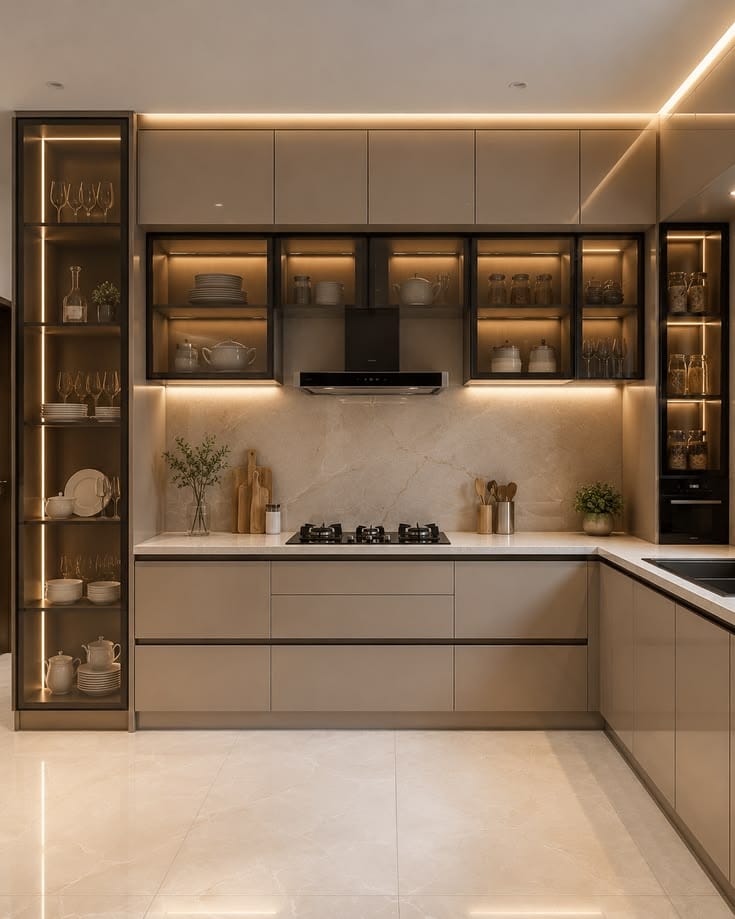
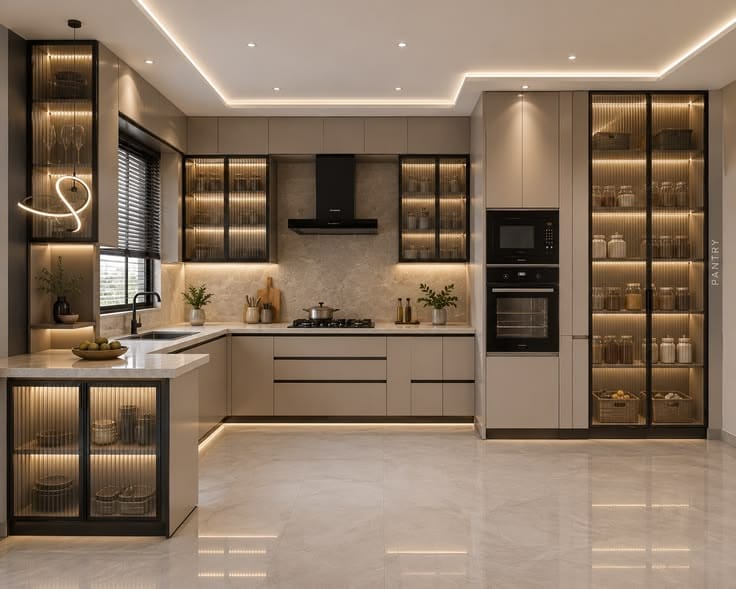
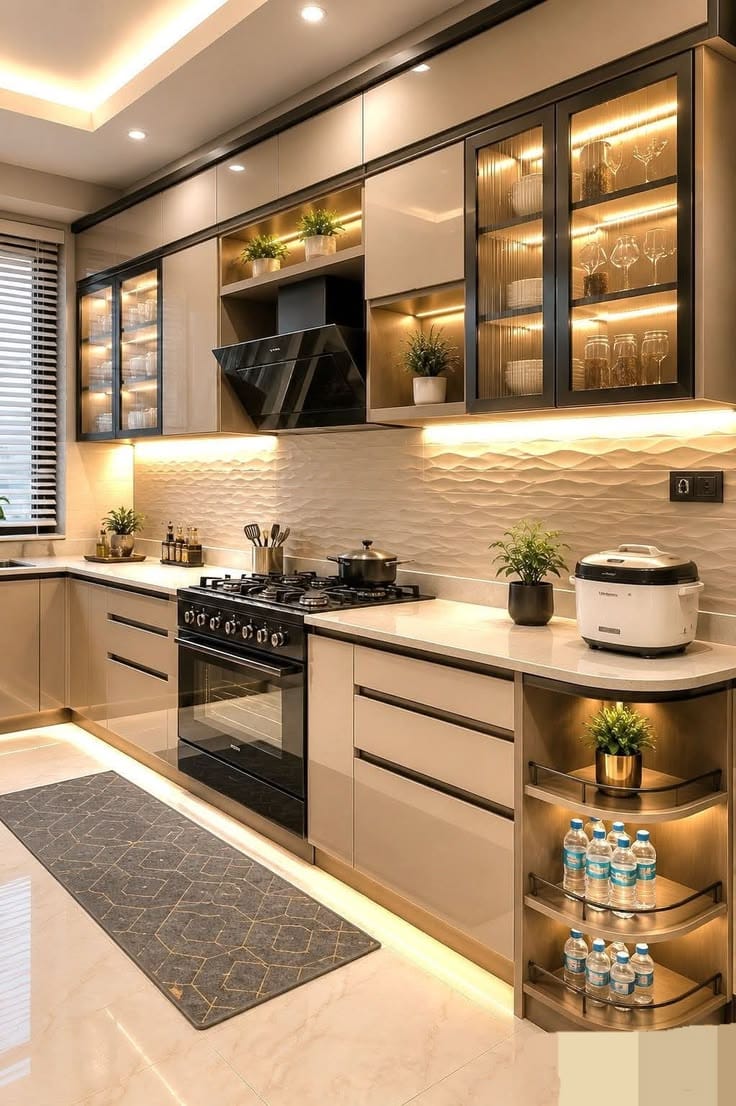
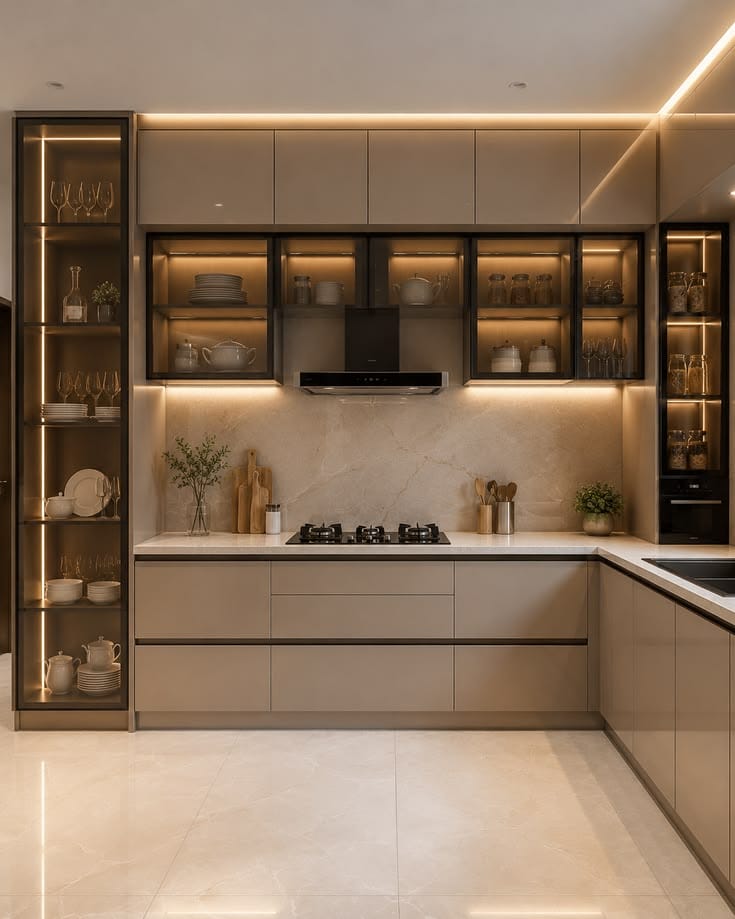
Ask for the full album on WhatsApp and we will send glass kitchens at sizes and budgets close to your own.
Colours and finishes
- Lacquered gloss. The classic glass kitchen. White, cream, light grey, cement grey, beige, olive, navy, graphite and black. Depth is the point here, and light colours are the easiest to live with.
- Lacquered satin or frosted. Our recommendation for anyone who loves dark colours but hates fingerprints. It keeps the depth of lacquered glass and removes the mirror effect entirely. Deeply underused in the Saudi market and, in our view, the smartest choice for family kitchens.
- Fluted and reeded glass. Vertical ribbed texture, currently very fashionable. Beautiful in upper display cabinets and on island fronts.
- Tinted and bronze glass. Warm and quietly luxurious, and a good bridge if the rest of your home leans classical rather than minimal.
- Mirror and antique mirror. Used selectively — one run, not a whole kitchen — to open up a narrow space dramatically.
- Printed glass. A design or photograph fired behind the glass. We will do it, but we advise restraint: printed graphics date faster than plain colour.
A design note worth more than it sounds: glass depends on light. Under-cabinet LED lighting is not decoration in a glass kitchen — it is what reveals what you paid for. Without good lighting, lacquered glass looks like ordinary paint, and the premium you paid disappears.
Mixing glass with other materials
The most intelligent use of a budget is rarely one material everywhere. Combinations we build constantly:
- Glass uppers with formica or aluminium lowers. The uppers sit at eye level and get touched least; the lowers take the knocks. Visually you still read the kitchen as a glass kitchen.
- A glass splashback with any other material. The cheapest way to get the benefit of glass — one seamless wiped surface where grease actually lands.
- Glass island fronts with matte units elsewhere. The island is the centrepiece of an open-plan kitchen; make it the exception.
- Glass panels inside aluminium frames for two display cabinets. A small, inexpensive gesture that breaks up a long, flat run.
- Glass with timber accents. Cold and warm together — a combination that keeps a glass kitchen from feeling clinical.
Where the price differences come from
| Line item | The cheap shortcut | Our specification |
|---|---|---|
| Glass type | Annealed, described vaguely | Tempered, stated in writing |
| Thickness | 4 mm | 6 mm doors, 8 mm oversized and splashbacks |
| Edge finish | Ground only | Polished flat or pencil edge |
| Colour layer | Sprayed paint, uncured | Cured back-lacquer, colour sealed behind glass |
| Mounting | Adhesive onto board | Aluminium frame or glass hinges with backing panel |
| Carcass board | Ordinary particle board | MDF/HDF, moisture-resistant in all wet zones |
| Hinges | Generic, not weight-rated | Soft-close rated for glass door weight |
| Drawer runners | Plastic roller | Full-extension telescopic metal |
| Legs and plinth | Timber on the floor | Adjustable legs, raised plinth |
The plinth row deserves a sentence of its own. A timber plinth resting directly on the floor is the commonest cause of early kitchen failure in Saudi homes — one mopped floor or one small leak and it absorbs water, swells, and takes the unit with it. Raising every cabinet on adjustable legs removes the risk for very little money, and it applies to a glass kitchen exactly as much as to a laminate one, because the carcass underneath is still board.
Compare tables of line items, not final totals. Any supplier who refuses to itemise these nine rows knows the detail does not favour him.
Our process — eight steps
- A call or WhatsApp message. City, property type, approximate size, and the budget you have in mind. Free, and it commits you to nothing.
- The measuring visit. A technician measures walls, corners, sockets, water and gas points and the extraction position himself. In a glass kitchen this step is critical, because glass cannot be trimmed after tempering.
- Free 3D design. You see the colour, the reflection, the handle type and position, and the lighting plan before you pay anything.
- Revisions. Unlimited now — and in glass, genuinely final once manufacturing starts. We will say this to you clearly rather than let you discover it later.
- An itemised quotation. Glass type and thickness, edge finish, mounting method, board type, hardware, worktop, lead time, warranty.
- Manufacturing in our own factory. No middleman, no subcontractor.
- Installation by our own crew. Glass installation is a skill; we do not delegate it.
- Handover and inspection with you, plus the written warranty certificate.
Caring for a glass kitchen — easier than you think
This is the part people get wrong before they even own one. Glass is the easiest surface in a kitchen to keep clean, because nothing penetrates it. The routine is short:
- A microfibre cloth and glass cleaner. One pass, no residue. Microfibre specifically, because it lifts rather than smears.
- Dry with a second cloth on gloss finishes if you want a perfect face. This is the only extra step glass asks for compared with other materials.
- No steel wool, no abrasive powder, no scraping blade. The glass will survive; the lacquer at the edges may not.
- No ammonia-heavy cleaners on frosted glass. They can leave a haze on satin finishes over time.
- Wipe the silicone joint at the splashback occasionally. The glass stays clean by itself; the joint is where residue collects.
- Check hinges every six months. Glass doors are heavy, and a quarter turn keeps them hanging square.
- Run the extractor while cooking. Glass does not mind steam at all, but the hardware and the carcass behind it do.
Nothing stains glass. Not turmeric, not tomato, not coffee, not oil. Owners of glass kitchens tell us this is the thing they appreciate most, and it is rarely what sold them in the first place.
Common mistakes we see in glass kitchens
- Choosing black gloss with small children in the house. A predictable source of daily frustration. Satin or frosted dark glass gives the same drama without the fingerprints.
- Skipping the lighting. The single most common regret. Glass without under-cabinet light is money spent and not seen.
- Untempered glass to save money. Not a saving — a hazard. Refuse it.
- Glass glued straight onto board. It works for a while and then it does not, and when it lets go it lets go with weight behind it.
- A cheap worktop under an expensive kitchen. The worktop takes knives, heat and standing water. Quartz, granite, solid surface or steel — not the cheapest laminate available.
- Handles decided after manufacturing. Holes are drilled before tempering. Decide early, or choose handleless push-to-open and remove the question entirely.
- Three or more colours. A glass kitchen with three colours looks busy no matter how good each colour is alone. Two, maximum.
Accessories, and why they matter more with glass
Glass doors are heavy, so hardware is not a comfort item here — it is load-bearing.
- Soft-close hinges rated for glass weight. Absolutely non-negotiable. Without them the door slams, and repeated impact on a glass edge is the one thing that genuinely threatens tempered glass.
- Full-extension telescopic runners. You see the back of the drawer. Roller runners open halfway and jam within a year.
- Rotating corner baskets. The corner is the worst space in any kitchen; this part turns it into usable storage.
- LED strip under the wall units. In a glass kitchen, treat this as part of the kitchen, not an extra.
- Push-to-open or recessed handles. Aesthetically the best match for glass, and they remove the drilling question completely.
- Integrated waste bin and in-drawer organisers. Cheap, and they change the daily feel of the kitchen more than any finish.
How the price is calculated — the linear metre, unpacked
Kitchens are priced by the linear metre, not the square metre. A linear metre normally covers the base unit, the wall unit above it and the worktop. An L-shaped kitchen with three metres on one wall and two on the other is five linear metres — but what those five metres cost moves with:
- How much of the kitchen is actually glass. A run with glass on every face costs more than a run with glass uppers and formica lowers. This is why we price from a materials plan, not from one flat rate.
- Doors versus drawers. A drawer needs a runner and a box. All drawers can run thirty per cent above all doors at the same length.
- Corners and columns. Special pieces, and ideally a rotating basket.
- A third upper row. More storage, more cost — and ask whether you will reach it without a chair.
- Built-in appliances. Each one needs a precise housing and ventilation.
- Oversized doors. Beyond a certain size we move to 8 mm glass and heavier hinges, and both are priced.
- The worktop. A separate line, and the spread between options can be a third of the kitchen’s total.
Which is why we will not give a final figure by phone before measuring. An indicative range on the phone; a precise itemised figure after the visit. Anyone quoting firmly before seeing your space will either raise it later or has priced the weakest possible specification.
What our quotation includes — and what it does not
Included: the measuring visit, 3D design, a materials plan showing which unit is glass, carcasses and doors, tempered glass with polished edges, mounting hardware, soft-close hinges and telescopic runners, handles, delivery, installation, post-installation adjustment, and a ten-year written warranty certificate.
Not included — quoted separately, only on request: the worktop, sink and tap, extractor, hob and oven, LED lighting, plumbing and electrical work inside the wall, the wall splashback if you want it in a different material, and removal of an old kitchen.
Ask every other quotation for the same breakdown. You will often find a “cheaper” offer excludes delivery or installation, which makes it the more expensive one once you add them back in.
An honest comparison with our other materials
| Material | Look | Durability | Price | Best for |
|---|---|---|---|---|
| Formica | Practical, neat | Good with the right spec | Lowest | Tight budgets and rentals |
| Acrylic + formica | Partly glossy | Very good | Low–medium | Best value for money |
| Saj steel | Metallic, modern | High | Medium | Longest life at the lowest price |
| Aluminium & alumetal | Modern, versatile | Very high | Medium–high | Heat, humidity, heavy daily use |
| Acrylic | Deep gloss | Very good | High | Kitchens open to the living room |
| Tempered glass | The most refined | High | High | Small spaces and a premium look |
| Natural wood | Warm, classical | High with care | Highest | Villas and classical taste |
There is no best material in the abstract — only the one best suited to your space, your usage and your budget. If you want depth and reflection and a surface nothing stains, glass is unmatched. If you want warmth, it is the wrong choice and we will say so.
Layouts and spaces
- Single run. For narrow galley rooms — and the layout where glass helps most, because reflection widens a tight space.
- L-shape. The most common layout in Riyadh apartments, giving a comfortable triangle between sink, hob and fridge.
- U-shape. Maximum storage; needs at least 240 cm of room width to stay comfortable to move in.
- Parallel runs. Good for long kitchens, with 110–120 cm of clear floor between them. Glass on one run and a matte material on the other is a combination that photographs and lives well.
- Island. Needs generous space. Fluted or lacquered glass island fronts are the single most effective way to make an open-plan kitchen look designed rather than assembled.
In every case the free 3D design settles it before manufacturing. We show the two or three layouts genuinely possible in your room, and you choose while looking rather than imagining.
Lead time and warranty
- Measuring and design: two to four days until you approve.
- Manufacturing: fourteen to twenty working days. Glass sits at the longer end of our range because tempering is a separate scheduled process and there is no shortcut for it.
- Installation: one to two days for an average kitchen.
The warranty is ten years in writing, covering manufacturing and installation defects, hinges and runners, and lacquer adhesion. It does not cover impact breakage, flooding, direct flame, abrasive cleaning, or units dismantled and reinstalled by anyone other than us.
Glass in the cities we serve
- Riyadh. Dry, hot, dusty. Glass is the easiest material to keep looking clean in dust, because dust wipes off a non-porous face completely. Gloss white and light grey are our most requested finishes here.
- Al-Ahsa. High humidity. The glass itself is entirely unaffected; what matters is the board behind it, so we specify moisture-resistant board throughout the wet zones and raised plinths without exception.
- Buraydah. Wide seasonal temperature swings. Tempered glass is dimensionally stable across them, unlike timber, which moves.
- Hail. Colder winters and warmer local taste. Bronze and tinted glass, or glass panels in wood-effect aluminium frames, suit the preference here well.
Across all four: the same crew, the same specification, the same warranty. We do not price Al-Ahsa or Buraydah higher for distance, and we do not thin the specification to absorb transport.
Replace or refurbish?
Glass is an unusually good refurbishment material, because glass doors can be fitted to sound existing carcasses — you get a completely new kitchen visually for a fraction of a full rebuild. Whether that is right for you depends on what is underneath:
- Sound carcasses, tired doors — replace the doors in glass. The most cost-effective upgrade we offer.
- Swollen plinths or units that move — full replacement. Mounting heavy glass doors on a failing carcass is asking for trouble.
- A layout that does not work — replace it. Do not spend money making an irritating arrangement look better.
- Over fifteen years old — usually replacement, because the old hardware is no longer available and glass doors need hinges rated for their weight.
We inspect what you have during the measuring visit and tell you what we actually think — including, more than once, that you should keep it and wait.
For contractors and property projects
- Use glass selectively, not everywhere. In a rental or a unit for sale, glass on the run visible from the apartment door delivers almost all of the impression for a fraction of a full-glass cost.
- Standardise colour and size across units so one spare door fits any apartment.
- Choose light gloss or satin, not black. Tenants will not polish a dark kitchen, and it will photograph badly at every viewing.
- Keep two spare doors in storage. Glass cannot be trimmed on site, so a spare is worth far more here than in other materials.
- Ask for project pricing. We price from five units upward with a phased delivery schedule matched to your handover programme.
Questions our clients ask
Will it break?
Tempered glass is four to five times stronger than ordinary glass and survives normal kitchen life without difficulty. And if it ever does fail, it granulates rather than forming blades — which is precisely why it is used for car windows and shower screens.
Is it safe with children?
Yes, and that is the specific reason tempering exists. What we do advise for families is a satin or frosted finish rather than mirror gloss — not for safety, but for your own sanity about fingerprints.
Can the colour scratch off?
No. The lacquer is on the back face, sealed behind the glass. The surface you touch is pure glass. This is one of glass’s real advantages over painted and filmed surfaces, and almost nobody mentions it.
Can I drill a new handle hole later?
No — tempered glass cannot be cut or drilled after treatment. This is why we confirm handle type and position explicitly at the design stage, and why push-to-open is a popular choice in glass.
Does glass make a small kitchen look bigger?
Yes, measurably so in practice. Reflection is the most effective tool there is for visually enlarging a small room, and it is our main argument for glass in compact Riyadh apartments.
Does the price include the worktop?
No. It is a separate, clearly stated line because the options vary so widely. We never fold it silently into a total.
Can I combine glass with another material to reduce cost?
Yes, and we often recommend it. Glass uppers with formica lowers, or a glass splashback with aluminium units, gives most of the effect at a considerably lower cost.
Is payment in stages possible?
Yes, tied to the stages of work and set out in the quotation.
Why Modern Palace
- A factory, not a showroom. No middleman margin on your price and no third party to refer you to when something goes wrong.
- We supply our own materials — we know the origin of every sheet and choose its specification.
- More than 5,000 kitchens delivered since 2015, and more than 15,000 clients.
- One installation crew across four cities — Riyadh, Al-Ahsa, Buraydah and Hail. Glass installation in particular is never subcontracted.
- A ten-year written warranty on every material, glass included.
- Free 3D design before any financial commitment.
And we will say what others avoid saying: if glass is not right for your kitchen, we will tell you and recommend the material that is — cheaper or more expensive. We are planning for ten years with you, not for one invoice.
Other materials that might suit you
- Acrylic kitchens — gloss at a lower cost than glass.
- Aluminium & alumetal kitchens — if durability outweighs refinement.
- Natural wood kitchens · Saj steel kitchens · Formica kitchens · Acrylic & formica kitchens
In summary
Tempered glass gives you three things no other material gives together: depth of colour that cannot scratch off, a surface nothing stains, and reflection that makes a small kitchen feel larger. Its honest costs are fingerprints on dark gloss, no changes after tempering, and a price in the upper half of our range. Specify it properly — tempered, 6 mm or 8 mm, polished edges, weight-rated hinges, lighting included — and it will still look new in ten years.
Request a free 3D design for your glass kitchen
Free measuring in Riyadh, Al-Ahsa, Buraydah and Hail, an itemised quotation with a materials plan — and a ten-year written warranty.


