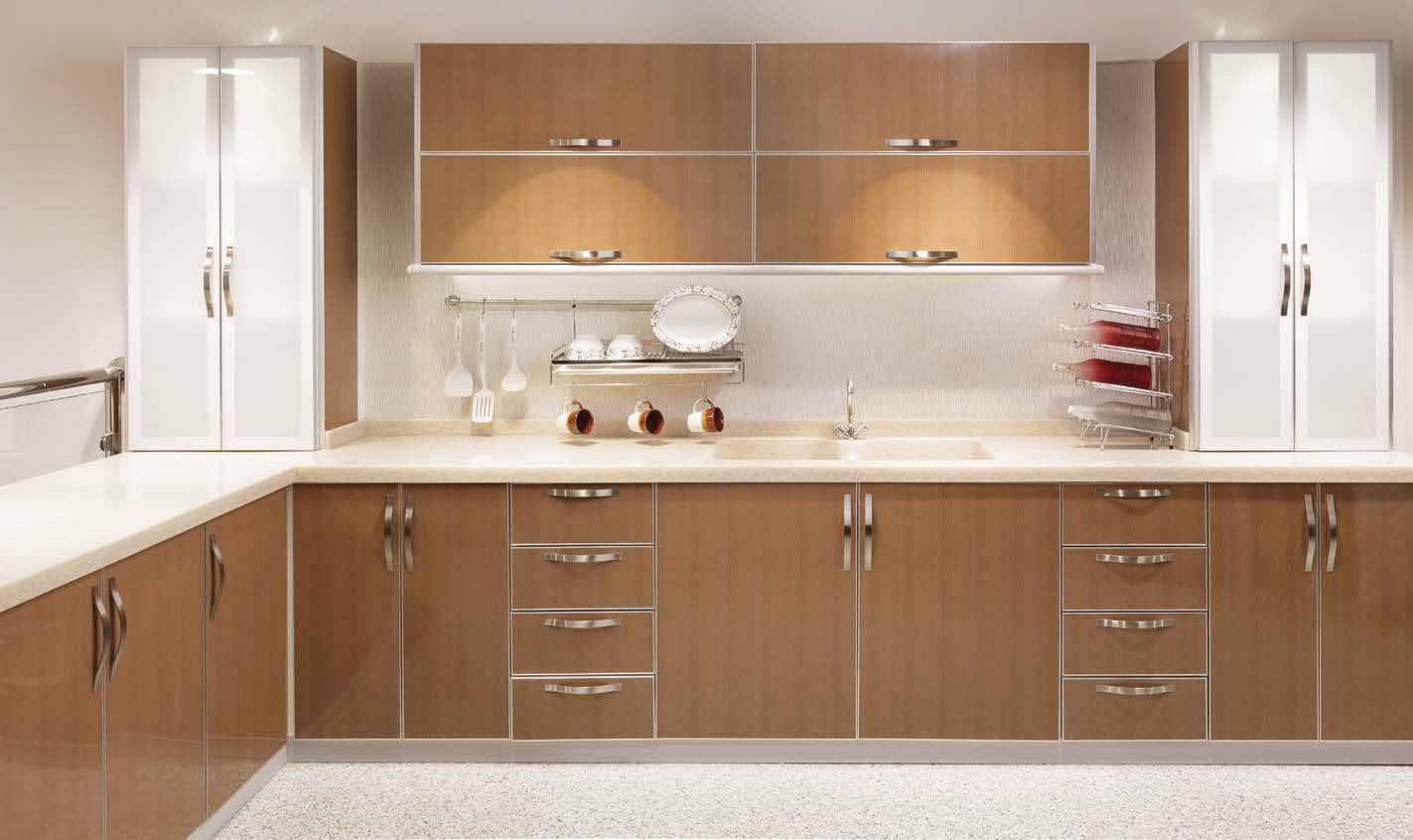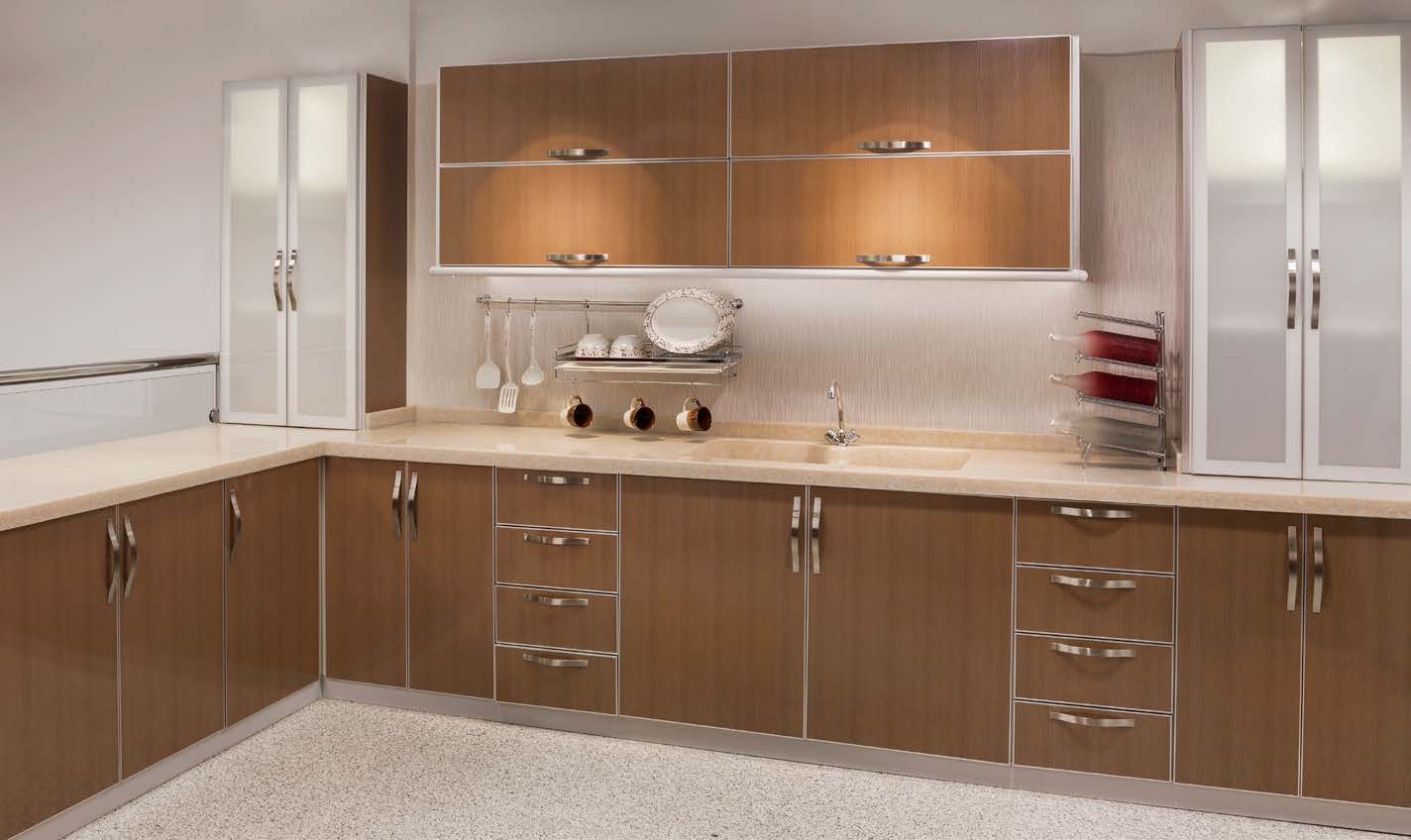
Formica is the material people underestimate unfairly. Yes, it is the least expensive of our seven materials — but good formica lasts for years and absorbs genuinely hard daily use. The complaint we hear most often from clients arriving after a bad experience elsewhere is “I tried formica and it swelled after a year.” What swelled was not the formica. It was the board underneath it.
We manufacture formica kitchens in our own Riyadh factory and install them with our own crew in Riyadh, Al-Ahsa, Buraydah and Hail, under the same written warranty we give our most expensive material: ten years. We do not sell formica as the option for people with no choice. We sell it as a deliberate, practical decision.
What formica actually is — the explanation nobody offers
“Formica” was originally an American company name, in the same way “Gillette” came to mean a razor blade. The word is now used generally for boards faced with a laminate layer (HPL or LPL) — sheets of paper impregnated with melamine resins and pressed onto the board under heat and pressure.
And here is the first thing to understand: formica is not the main material — it is the skin. The main material is the board beneath it, which is one of:
- MDF — medium-density fibreboard. Very smooth face, excellent for laminating, but it drinks water quickly if the edges are not properly sealed.
- HDF — the same idea at higher density. Stronger, heavier, slightly more expensive.
- Ordinary particle board — the cheapest and weakest. Widely used in the market and then described to the customer simply as “formica”, with no further detail.
- Moisture-resistant MDF (the green board) — what we use in sink units and wet zones. It is dyed green during manufacture purely so it can be identified.
So when a supplier quotes “a formica kitchen for X riyals”, the question is not “what does the formica cost?” It is: “what board is underneath, and how thick is it?” That answer determines whether your kitchen lives ten years or one.
When formica is the right decision
- A rental apartment or a temporary kitchen. There is no sense putting a solid timber budget into a place you will leave in two or three years.
- A limited budget across a large area. Well-specified formica across the whole kitchen beats poor acrylic across half of it with the other half left bare.
- A service kitchen or an outdoor kitchen. Many Saudi homes have a main kitchen and a service kitchen. The sensible split is a finer material in the main one and practical formica in the service one.
- Multi-unit property. If you own a building or a group of apartments, formica gives you a repeatable cost and spare parts that are always available.
- B2B projects and fast delivery. Laminate boards are always in stock in our factory, so the lead time is shorter than for materials needing a special order.
And when do we not recommend it? If your kitchen opens onto a reception area and you want a luxurious glossy look, acrylic or tempered glass will serve you better. If the kitchen is used very heavily with constant steam, aluminium or saj steel withstands more.
And the drawbacks? Three we state before you ask
We are a factory, not brokers. It is in our interest that you know the weaknesses before you sign, not after installation:
- The edges are the weak point. The laminate itself is water-resistant; the board beneath it is not. If the edge band is thin or applied without enough heat, water works in at the edge and the board swells. The fix: 2 mm PVC edge banding bonded by a heated edgebander — not a 0.4 mm strip stuck on with cold glue.
- Deep scratches cannot be repaired. In solid timber you can sand a scratch away. In laminate the layer is thin — a light scratch disappears from view, but a real cut stays. The practical answer: replace the affected door, which is inexpensive and readily available.
- It does not look as luxurious as gloss. Formica today is available in convincing wood effects and elegant matte colours, but it will not give the depth and shine of acrylic. Anyone who tells you otherwise is selling you an illusion.
All three are managed by specification, not endured. The difference between a formica kitchen that lasts ten years and one that fails in one is precisely these details.
How to tell good formica from bad — six checks you can do yourself
None of these need technical knowledge. Just ask to see a sample and do them in front of the salesperson:
- Turn the sample over and look at the cut section. Do you see fine, even fibres (MDF/HDF) or visible coarse wood chips (particle board)? The second is the cheapest and the weakest.
- Measure the thickness. Doors should be no less than 18 mm. Anything at 16 mm or under is a saving taken out of your kitchen, and you will notice it within a year as the hinges loosen.
- Run your finger along the edge. Can you feel a glue line or a step? A good edge is smooth and continuous, because it was bonded with heat rather than cold adhesive.
- Ask for the edge band thickness as a number. The acceptable answer is 2 mm. “Standard banding” means 0.4 mm.
- Put the sample in water for ten minutes and then inspect the edge. A harsh test, but a decisive one. A confident supplier will agree to it.
- Ask for the name of the board manufacturer. Boards have known origins and specifications. Anyone who will not name the mill is hiding something.
And we say this while you are reading our own page: do these checks with us too. We are not asking for blind trust — we are asking you to compare line items.
Formica kitchens we built ourselves
Not stock photography. Each image is a formica kitchen that left our Riyadh factory and was installed in a client’s home — judge the work, not the wording.
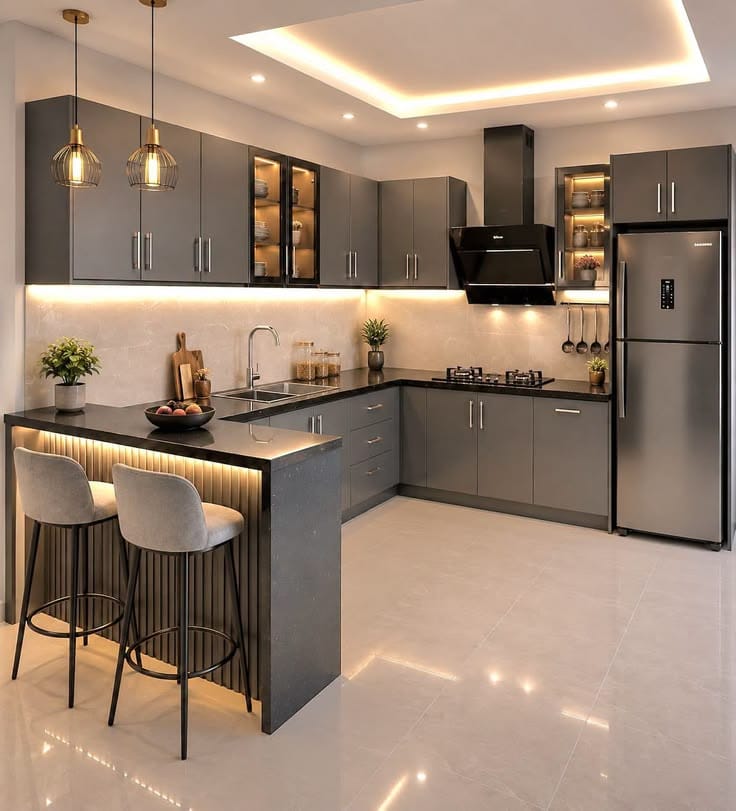
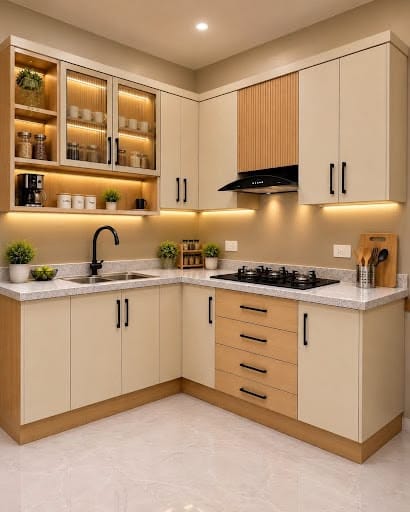
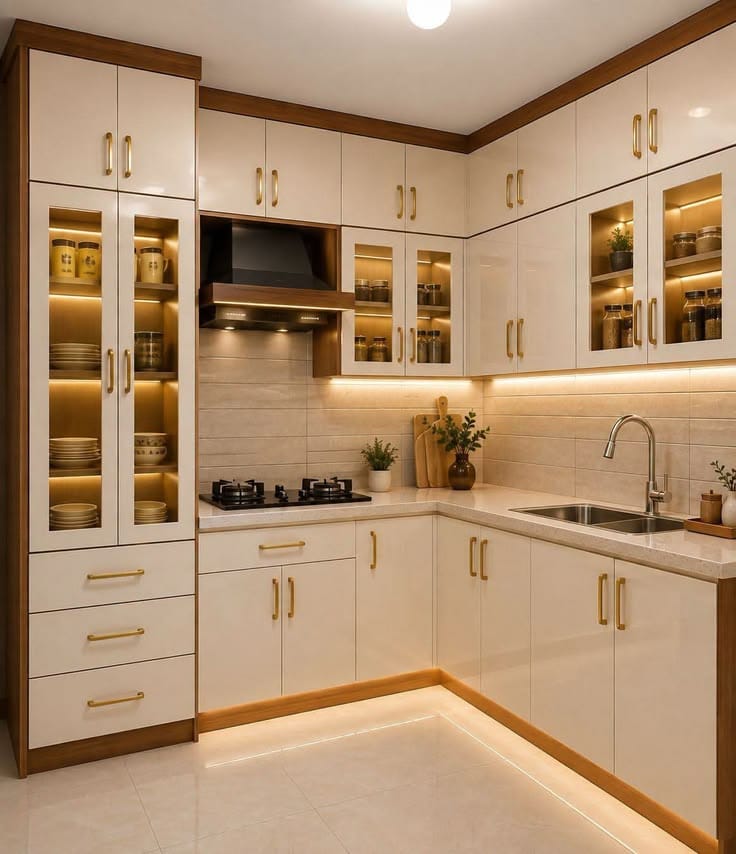
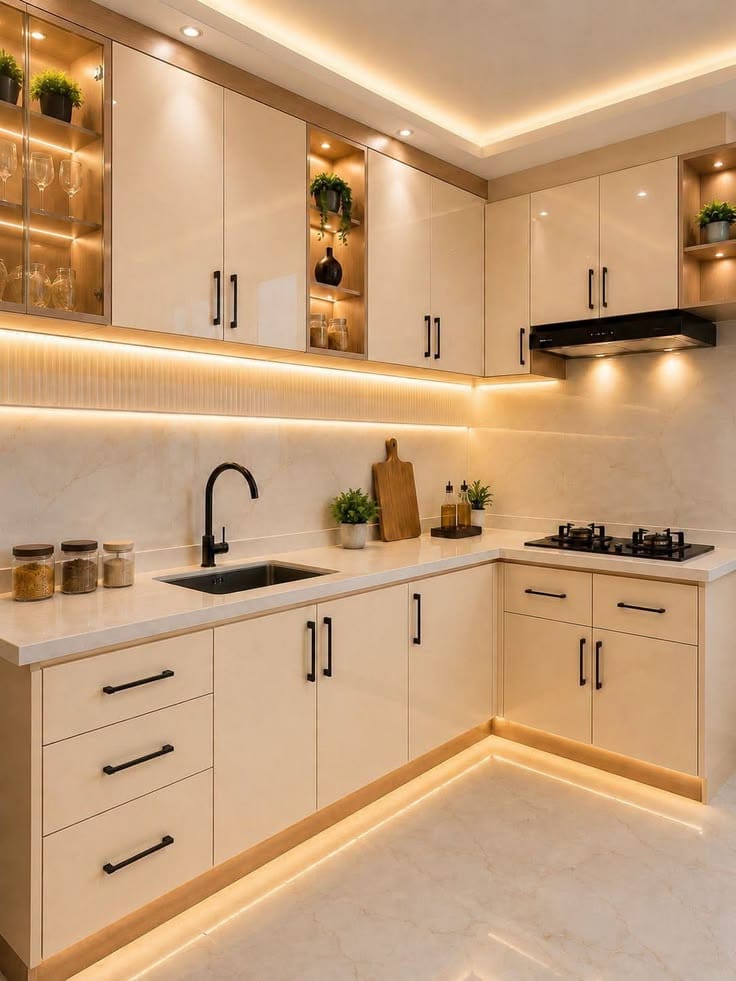
Ask for the full album on WhatsApp and we will send formica kitchens at sizes and budgets close to your own project.
Where the price differences come from — seven line items
When you receive three quotations for a formica kitchen at three different prices, the difference is not some vague notion of “quality”. It is these specific rows:
| Line item | The cheap shortcut | Our specification |
|---|---|---|
| Board type | Particle board | MDF / HDF, green moisture-resistant board in all wet zones |
| Door thickness | 16 mm | 18 mm |
| Edge banding | 0.4 mm with cold glue | 2 mm PVC, heat-bonded by machine |
| Cabinet backs | 3 mm sheet, pinned on | Faced board, finished both sides |
| Hinges | Generic, no soft close | Soft-close, warranted |
| Drawer runners | Plastic roller | Full-extension telescopic metal |
| Legs and plinth | Timber sitting on the floor | Adjustable plastic legs, raised plinth |
| Laminate grade | Unstated | HPL or LPL, stated in the quote |
That second-to-last row matters more than it looks. A timber plinth resting directly on the floor is the number one cause of formica kitchen failure in Saudi homes. One mopped floor, or one small leak, and the plinth drinks the water, swells, and drags the whole unit with it. Raising every cabinet on adjustable plastic legs eliminates the problem completely and costs very little.
Which is why we always say: do not compare final prices, compare tables of line items. Ask every quotation to spell out these eight rows in writing. Anyone who refuses knows the detail is not in his favour.
Colours and finishes available
Modern formica has come a long way from the mental image people carry. What our factory offers today:
- Wood effects — oak, walnut, beech and dark wenge. Some current ranges carry a texture that reproduces the grain to the touch, not just to the eye, and they are the closest thing to natural wood at a small fraction of its cost.
- Matte solid colours — white, light grey, cement grey, beige, olive green, navy. Matte is the more sensible choice in formica because it hides fingerprints.
- Gloss colours — available, but honestly: if you want real gloss, acrylic is its material. Gloss in formica reads as shallower and shows scratches sooner.
- Stone and concrete effects — very popular in contemporary design and a good match for kitchens open to the living room.
And a free design tip: in a small space, use a light colour on the wall units and something slightly deeper below. It widens the room visually and hides wear in the zone that gets touched most.
Combining formica with other materials
The smartest use of a budget is rarely choosing one material for the whole kitchen — it is distributing materials according to what is seen and what is used:
- Formica below, acrylic above. The wall units are what a visitor sees first; the base units take the knocks and the water. This distribution gives you a glossy look at a substantially lower cost, and it has its own page here: acrylic & formica kitchens.
- Formica with an island in a finer material. The island is the star of an open-plan kitchen — make it the luxurious exception.
- Formica with glass fronts on two wall cabinets. A touch that breaks the monotony at a token cost.
- Aluminium sink units with formica elsewhere. A clever engineering split: metal where the water is, formica where it is not.
Our process — eight clear steps
- A call or WhatsApp message. We ask about your city, the type of property, the approximate area and the budget you have in mind. This conversation is free and commits you to nothing.
- The measuring visit. A technician comes and measures the walls, the corners, the electrical outlets, the water and gas points and the extraction position himself. We do not work from measurements sent to us, because two centimetres makes a real difference.
- Free 3D design. You see your kitchen before you pay: the colours, the unit layout, the shelf heights, where the microwave and oven go.
- Revisions. Unlimited at this stage — because changing a drawing is free and changing a manufactured cabinet is expensive.
- An itemised quotation. Not one opaque number, but a table: board type, thickness, edge banding, hardware, worktop, lead time and warranty.
- Manufacturing in our own factory. No middleman and no subcontractor. What comes off our machines is our responsibility directly.
- Installation by our own crew. The same crew in all four cities; we do not hand your kitchen to a local contractor.
- Handover and inspection with you. We open and close every drawer and door in front of you, adjust the hinges, and give you the written warranty certificate.
Caring for a formica kitchen — simple rules that double its life
- Never leave standing water at the edges. This is the one golden rule. A splash on the face does no harm; water pooling against a door edge for hours does.
- Wipe with a damp cloth, not a wet one. Then dry. Do not use a hose or a soaking mop near the plinths.
- No steel wool and no abrasive powders. They leave fine lines that turn into uneven matte patches over time.
- Chlorine bleach and acetone are prohibited. Both can lighten the colour locally in a way that cannot be repaired.
- Never set a hot pan directly on the surface. Laminate tolerates reasonable heat but not the base of a pan straight off the flame.
- Always run the extractor while cooking. Accumulated steam is the enemy of every kitchen without exception, and formica is more sensitive to it than most.
- Check the hinges every six months. A quarter turn with a screwdriver returns the door to square and prevents rubbing.
With these seven habits, a formica kitchen from our factory passes ten years in good condition. Without them it can fail in two. The material does not fail on its own — it fails alongside wrong use or wrong installation.
Common mistakes we see in formica kitchens
- A worktop made from the same laminate. The worktop meets knives, heat and water — it deserves a stronger material such as quartz, granite or steel. Saving here loses money.
- A sink fitted without enough silicone. Most leaks we are called to inspect start at the sink perimeter, not at the tap.
- An ordinary board in the sink unit. This cabinet specifically must be moisture-resistant board, preferably with a plastic tray in the base to catch any leak.
- No ventilation gap for a built-in oven. Trapped heat damages the adjacent unit.
- Worktop height set without regard to the user. The standard is 85–90 cm, but somebody who stands in the kitchen for hours deserves a height chosen for their own build.
- Wall cabinets running to the ceiling for no reason. A shelf you cannot reach without a chair is seasonal storage — decide that before the design, not after.
Formica in rentals and property projects
This is a market we work in a great deal, and our advice to landlords differs from our advice to homeowners:
- Standardise the specification across units. One colour and one size means a spare part fits any apartment, and maintenance is cheaper and faster.
- Raise every unit on adjustable legs. A tenant will not care for your kitchen the way you would, and water on the floor is expected rather than exceptional.
- Choose matte mid-tone colours. White shows every mark and black shows every speck of dust. Grey and beige are smarter.
- Keep two spare doors in storage. They cost little and save you waiting for manufacturing at the first incident.
- Ask for project pricing. We price from five units upward with a phased delivery schedule matched to your handover programme.
Accessories: where the daily experience is decided
A formica kitchen with excellent accessories can be more pleasant to live with than a timber kitchen with poor ones — because what you touch every day is the hinge, the runner and the handle, not the board.
- Soft-close hinges. Non-negotiable for us. They prevent impact and protect the door edge over the long term.
- Full-extension telescopic runners. They bring the drawer all the way out so you can see the back of it. A roller runner opens halfway and jams within a year.
- Rotating corner baskets. The corner is the worst space in any kitchen, and this one part turns it into real storage.
- In-drawer knife and cutlery organisers. An inexpensive part that changes how the kitchen feels every day.
- An internal laundry basket or integrated waste bin. They hide the ugliest object in the room.
- LED lighting under the wall units. It turns the worktop from a shadowed strip into a comfortable work surface, and it is among the cheapest upgrades with the largest effect.
How the price is calculated — the linear metre, unpacked
The most common question we receive is “what is the price per metre?”. The honest answer is that kitchens are priced by the linear metre, not the square metre, and that a linear metre is not a single number.
A linear metre normally covers the base unit, the wall unit above it and the worktop. So an L-shaped kitchen with three metres along one wall and two along the other is five linear metres. But the cost of those five metres moves with:
- Corners and columns. Corners need special pieces and a rotating basket, and cost more than a straight metre.
- Drawers versus doors. A drawer needs a runner and a box. A kitchen of all drawers can run thirty per cent above a kitchen of all doors at the same length.
- A third upper row. More storage and more cost.
- Built-in appliances. Every integrated oven or microwave needs a precisely sized housing and ventilation.
- The worktop. A separate line item, and the spread between options can be a third of the kitchen’s cost.
Which is why we refuse to give a final figure over the phone before measuring. We give an indicative range on the phone and a precise itemised figure after the measuring visit. Anyone who gives you a firm number before seeing your space will either raise it later or has priced the weakest possible specification.
What our quotation includes — and what it does not
Included: the measuring visit, 3D design, carcasses and doors, edge banding, hinges and runners, handles, delivery, installation, post-installation door adjustment, and a ten-year written warranty certificate.
Not included — quoted separately, only on request: the worktop, the sink and tap, the extractor, hob and oven, plumbing and electrical work inside the wall, the wall splashback, and removal or relocation of an old kitchen.
Ask for the same breakdown from every other quotation you receive. You will then discover that some “cheaper” offers exclude installation or delivery — which makes them the more expensive ones once you add them back.
An honest comparison with our other materials
| Material | Durability | Look | Price | Best for |
|---|---|---|---|---|
| Formica | Good with the right spec | Practical, neat | Lowest | A measured budget and rentals |
| Acrylic + formica | Very good | Partly glossy | Low–medium | Best value for money |
| Saj steel | High | Metallic, modern | Medium | Longest life at the lowest price |
| Aluminium & alumetal | Very high | Modern, versatile | Medium–high | Humidity, heat and heavy use |
| Acrylic | Very good | Deep gloss | High | Kitchens open to the living room |
| Tempered glass | High | The most refined | High | Small spaces and a premium look |
| Natural wood | High with care | Warm, classical | Highest | Villas and classical taste |
Notice that we did not call any one material “the best”. There is no best material in the abstract — there is a material best suited to your space, your usage and your budget. Our job is to recommend the right one even when it is the cheapest one.
Layouts and spaces
- Single run. For narrow spaces and galley rooms. Cheapest to build and simplest to maintain.
- L-shape. The most common layout in Riyadh apartments, giving a comfortable working triangle between sink, hob and fridge.
- U-shape. The highest storage capacity; needs a room width of at least 240 cm to keep circulation comfortable.
- Parallel runs. Excellent for long kitchens, with 110–120 cm of clear floor between the runs.
- Island. Needs generous space, and looks best finished in a different material from the rest of the kitchen.
In every case, the free 3D design settles the argument before manufacturing. We show you the two or three layouts genuinely possible in your space, and you choose while looking rather than while imagining.
Lead time and warranty
A formica kitchen is among the fastest things we build, because the boards are always in stock:
- Measuring and design: two to four days until your final approval.
- Manufacturing: seven to twelve working days depending on size.
- Installation: one to two days for an average kitchen.
The warranty is ten years in writing, covering manufacturing and installation defects, hinges and runners. It does not cover — and we say this plainly — misuse such as flooding, direct flame, or units dismantled and reinstalled by someone other than us.
Formica in the cities we serve
- Riyadh. Dry and hot. Formica performs well, and the main challenge is dust — so we recommend matte mid-tone finishes because they are far easier to keep looking clean than gloss white.
- Al-Ahsa. Much higher humidity. Here we insist on moisture-resistant board in every wet unit, not just the sink cabinet, on raised plinths, and on 2 mm edge banding without exception. For clients who want maximum safety in Al-Ahsa we recommend aluminium or saj steel instead.
- Buraydah. Wide seasonal temperature swings. Formica is more stable across them than natural wood, which expands and contracts.
- Hail. Colder winters. No particular challenge for formica, and here we recommend warm colours and wood effects because they suit the local taste.
Across all four: the same crew, the same specification, the same warranty. We do not price Al-Ahsa or Buraydah higher because of distance, and we do not thin the specification to absorb transport.
Replace or refurbish?
A question that saves many of our clients a great deal of money. If your existing kitchen has:
- Sound carcasses and only damaged doors — replacing the doors alone is sensible and costs a fraction of a full kitchen.
- Swollen plinths or units that move when pushed — full replacement is cheaper in the end. Any refurbishment over a failed carcass will fail again.
- A layout that simply does not work for you — replace it. There is no point refreshing the appearance of an arrangement that irritates you every day.
- More than fifteen years of age — replacement is usually better value, because the old hardware is no longer available.
We inspect your existing kitchen during the measuring visit and tell you what we actually think — including, on more than one occasion, that you should keep what you have and wait.
Questions our clients ask
Does formica really swell?
The laminate does not swell. The board beneath it swells if water reaches it. This is why everything we have said about edge banding, raised plinths and moisture-resistant board matters — that is the real protection, not the type of outer layer.
Can the colour be changed later?
Laminate cannot be painted with an acceptable result. But the doors alone can be replaced while keeping the carcasses — which costs a small fraction of a new kitchen and completely renews the appearance. It is a genuinely useful practical advantage of formica.
What is the difference between HPL and LPL?
HPL is a layer pressed at high heat and pressure and then bonded to the board; it is thicker and stronger. LPL is pressed directly onto the board and is thinner and cheaper. The difference shows in scratch resistance. We state which one we are using in the quotation.
Does the price include the worktop?
We price it as a separate, clearly stated line, because the options are many and the spread between them is large. We do not fold it silently into a single total.
Do you build single kitchens or only projects?
Both. One kitchen for one apartment gets the same measuring visit, the same 3D design and the same warranty.
Is payment in stages possible?
Yes, on a schedule tied to the stages of work, set out in the quotation.
How long does a formica kitchen actually last?
With our specification and reasonable use: ten years and more. We have seen formica kitchens we built years ago still working, and formica kitchens from elsewhere that failed in one year. Same material — different specification.
Why Modern Palace
- A factory, not a showroom. We manufacture ourselves, so there is no middleman margin added to your price and no third party to refer you to when something goes wrong.
- We supply our own materials. We know the origin of every board and choose its specification, rather than buying whatever happens to be available.
- More than 5,000 kitchens delivered since 2015, and more than 15,000 clients.
- One installation crew across four cities — Riyadh, Al-Ahsa, Buraydah and Hail.
- A ten-year written warranty on every material without exception, formica included.
- Free 3D design before any financial commitment from you.
And we say what others do not: if formica is not right for you, we will tell you and recommend the material that is — even if it is cheaper or more expensive. Our relationship with you runs for the next ten years, not for a single transaction.
Other materials that might suit you
- Acrylic & formica kitchens — if you want gloss at a nearby budget.
- Saj steel kitchens — if durability matters more than appearance.
- Aluminium & alumetal kitchens — if the kitchen works hard every day.
- Acrylic kitchens · Glass kitchens · Natural wood kitchens
In summary
Formica is an honest, practical material if you buy it to the right specification, and a disappointing one if you buy it at the lowest price. The difference is not the name on the quotation — it is the type and thickness of the board, the edge banding, and the base the cabinet stands on. We spell those out in writing before you pay a single riyal, because we are a factory that carries the consequence of what it makes for ten years.
Request a free 3D design for your formica kitchen
Free measuring in Riyadh, Al-Ahsa, Buraydah and Hail, an itemised quotation instead of one vague number — and a ten-year written warranty.