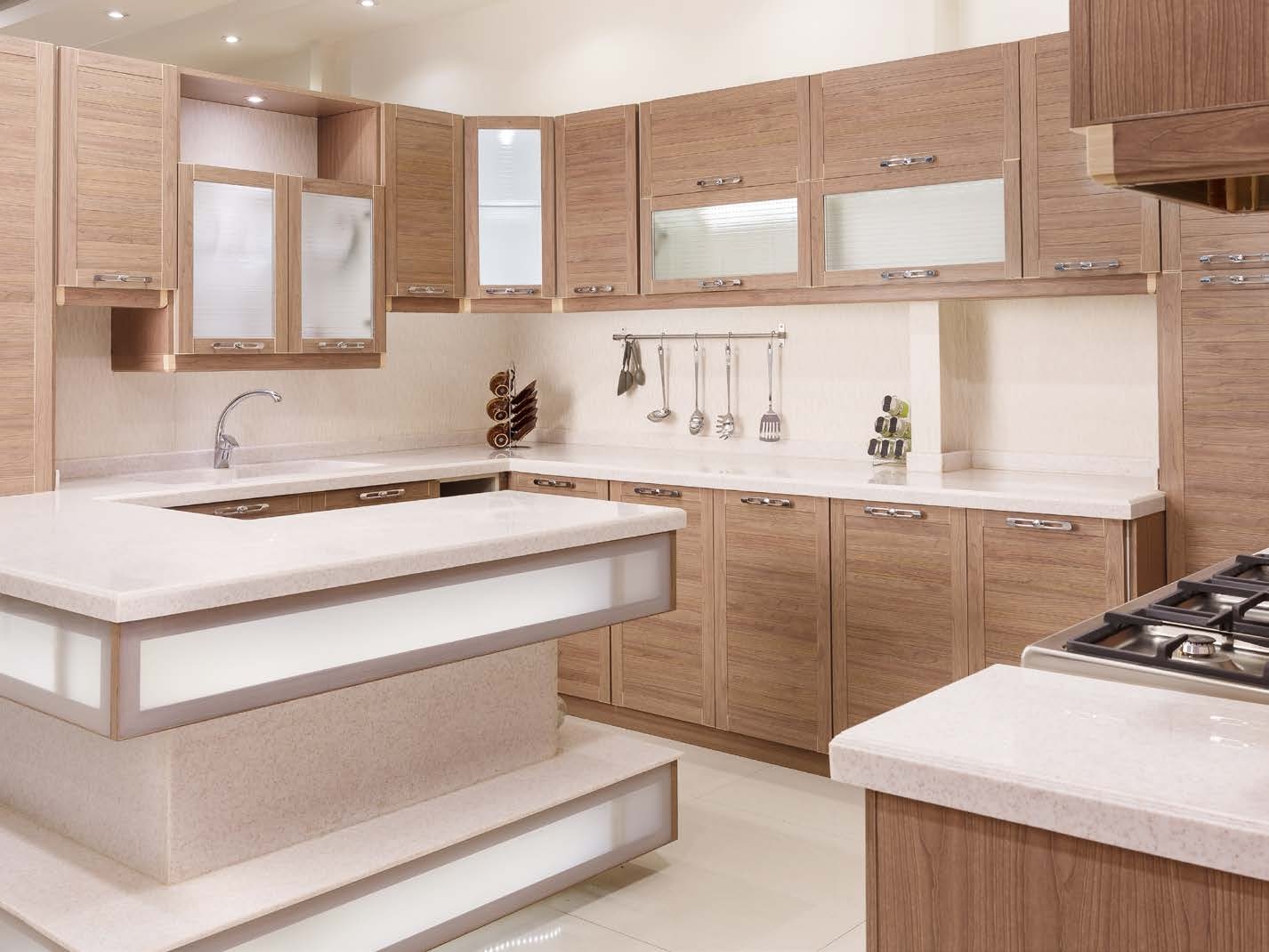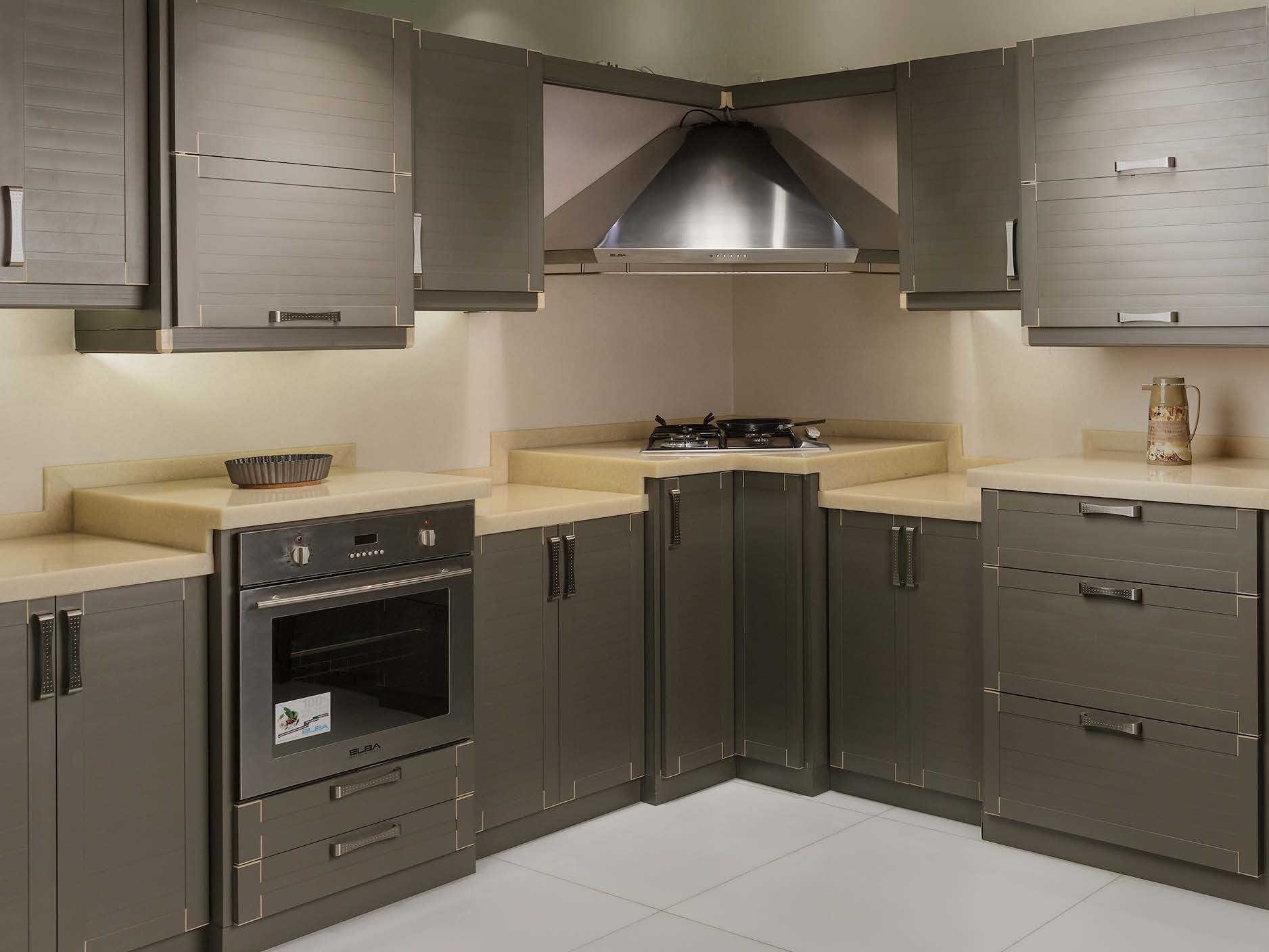
Aluminium — or alumetal, as it is usually called across Saudi Arabia — is the material we recommend most often for kitchens in this climate, and we will tell you exactly why: it does not rust, it does not swell, and it does not care how hot or humid the room gets. In a country where summer surface temperatures inside a closed kitchen can be brutal and coastal humidity is a daily fact, that matters more than any brochure adjective.
We manufacture aluminium and alumetal kitchens in our own factory in Riyadh and install them with our own crew in Riyadh, Al-Ahsa, Buraydah and Hail, with the same written warranty we give our most expensive material: ten years.
What aluminium actually is — and what “alumetal” means
An aluminium kitchen is built from extruded aluminium profiles that form the frame of every door and every cabinet, with a panel set inside that frame. The profile is the structural part; the panel can be aluminium sheet, MDF with a finish, glass, or a composite board. “Alumetal” is the name the Saudi market gave to the same construction, and the two words are used interchangeably in daily conversation. Some workshops try to sell “alumetal” as if it were a distinct, superior material — it is not. It is the same thing, and anyone who tells you otherwise is selling vocabulary, not engineering.
What does differ, enormously, is the profile itself:
- Wall thickness of the extrusion. This is the single most important number in an aluminium kitchen. A thin-walled profile flexes, and a door that flexes will never close cleanly for ten years.
- The alloy and the coating. Powder coating and thermal-transfer finishes behave very differently over a decade of sunlight and steam.
- The corner joint. Mechanically joined corners with internal corner keys hold; corners held by glue and a screw open up.
- Whether the profile has a thermal break or a rubber gasket where the panel sits — this is what stops rattle and stops a hairline gap from collecting grease.
So when someone quotes you “an aluminium kitchen”, the question is never how much per metre first. It is which profile, what wall thickness, and how are the corners joined.
Why aluminium suits Saudi kitchens specifically
- It does not absorb water. Metal has no fibres to swell. The failure mode that kills wood-based kitchens — a swollen base under the sink, a puffed-up edge near the dishwasher — simply does not exist here.
- Heat does not deform it. A kitchen closed up all day in a Riyadh summer reaches temperatures that make some boards and some glossy films unhappy. Aluminium is indifferent.
- Humidity is a non-issue. This is why we push aluminium hardest for Al-Ahsa, where humidity is the real enemy of every other material.
- It is not food for insects and does not host mould. A practical, unglamorous advantage that owners appreciate five years in.
- It is repairable in pieces. One damaged door is one door — not a reason to rebuild a run of cabinets.
- It is genuinely recyclable at end of life, which matters to a growing number of our clients.
Who should choose aluminium — and who should not
We recommend it strongly if:
- Your kitchen is used heavily every day, with real cooking and real steam.
- You are in Al-Ahsa or any high-humidity location.
- You have had a kitchen fail on you before and you want the failure mode gone rather than managed.
- You want a modern look with a wide range of finishes, including convincing wood-effect panels.
- You are furnishing a property you intend to hold for a long time, and total cost over ten years matters more than the invoice this month.
We do not recommend it if:
- You want the deep, seamless gloss of acrylic or tempered glass. Aluminium gives you a framed look; the frame is visible, and that is its character.
- You want a warm, classical, solid-timber feel — that is natural wood, and nothing imitates it perfectly.
- Your budget is genuinely tight. In that case a well-specified formica kitchen or an acrylic-and-formica combination is a more honest use of your money than a cheap aluminium profile.
And the drawbacks? Four things we say before you ask
- The frame is always visible. Every door has a visible aluminium border. Some people love it; some want a flat, frameless slab. Decide which you are before you commit, because this is a matter of taste, not quality.
- Cheap profiles dent. Thin-walled aluminium will take a dent from a hard knock, and a dent in metal does not bounce back. The answer is wall thickness, not wishful thinking.
- Poor hardware ruins a good frame. Metal doors are heavier than laminate doors. With weak hinges they sag within a year. Soft-close hinges rated for the door weight are not optional in an aluminium kitchen — they are structural.
- It conducts heat. Units immediately beside a built-in oven need proper thermal isolation. We do this as standard, but it is a line item you should see in writing.
None of these are reasons to avoid aluminium. All four are reasons to read the specification instead of the price.
How to tell a good aluminium kitchen from a bad one — seven checks
None of these require technical expertise. Ask to see a sample door and do them in front of the salesperson:
- Feel the weight of the door. Pick it up. A properly specified aluminium door has real mass. If it feels like an empty picture frame, the profile is thin.
- Press the middle of the frame with your thumb. It should not flex visibly. Any give you can see by hand becomes a misaligned door within a year.
- Look at the corner joint from the inside. You want a clean mechanical joint with a corner key. A bead of glue and a self-tapping screw is not a joint — it is a hope.
- Ask for the wall thickness as a number, in millimetres. A supplier who answers “it’s strong, don’t worry” is telling you the number is not in your favour.
- Run your finger along the inside edge where the panel meets the profile. There should be a rubber gasket. Without it, the panel rattles and the gap collects grease you cannot reach.
- Open and close the door ten times. Soft-close should be smooth and silent from the first centimetre. Any metallic clack means the hinge is underrated for the weight.
- Ask what the finish is and how it was applied. Powder coating and thermal-transfer printing are both legitimate; spray paint applied in a back room is not, and it will fade unevenly.
Do these checks with us as well as with everyone else. We are not asking for blind trust — we are asking you to compare line items.
Aluminium kitchens we built ourselves
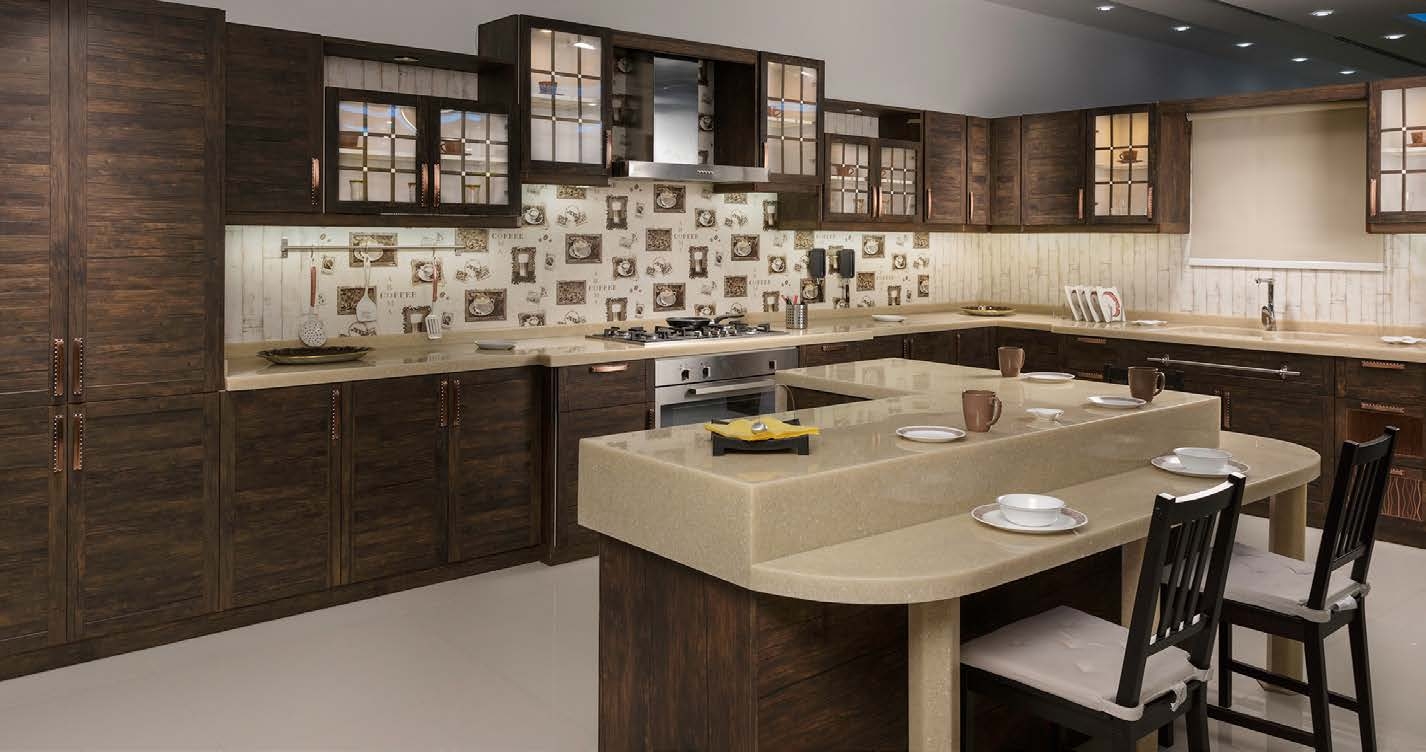
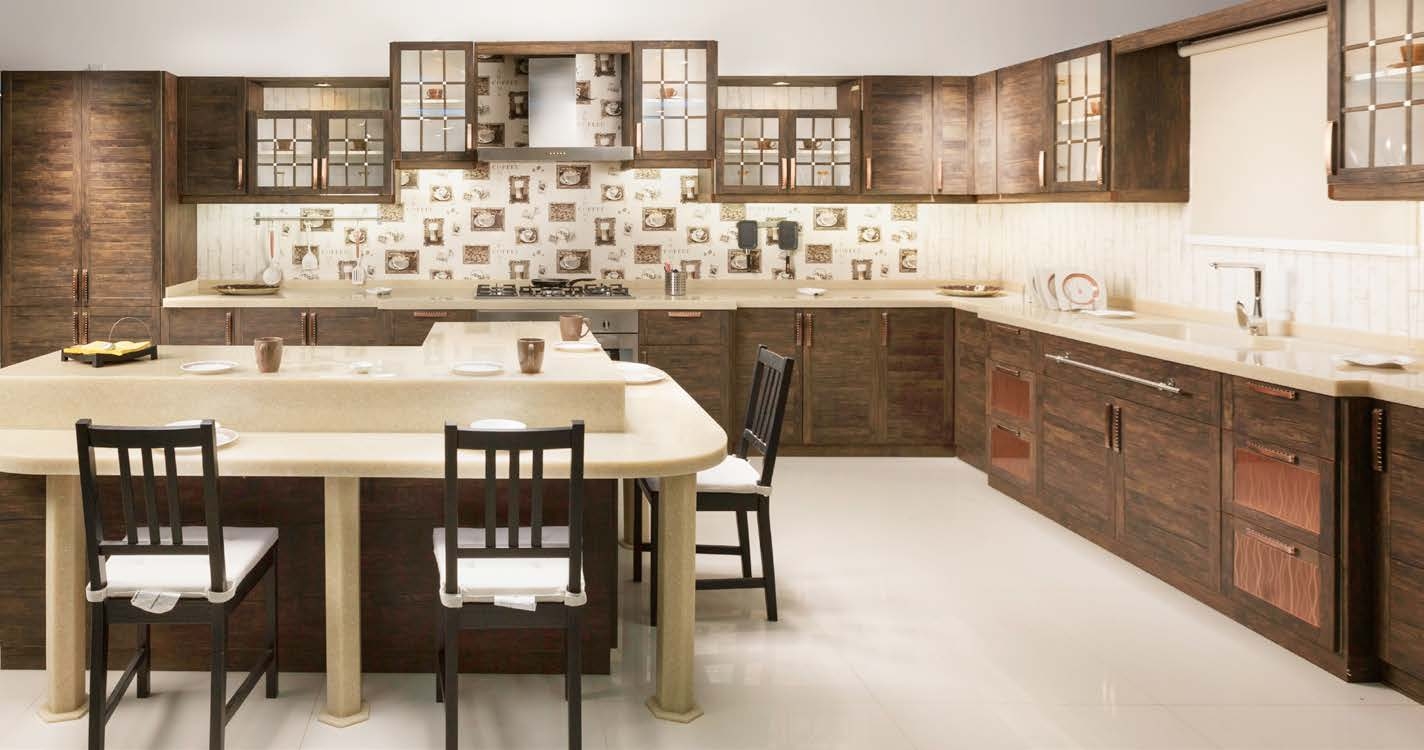
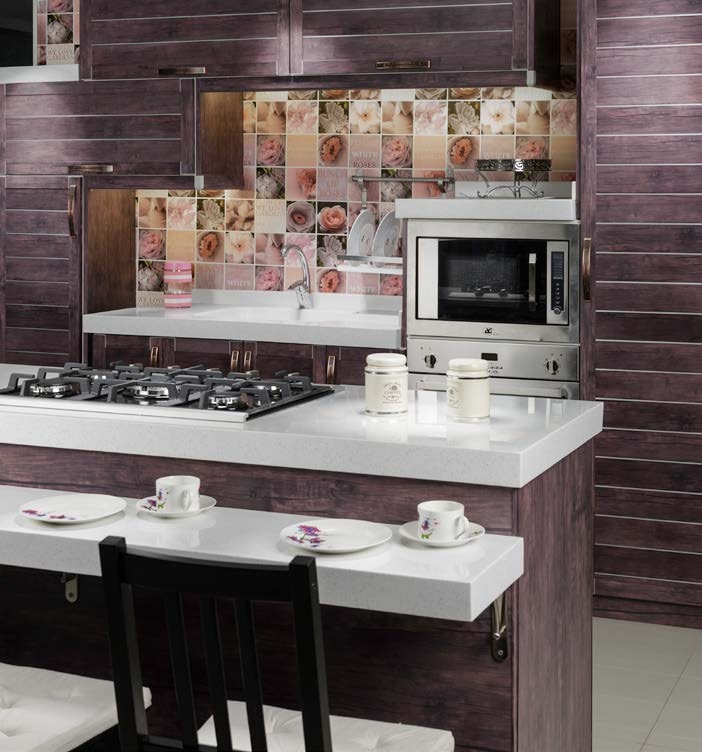
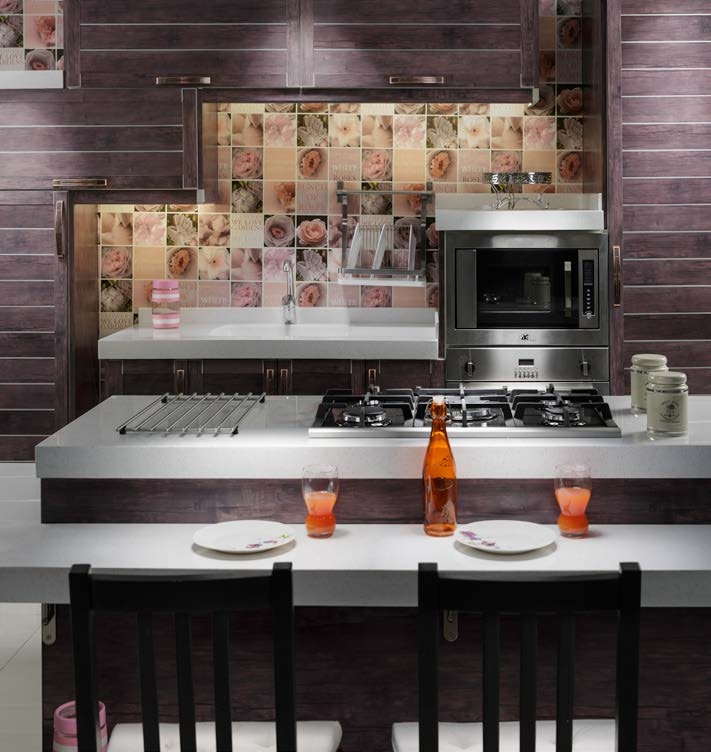
These are not stock photos. Every image below is an aluminium kitchen that left our Riyadh factory and was installed in a client’s home — so you can judge the work, not the wording.
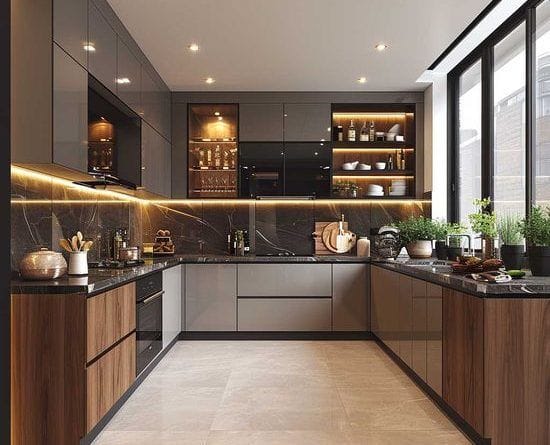
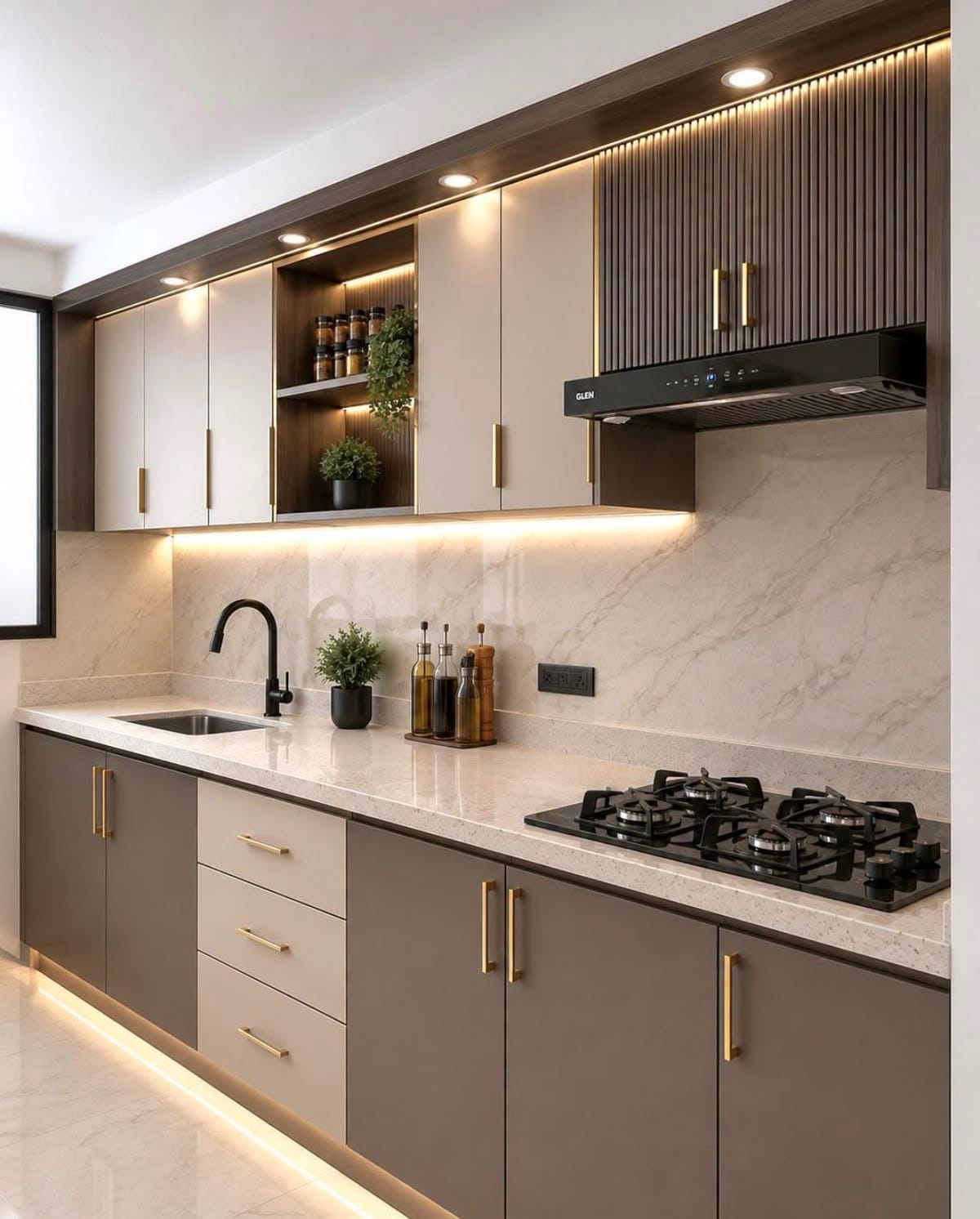
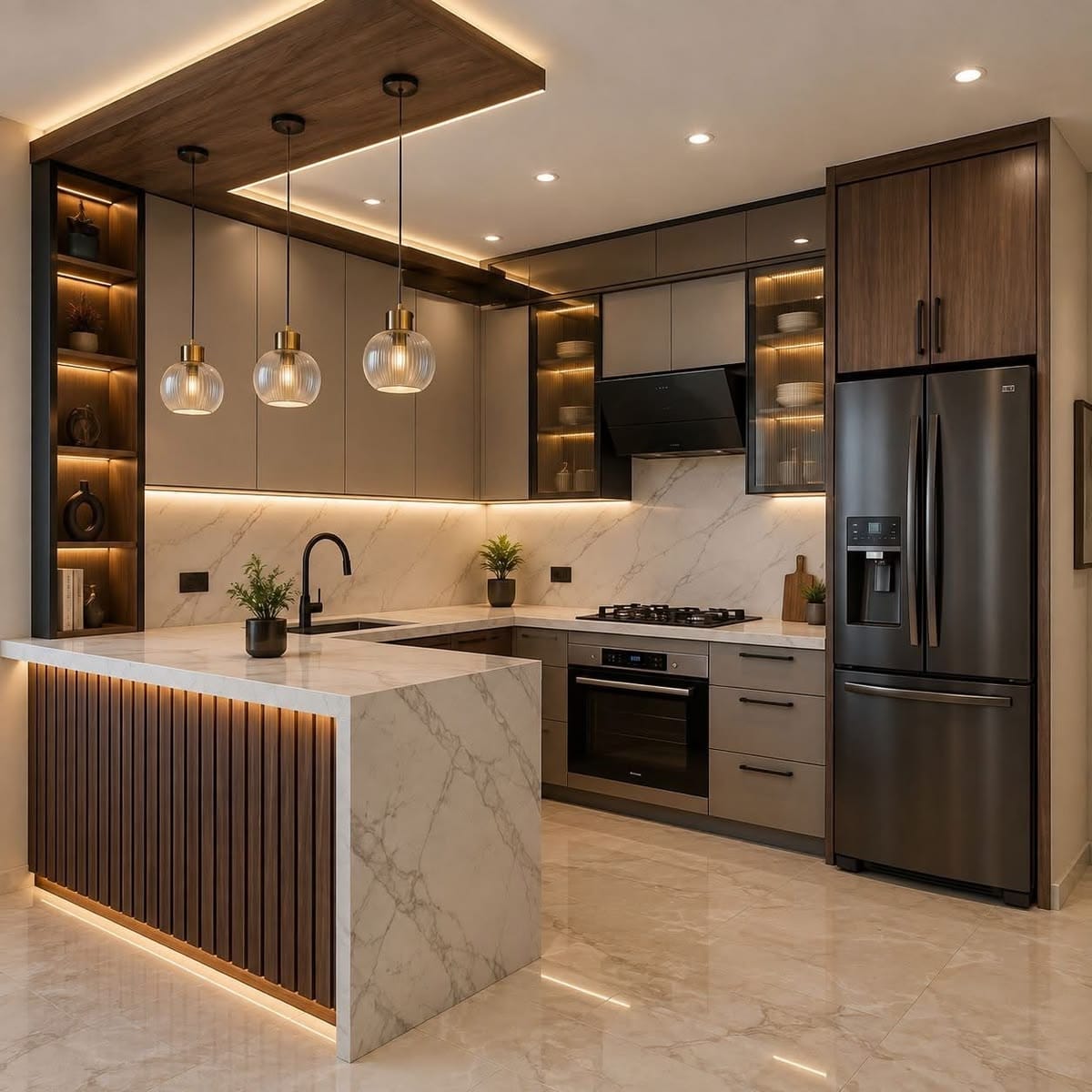
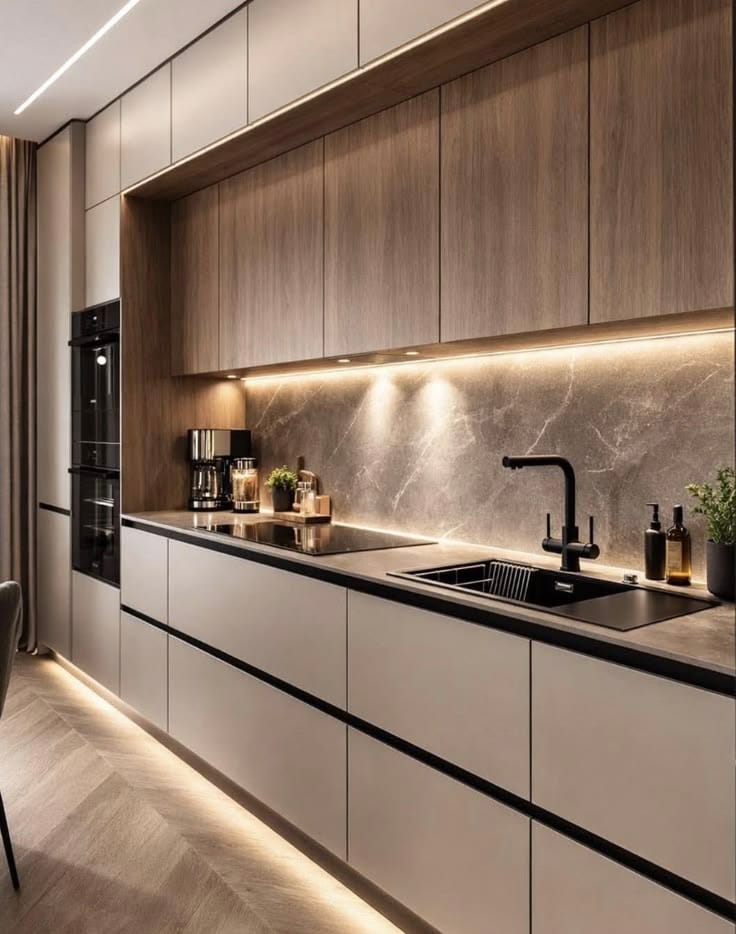
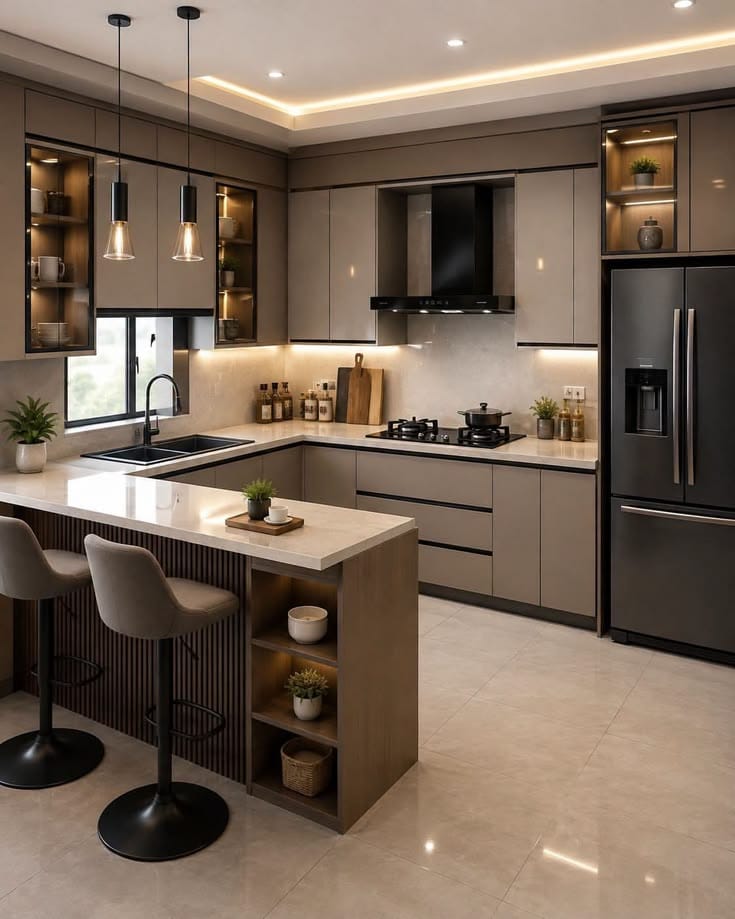
Want to see more? Ask for the full photo album on WhatsApp and we will send kitchens with sizes and budgets close to your own project.
Finishes and colours available
The idea that aluminium means “silver and industrial” is twenty years out of date. What we produce today:
- Wood-effect thermal transfer. Oak, walnut, beech and dark wenge printed onto the aluminium. From arm’s length these are convincing, and they give you the warmth of timber with the behaviour of metal. This is our most requested finish in Hail and Buraydah.
- Matte powder-coated solids. White, light grey, cement grey, beige, olive green, navy, graphite. Matte is the smarter choice in aluminium because it hides fingerprints and does not flatten under harsh light.
- Glossy powder coat. Available, but be honest with yourself: if deep gloss is the goal, acrylic does it better and we will say so.
- Anodised metallics. Brushed silver, champagne, bronze and black. Excellent for a contemporary open-plan kitchen and extremely durable.
- Glass-panel doors inside aluminium frames. The frame carries the load, the glass carries the look. Frosted, tinted, lacquered or fluted — see glass kitchens for the options.
A free design tip: in a small kitchen, use a light finish on the upper run and something a shade deeper below. It widens the room visually and hides the wear in the zone that actually gets touched.
Where the price differences come from
| Line item | The cheap shortcut | Our specification |
|---|---|---|
| Profile wall thickness | Thin-walled, unstated | Stated in millimetres in the quote |
| Corner joints | Glue and a screw | Mechanical joint with corner keys |
| Panel gasket | None — panel sits loose | Rubber gasket all round |
| Finish | Sprayed on site | Factory powder coat or thermal transfer |
| Carcass board | Ordinary particle board | MDF/HDF, moisture-resistant board in all wet zones |
| Hinges | Generic, not weight-rated | Soft-close, rated for the door weight |
| Drawer runners | Plastic roller | Full-extension telescopic metal |
| Legs and plinth | Timber sitting on the floor | Adjustable plastic legs, raised plinth |
| Oven isolation | Not mentioned | Thermal isolation as standard |
That last-but-one row matters more than it looks. A timber plinth sitting directly on the floor is the number one cause of premature kitchen failure in Saudi homes — one mopped floor, one small leak, and the plinth drinks the water and drags the unit with it. Raising every unit on adjustable legs eliminates the problem entirely and costs very little.
So: do not compare final numbers, compare tables of line items. Ask every quotation to spell out these nine rows in writing. A supplier who refuses knows the detail is not on his side.
Our process — eight steps
- A call or a WhatsApp message. We ask about your city, the type of property, the approximate size and the budget you have in mind. This conversation is free and commits you to nothing.
- The measuring visit. A technician comes and measures the walls, the corners, the electrical outlets, the water and gas points and the extraction position himself. We do not build from measurements sent to us, because two centimetres makes a real difference.
- Free 3D design. You see your kitchen before you pay: colours, unit layout, shelf heights, where the oven and microwave go.
- Revisions. Unlimited at this stage — changing a drawing is free, changing a manufactured cabinet is not.
- An itemised quotation. Not one opaque number, but a table: profile thickness, board type, edge banding, hardware, worktop, lead time and warranty.
- Manufacturing in our own factory. No middleman and no subcontractor. What comes off our machines is our responsibility directly.
- Installation by our own crew — the same crew in all four cities. We do not hand your kitchen to a local contractor whose work we have not seen.
- Handover and inspection with you. We open and close every door and drawer in front of you, adjust the hinges, and give you the written warranty certificate.
How the price is calculated — the linear metre, unpacked
The most common question we receive is “what is the price per metre?”. The honest answer is that kitchens are priced by the linear metre, not the square metre, and that a linear metre is not a single number.
A linear metre normally covers the base unit, the wall unit above it, and the worktop. So an L-shaped kitchen with three metres on one wall and two on the other is five linear metres. But the cost of those five metres moves with:
- Doors versus drawers. A drawer costs more than a door because it needs a runner and a box. A kitchen of all drawers can run thirty per cent above a kitchen of all doors at the same length.
- Corners and columns. Every corner needs special pieces and ideally a rotating corner basket.
- A third upper row. It adds storage and it adds cost — and ask yourself first whether you will reach it without a chair.
- Built-in appliances. Every integrated oven or microwave needs a precisely sized housing and ventilation.
- Glass panels. Glass inside aluminium frames is priced separately per door.
- The worktop. A separate line item, and the spread between options can be a third of the kitchen’s cost.
This is why we refuse to give a final figure over the phone before measuring. We give an indicative range on the phone and a precise itemised figure after the measuring visit. Anyone who gives you a firm number before seeing your space will either raise it later or has quoted the weakest possible specification.
What our quotation includes — and what it does not
Included: the measuring visit, 3D design, carcasses and doors, profiles and gaskets, edge banding, hinges and runners, handles, thermal isolation around the oven, delivery, installation, post-installation door adjustment, and a ten-year written warranty certificate.
Not included — quoted separately, only if you ask for it: the worktop, the sink and tap, the extractor, hob and oven, LED lighting, plumbing and electrical work inside the wall, the wall splashback, and removing or relocating an old kitchen.
Ask for the same breakdown from every other quotation you receive. You will often discover that a “cheaper” offer excludes delivery or installation — which makes it the more expensive one once you add them back.
Caring for an aluminium kitchen
- A damp cloth and mild soap is all it needs. Then dry it. Aluminium does not fear water, so this is easier than any other material.
- No steel wool and no abrasive powders. They will scratch the coating, and coating is what protects the metal.
- No chlorine bleach and no acetone. Both can discolour a powder coat locally, and that cannot be undone.
- Wipe grease off the gasket line every few weeks. This is the one spot people forget, and it is where residue accumulates.
- Check the hinges every six months. A quarter turn of a screwdriver keeps the door square and stops the door edge rubbing on the frame.
- Run the extractor while cooking, every time. Steam is the enemy of every kitchen; aluminium tolerates it, but hardware and adjacent surfaces do not.
With those six habits, our aluminium kitchens comfortably pass ten years looking respectable. Metal does not fail on its own — it fails with bad hardware or bad installation.
Common mistakes we see in aluminium kitchens
- A thin profile chosen to hit a price. The most expensive saving in this material. It shows up as flexing doors, then sagging doors, then doors that never sit flush.
- Hinges not rated for the door weight. Metal doors are heavy. Underrated hinges sag, and a sagging door will eventually damage the frame it hangs on.
- A worktop made of the cheapest available surface. The worktop takes knives, heat and standing water. It deserves quartz, granite or stainless steel — not the cheapest laminate available.
- No thermal isolation beside the oven. Trapped heat damages whatever sits next to it, whatever that thing is made of.
- Worktop height set by habit rather than by the person using it. The standard is 85–90 cm, but somebody who stands in the kitchen for hours deserves a height chosen for their own build.
- Upper cabinets running to the ceiling for no reason. A shelf you cannot reach without a chair is seasonal storage. Decide that before the design, not after.
- A sink cut without enough silicone around the rim. Most leaks we are called to inspect start at the sink perimeter, not at the tap.
Accessories: where daily experience is decided
An aluminium kitchen with excellent accessories is more pleasant to live with than a timber kitchen with poor ones — because what you touch every day is the hinge, the runner and the handle, not the panel.
- Soft-close hinges rated for the weight. Non-negotiable in metal. They protect both your ears and the frame.
- Full-extension telescopic runners. The drawer comes all the way out so you can see the back of it. Roller runners open halfway and jam within a year.
- Rotating corner baskets. The corner is the worst space in any kitchen; this one part turns it into real storage.
- In-drawer organisers for knives and cutlery. Inexpensive, and they change how the kitchen feels every single day.
- Integrated waste bin and internal laundry basket. They hide the ugliest object in the room.
- LED lighting under the wall units. It turns the worktop from a shadowed strip into a comfortable work surface, and it is among the cheapest upgrades with the largest effect.
- Push-to-open or recessed handles if you want a completely clean face. Priced as a clear line item.
An honest comparison with our other materials
| Material | Durability | Look | Price | Best for |
|---|---|---|---|---|
| Formica | Good with the right spec | Practical, neat | Lowest | Tight budgets and rentals |
| Acrylic + formica | Very good | Partly glossy | Low–medium | Best value for money |
| Saj steel | High | Metallic, modern | Medium | Longest life at the lowest price |
| Aluminium & alumetal | Very high | Modern, versatile | Medium–high | Heat, humidity and heavy daily use |
| Acrylic | Very good | Deep gloss | High | Kitchens open to the living room |
| Tempered glass | High | The most refined | High | Small spaces and a premium look |
| Natural wood | High with care | Warm, classical | Highest | Villas and classical taste |
Notice that we did not call any one material “the best”. There is no best material in the abstract — there is a material best suited to your space, your usage and your budget. Our job is to recommend the right one even when it is the cheaper one.
Layouts and spaces
- Single run. For narrow rooms and galley spaces. Cheapest to build and simplest to maintain.
- L-shape. The most common layout in Riyadh apartments. It gives a comfortable working triangle between sink, hob and fridge.
- U-shape. The highest storage capacity; needs a room width of at least 240 cm to keep circulation comfortable.
- Parallel (two facing runs). Excellent for long kitchens, and needs 110–120 cm of clear floor between the runs.
- Island. Needs generous space, and looks best when the island is finished differently from the rest of the kitchen — an anodised metallic island against matte units is a combination that works every time.
In every case, the free 3D design settles the argument before anything is manufactured. We show you the two or three layouts that are actually possible in your space, and you choose while looking rather than while imagining.
Lead time and warranty
- Measuring and design: two to four days until you approve.
- Manufacturing: twelve to eighteen working days depending on size and finish. Anodised and special colours sit at the longer end.
- Installation: one to two days for an average kitchen.
The warranty is ten years, in writing, covering manufacturing and installation defects, hinges and runners. It does not cover — and we say this plainly — misuse such as flooding, direct flame, abrasive cleaning, or units dismantled and reinstalled by someone other than us.
Aluminium in the cities we serve
- Riyadh. Dry, hot and dusty. Aluminium is entirely at home; the practical challenge is dust, so we recommend matte mid-tone finishes because they are far easier to keep looking clean than high-gloss white.
- Al-Ahsa. High humidity. This is where aluminium earns its price outright, and it is our first recommendation for the city without hesitation.
- Buraydah. Large seasonal temperature swings. Aluminium is dimensionally stable across them, unlike timber, which expands and contracts.
- Hail. Colder winters and warmer tastes. Wood-effect thermal-transfer finishes are the most requested here, and they suit the local preference well.
In all four cities: the same crew, the same specification, the same warranty. We do not price Al-Ahsa or Buraydah higher because of distance, and we do not thin the specification to absorb transport.
Replace or refurbish?
A question that saves many of our clients a great deal of money. If your existing kitchen has:
- Sound carcasses and only damaged doors — replacing the doors alone is sensible and costs a fraction of a full kitchen.
- Swollen plinths or units that move when pushed — full replacement is cheaper in the end. Any refurbishment over a failed carcass will fail again.
- A layout that simply does not work for you — replace it. There is no point refreshing the appearance of an arrangement that irritates you daily.
- More than fifteen years of age — replacement is usually better value, because the old hardware is no longer available.
We inspect your existing kitchen during the measuring visit and tell you what we actually think — including, on more than one occasion, that you should keep what you have and wait.
For contractors and property projects
- Standardise the specification across units. One profile, one colour, one size means a spare part fits any apartment and maintenance is cheaper and faster.
- Aluminium is the right long-term choice for buildings you will hold, because tenants do not maintain kitchens the way owners do, and aluminium tolerates neglect better than any board-based material.
- Keep two spare doors in storage. Inexpensive, and it saves waiting for manufacturing at the first incident.
- Ask for project pricing. We offer dedicated pricing from five units upward, with a phased delivery schedule that matches your handover programme.
Questions our clients ask
Is “alumetal” better than aluminium?
They are the same construction under two names. What differs is profile quality, not terminology. Anyone charging a premium for the word is charging for nothing.
Will the doors rattle?
Not with a gasket around the panel and soft-close hinges. Rattle is a symptom of a missing gasket or an underrated hinge, both of which are specification failures rather than material failures.
Does aluminium dent easily?
A properly thick profile resists normal domestic knocks. A thin one dents, and metal does not spring back. This is the single reason we insist on stating wall thickness in the quotation.
Can I get a genuine wood look?
Yes, through thermal-transfer wood finishes, and the good ones are convincing. If the timber look is the entire point for you, read our natural wood page and decide with both options in front of you.
Does the price include the worktop?
No. It is a separate, clearly stated line because the options vary enormously. We do not fold it silently into a single total.
Can I extend the kitchen later?
Yes. We keep your kitchen’s specification on file — profile type, coating and colour reference — so an additional unit years later matches what you have instead of looking like a foreign object.
Do you build single kitchens or only projects?
Both. One kitchen for one apartment gets the same measuring visit, the same 3D design and the same warranty.
Is payment in stages possible?
Yes, on a schedule tied to the stages of work. The details are set out in the quotation.
Why Modern Palace
- A factory, not a showroom. We manufacture ourselves, so there is no middleman margin added to your price and no third party to refer you to when something goes wrong.
- We supply our own materials. That means we know the origin of every profile and board and choose its specification, rather than buying whatever is available.
- More than 5,000 kitchens delivered since 2015, and more than 15,000 clients.
- One installation crew across four cities — Riyadh, Al-Ahsa, Buraydah and Hail.
- A ten-year written warranty on every material without exception.
- Free 3D design before any financial commitment from you.
And we will tell you what others will not: if aluminium is not right for you, we will say so and recommend the material that is — cheaper or more expensive. Our relationship with you runs for the next ten years, not for a single transaction.
Other materials that might suit you
- Saj steel kitchens — metal durability at a lower price point.
- Acrylic kitchens — if deep gloss is what you are after.
- Glass kitchens · Natural wood kitchens · Formica kitchens · Acrylic & formica kitchens
In summary
Aluminium and alumetal solve the problem that actually kills kitchens in Saudi Arabia: water and heat. They are not the cheapest option and they do not give you a frameless gloss slab — but specified properly, they are the material least likely to ever surprise you. The whole decision comes down to profile wall thickness, corner joints, gaskets and hardware, and we put all four in writing before you pay anything.
Request a free 3D design for your aluminium kitchen
Free measuring in Riyadh, Al-Ahsa, Buraydah and Hail, an itemised quotation instead of one vague number — and a ten-year written warranty.