
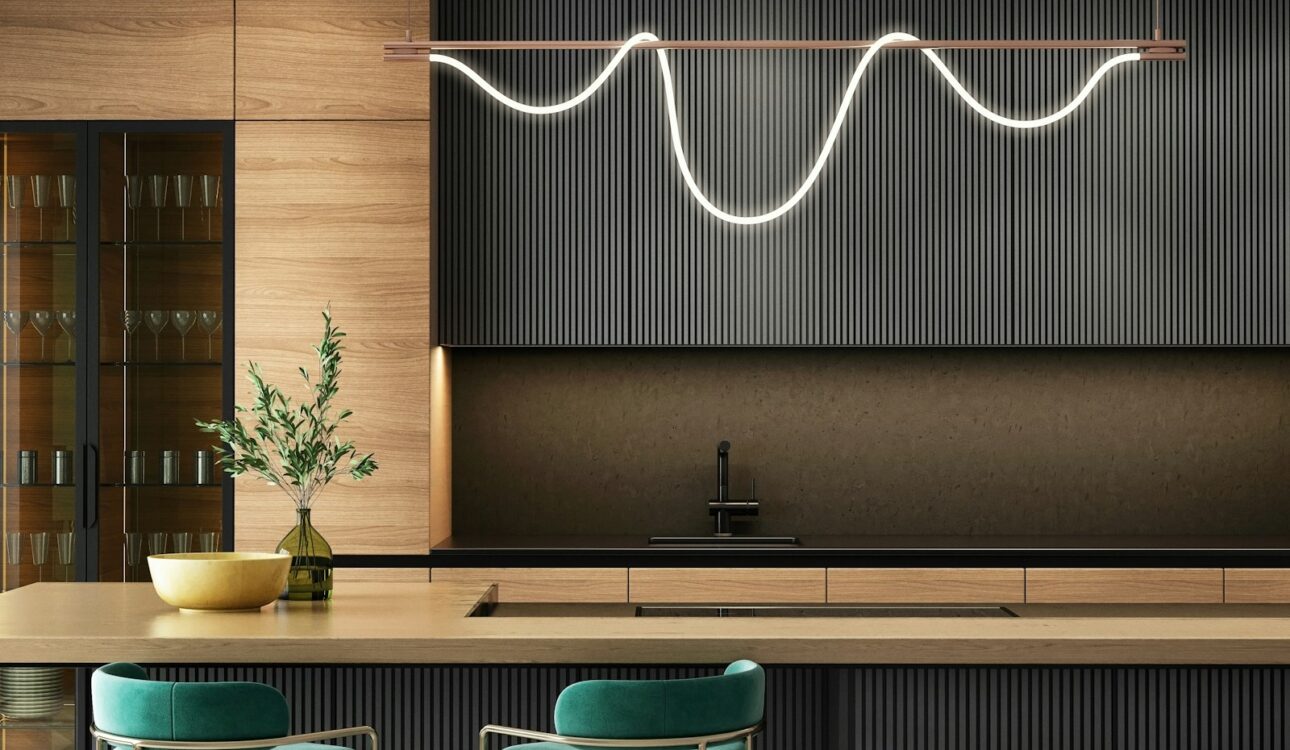
This is the combination we recommend more often than any other, and we will tell you plainly why: it is the best value for money in the Saudi market today. The idea is simple and clever — glossy acrylic where the kitchen is seen, and durable formica where it is used hard or not seen at all.
The idea, simply put
Acrylic where the eye lands, and formica where it does not.
Upper units sit directly at eye level — they are what creates the visual impression of the whole kitchen. Lower units are often partly hidden by the worktop and the appliances, and they take far more rubbing and scratching.
So the logic is double: a saving in cost, and a more suitable material for how each position is actually used.
How the two are distributed
1. Acrylic above, formica below
The most requested. Wall units sit at eye level and are the first thing a visitor sees, so they are glossy. Base units take knocks from feet, water and hard daily cleaning, so they are formica. This saves between 25% and 40% against a full acrylic kitchen — and is sometimes more durable.
2. Acrylic on the doors, formica on the internal carcasses
Everything visible from outside is acrylic; cabinet sides, shelves, backs and drawer interiors are formica. Nobody judges a kitchen from inside a closed cupboard, and formica interiors resist pan scratches better.
3. Acrylic on the island and main run, formica elsewhere
Right for kitchens open to the living room. A large saving with the full visual effect intact.
Why the combination is sound engineering
Both acrylic and formica are skins on the same kind of board. The structure of the kitchen does not differ — only the outer layer. Combining them creates no weak point where the two meet.
And the drawbacks? Two, stated plainly
- Visual mismatch if coordination is poor. Glossy acrylic and matte formica reflect light differently. If the formica colour does not sit well with the acrylic, the kitchen looks patched rather than designed. We show you the coordination in 3D before manufacturing.
- Some suppliers exploit the idea. They sell an “acrylic and formica” kitchen, put acrylic on two doors and cheap formica everywhere else, and price it as acrylic. Ask for a plan showing which unit is which material, in numbers rather than words. We provide it with every quotation as standard.
The colour pairings that work
- Glossy white above, wood-effect formica below — the safest and most requested; widens the space and adds warmth low down.
- Glossy grey with cement-grey formica — calm and contemporary, and hides daily use better than white.
- Navy acrylic with light oak formica — bolder and elegant, excellent in open-plan kitchens.
- Olive-green acrylic with beige formica — currently fashionable and easy on the eye long term.
A golden rule: never more than two colours on the doors. A three-colour kitchen always looks busy, even if you like each colour alone.
And one lighting note: glossy acrylic depends on light. LED lighting under the wall units is not a luxury here — it is what reveals the value of the acrylic you paid for.
Which unit gets which material?
| Position | Material | Why |
|---|---|---|
| Upper units | Acrylic | Eye level — they create the impression |
| Lower units | Formica | More rubbing, less seen |
| Tall columns | Acrylic | Fully exposed |
| The island | Acrylic | Visible from every direction |
| Inside the units | Formica | Nobody sees it |
During the measuring visit we propose the distribution after seeing where the kitchen is entered from and where it is seen from — because that is what decides where acrylic is worth its cost. You receive it as a written plan, not a verbal promise.
How we make sure it looks deliberate, not improvised
This is the difference between an elegant combination and one that looks as though the material ran out:
- Colour harmony — either the same colour in two tones, or a clear, deliberate contrast. Two near-but-not-matching colours simply read as a mistake.
- A logical dividing line — the transition happens at the worktop or at a clear architectural edge.
- Consistent hardware — the same handles and hinges on both parts. Different hardware exposes the combination instantly.
This is why we insist on the 3D design before fabrication — you see the distribution with your own eyes and approve or adjust it before a single panel is cut.
Who we recommend it for
- Anyone who wants a modern, glossy look on a balanced budget.
- Anyone who would rather put the saving into the accessories and the worktop — both of which matter more to the life of the kitchen than the door face.
- Large kitchens, where the cost difference between the two options becomes significant.
And if you want a single material, acrylic on its own remains the strongest choice.
Working with us
Free measuring, a 3D design, a written materials plan by unit, installation by our own crew, and a ten-year written warranty across both materials — we do not distinguish between the acrylic and the formica in the warranty.
We serve Riyadh, Al-Ahsa, Buraydah and Hail.
Ready to have your kitchen built?
Send us the length of your kitchen wall and we will arrange a free measuring visit, with a 3D design that shows you the kitchen before manufacturing.