
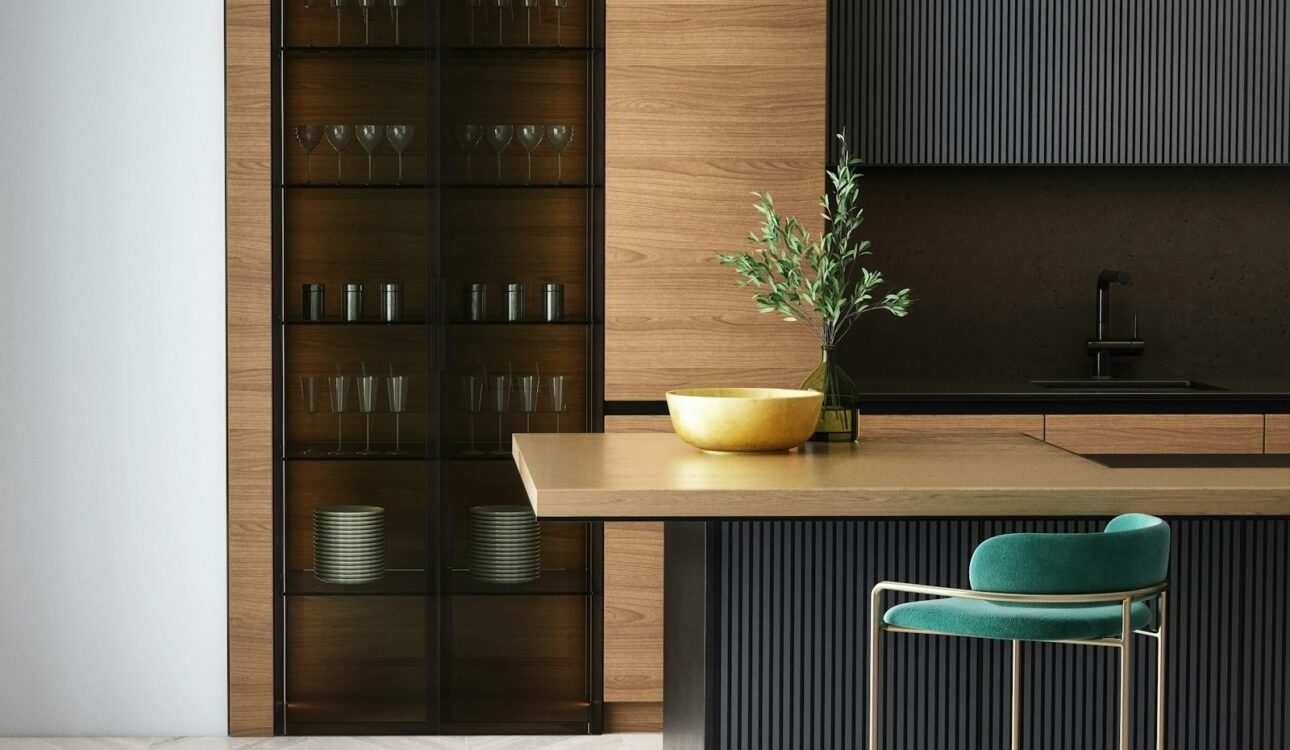
Almost everyone who asks us about glass has the same two worries: will it break? and will it show every fingerprint? Both have clear answers, and neither is the one people expect.
Tempered glass is not window glass
The glass we use is tempered — heated to roughly 650°C then cooled rapidly, which makes it four to five times stronger than ordinary glass of the same thickness. Three practical consequences follow:
- It resists impact far better than people assume. A pan handle knocking against a tempered door does nothing.
- If it ever fails, it fails safely — shattering into small blunt granules rather than long blades. This is exactly why it is mandated for shower screens and car windows.
- It cannot be cut or drilled after tempering. Every hole for a hinge or handle is made before the heat treatment, which is why measurement accuracy matters more here than in any other material.
Standard thickness for doors is 6 mm; we use 8 mm for oversized doors and for splashbacks.
Lacquered glass — where the depth comes from
The colour is applied to the back face of the glass and cured, so you are looking at the colour through the glass. Light enters, reflects off the colour layer, and comes back out. That round trip is what your eye reads as depth — and it is why a glass kitchen looks more expensive than a merely glossy one.
Because the paint sits on the back, the colour can never scratch off. The face you touch is pure glass. That is a genuine durability advantage almost nobody mentions.
Why glass suits small Riyadh kitchens
This is the most underrated argument for glass. Reflective surfaces bounce light and visually enlarge a room more than any paint colour. A small apartment kitchen in light lacquered glass feels noticeably larger than the same kitchen in matte laminate. Add that nothing stains it — turmeric, tomato, coffee and oil all wipe off completely — and it becomes the easiest surface in the kitchen to keep clean.
And the drawbacks? Honestly
- Fingerprints on dark colours. On black or navy gloss every fingerprint shows. On white, cream or light grey they are almost invisible. If you want a dark kitchen and have children, choose frosted or satin dark glass instead of mirror-gloss — it solves the problem completely.
- No changes after tempering. Decide handle type and position before manufacturing, or choose push-to-open and remove the question entirely.
- Edges need protection during installation. This is a crew competence issue, and the main reason we never subcontract glass installation.
- It sits in the upper half of our price range.
A glass splashback — the cheapest way in
A single tempered sheet behind the worktop instead of tiles: one surface, no grout lines, wiped clean in one pass. Anyone who has scrubbed grease out of tile grout understands the appeal immediately. It pairs with any other material — aluminium, formica or timber.
How we use glass in the design
| Position | Our recommendation |
|---|---|
| Upper units | Glass — it lifts the light at eye level |
| Lower units | An opaque material — it shows fingerprints and wear less |
| A full glass front | Matt rather than gloss, to reduce fingerprints |
| A dark kitchen | Light or white glass — maximum light reflection |
Glass or something else?
Glass for small, dark spaces. Acrylic if you want the gloss with higher durability. Aluminium if heat and humidity are the real challenge. Natural timber for classic character.
Working with us
Free measuring, a 3D design before manufacturing, glass with polished edges and hinges rated for its weight, installation by our own crew, and a ten-year written warranty.
We serve Riyadh, Al-Ahsa, Buraydah and Hail.
Ready to have your kitchen built?
Send us the length of your kitchen wall and we will arrange a free measuring visit, with a 3D design that shows you the kitchen before manufacturing.