
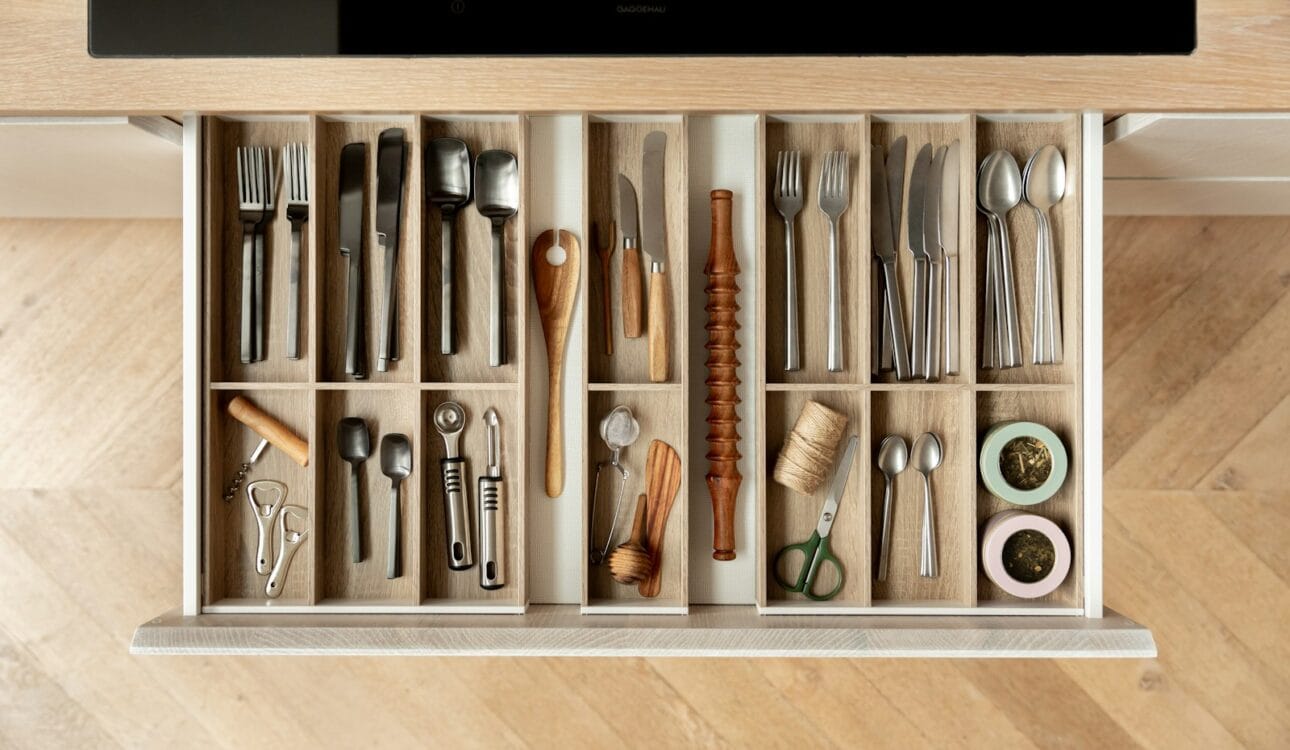
Open a kitchen drawer a few thousand times and you will learn more about its quality than any brochure can tell you. The fronts may be beautiful and the worktop impressive, but the part of the kitchen you actually touch dozens of times a day is the hardware: the hinges that carry every door, the runners that carry every drawer, and the lift systems that hold wall-cabinet flaps open above your head. When hardware is good, you never think about it. When it is poor, doors sag, drawers stick, fronts slam and gaps grow uneven within months.
In Saudi kitchens, hardware works under demanding conditions: heavy daily use, large families, heavy pots and trays, heat near cooktops, steam around dishwashers and, in coastal and humid regions such as Al-Ahsa, moisture that attacks low-grade metal. This guide explains the main types of hinges, drawer runners, lift systems and opening mechanisms, what the specifications really mean, and how to compare them before you approve a kitchen. It is written by a Riyadh kitchen factory that has fitted hardware to more than 5,000 kitchens since 2015 — and has replaced plenty of failed hardware in other people’s kitchens.
Why hardware quality matters more than it looks
A typical family opens and closes kitchen doors and drawers many times a day. Over ten years, the busiest drawers — cutlery, utensils, pots — may complete tens of thousands of cycles. Reputable hardware manufacturers test their products for this kind of use, loading drawers with weight and cycling them repeatedly. Cheap hardware may feel fine on day one and fail in the second year.
Hardware also affects safety and comfort. A drawer that slams can trap fingers. A wall-cabinet flap that does not stay open can fall on someone’s head. A door that swings too wide can hit the wall or a nearby appliance. These details are decided when the hardware is specified, not when the kitchen is installed.
Concealed cabinet hinges
Almost all modern kitchen doors use concealed hinges, often called European or cup hinges. The hinge is fixed into a round recess drilled into the back of the door — commonly 35 mm in diameter — and clipped onto a mounting plate inside the cabinet. When the door is closed, the hinge is invisible.
Overlay types
The hinge’s crank determines how the door sits relative to the cabinet side.
- Full overlay: the door covers the whole front edge of the cabinet side. This is the standard for most modern kitchens.
- Half overlay: two doors share one cabinet side, each covering half of it.
- Inset: the door sits inside the cabinet frame, flush with the front edge — typical of classic and frame-style kitchens.
Choosing the wrong crank leads to doors that clash or leave uneven gaps, so this is decided at the design stage for every door.
Opening angles
Standard hinges open to roughly 95 to 110 degrees, which suits most doors. Wide-angle hinges of about 155 to 170 degrees let the door swing clear of the cabinet opening, which is useful when pull-out baskets, corner mechanisms or internal drawers must pass the door. Restricted-angle hinges or opening limiters prevent doors from hitting walls, tall units or appliances next to them.
Soft-close
Soft-close hinges include a damper that slows the door in its final movement so it closes quietly without slamming. Today soft-close is expected in most kitchens. It can be integrated in the hinge or added as a separate damper; integrated versions are generally neater and more consistent.
Adjustment
Good concealed hinges offer three-way adjustment: side-to-side, height and depth. This allows the installer to align gaps precisely, and it allows you to correct small movements later with a screwdriver. Clip-on mounting lets doors be removed and refitted without unscrewing the hinge, which is convenient for cleaning and maintenance.
Number of hinges per door
Door height and weight decide how many hinges are needed. Small doors use two; tall pantry and appliance doors need three, four or more. Heavy fronts — thick wood, glass or large panels — need more hinges than a light door of the same size. Too few hinges is one of the main causes of sagging doors.
Special hinges
- Glass door hinges: designed to grip glass fronts without drilling a cup recess.
- Aluminium-frame hinges: for narrow aluminium frame doors, often used with glass inserts.
- Blind-corner and bi-fold hinges: for corner cabinets where two doors meet at an angle.
- Thick-door hinges: for heavier, thicker fronts that need a different geometry.
Drawer runners
Drawers have largely replaced doors in modern base cabinets, because they bring contents into view instead of hiding them at the back. The runner decides how smoothly, quietly and fully the drawer opens, and how much weight it can carry.
Side-mounted ball-bearing runners
Metal runners fixed to the sides of the drawer box, with ball bearings for smooth movement. They are visible when the drawer is open and are common in budget and mid-range kitchens. Quality varies widely; good ones are smooth and strong, poor ones rattle and loosen.
Concealed undermount runners
Fixed underneath the drawer, invisible when the drawer is open. They usually offer full extension and soft-close, run very smoothly and quietly, and suit timber or board drawer boxes. They are a popular upgrade for a cleaner look.
Metal drawer box systems
Complete systems with metal side walls and integrated runners. They are strong, precise and easy to adjust, and they come in several side heights for shallow cutlery drawers and deep pot drawers. Many include gallery rails or glass sides for tall drawers. For busy family kitchens, they are often the most durable choice.
Extension: three-quarter or full?
Three-quarter extension leaves the back part of the drawer inside the cabinet. Full extension brings the whole drawer out, so you can reach everything. For deep base drawers and pantry pull-outs, full extension is strongly recommended. Some systems offer over-extension, which brings the drawer slightly beyond the worktop edge for easier access to the back.
Load rating
Every runner has a rated load. Standard runners are fine for cutlery and utensils. Wide drawers for pots, plates, tins and small appliances need heavy-duty runners with a higher rating. Always check the manufacturer’s rating against the drawer’s width and what will be stored in it. Overloaded drawers sag, stick and wear out quickly.
Soft-close and push-to-open for drawers
Soft-close drawers close gently and quietly even when pushed hard. Push-to-open drawers open with a light press, ideal for handleless kitchens. Electric servo-assisted opening, available on some premium systems, opens a drawer with a light touch even when it is heavy. Not every system combines soft-close with push-to-open, so these choices must be made together.
Lift systems for wall cabinets
Wall cabinets with side-hinged doors are fine, but lift-up fronts can be more convenient and look cleaner, especially above worktops where an open door could hit your head.
- Lift-up flap: the front swings upwards and stays open at any position.
- Bi-fold lift: the front folds in two as it rises, ideal for tall wall cabinets under low ceilings.
- Vertical lift: the front slides straight up, useful where there is little space above the cabinet.
- Up-and-over lift: the front moves up and over the cabinet top, for large wall units.
Lift systems are rated for front weight and size. A glass or heavy front needs a mechanism sized for it, otherwise it will not stay open or will close too fast. Electric lift systems are available for high cabinets that are otherwise hard to reach.
Handleless opening systems
Handleless kitchens depend on hardware as much as on design. The main options are:
- Integrated handle profiles: a recessed aluminium channel along the top of base units or the side of tall units, into which you slip your fingers.
- Push-to-open mechanisms: a mechanical latch that opens the door or drawer when you press it.
- Electric opening: a motorised unit that opens drawers or doors with a light touch, useful for heavy drawers and integrated appliances.
Each option affects the cabinet design, gaps and door thickness, so the choice must be made early. We discuss this further in our guide to handleless and hidden kitchens.
Hardware for pantries and tall units
Tall pantry pull-outs carry a lot of weight — tins, jars, bottles — and move a large, heavy front. They need robust runners or frames rated for the load, with dampers for smooth closing. Swing-out pantry systems and larder units with internal baskets also depend on strong hinges and precise installation. Appliance housings for integrated refrigerators and ovens use the appliance manufacturer’s specified hinges or fixing kits, which must match the cabinet design.
Corner solutions
Corners are where hardware makes the biggest difference. A plain corner cabinet with shelves wastes space. Hardware solutions include:
- Swing-out corner shelves that bring items out into the room.
- Carousel (lazy Susan) shelves that rotate.
- Pull-out mechanisms that slide one set of baskets out and then bring the hidden ones forward.
- Corner drawers with angled fronts that use the full depth.
Each needs a specific hinge opening angle and cabinet size, so it must be chosen before manufacturing. Our upcoming guide to kitchen storage accessories covers these in detail.
Hardware and the Saudi climate
Metal hardware is affected by moisture, steam and cleaning chemicals. Around the sink and dishwasher, where steam and water are constant, low-grade finishes can corrode. In humid regions, the risk is greater. Quality hardware uses corrosion-resistant finishes and materials. When combined with water-resistant cabinet structures such as aluminium or saj, the areas most exposed to water stay stable for many years. Avoid spraying cleaning products directly onto hinges and runners, and dry any water that drips into drawers near the sink.
How to test hardware in a showroom
Specifications are useful, but your hands are the best test. When you visit a showroom:
- Open a drawer quickly and let it close: it should slow down and close softly, without bouncing.
- Open a deep drawer fully and press down on the front: it should feel solid, not wobbly.
- Load a drawer with something heavy if possible and open it: movement should stay smooth.
- Open and close doors firmly: they should close quietly and align evenly.
- Lift a wall-cabinet flap and let go at different heights: it should stay in place.
- Look at the gaps between fronts: they should be even and consistent.
- Ask for the brand, model, extension and load rating of each type, and ask how long spare parts are available.
Maintenance and adjustment
Good hardware needs little maintenance, but a few habits extend its life:
- Check door alignment after the first few months, when the kitchen has settled, and adjust hinges if needed.
- Do not overload drawers beyond their rating.
- Keep runners free of crumbs and spilled liquids; wipe with a damp cloth and dry.
- Do not oil soft-close dampers or ball bearings unless the manufacturer recommends it.
- Tighten any loose fixing screws promptly before holes wear.
- Avoid hanging heavy items or towels on door edges.
Reading hardware in a quotation
Two quotations can look identical in materials and dimensions and still differ greatly in hardware. When comparing offers, look for:
- The hinge type, overlay, opening angle and whether soft-close is integrated.
- The drawer runner type (side-mounted, undermount or metal box system), the extension and the load rating.
- The lift system model for wall flaps and its weight range.
- The opening system for handleless fronts.
- Corner and pantry mechanisms by name and size.
- Whether the brand is named or described vaguely as “imported” or “soft-close”.
A vague description often hides lower-grade hardware. An itemised, written quotation removes that uncertainty. Our pricing guide explains how hardware choices affect the total.
Where to invest and where to save
If the budget is limited, prioritise hardware where use is heaviest: cutlery and utensil drawers, pot drawers, the bin pull-out under the sink, and the pantry. These see the most cycles and the most weight. Rarely used high wall cabinets can use simpler hinges without affecting daily comfort. It is usually better to have fewer, high-quality drawers than many drawers on weak runners.
Hardware for different kitchen materials
Each front material places different demands on hinges and runners, and the hardware must be matched to it.
Glass fronts are heavy for their size and cannot be drilled for standard cup hinges, so they need glass-specific hinges or aluminium frames with their own hinge system. Lift systems for glass wall flaps must be rated for the extra weight. Soft-close is especially important, because a slamming glass door is both noisy and risky.
Solid wood fronts are heavier than board fronts and can move slightly with changes in humidity. They benefit from an extra hinge on tall doors and from hinges with generous adjustment so gaps can be corrected after the first seasons.
High-gloss acrylic fronts show every misalignment, because reflections exaggerate uneven gaps. Precise three-way adjustable hinges and careful installation are essential to keep the lines perfect.
Formica and acrylic-with-formica kitchens are often chosen for value, but it is still worth investing in quality runners for the most used drawers; the fronts can be economical while the movement stays premium.
Aluminium and saj kitchens are chosen for their resistance to water, so the hardware inside should be equally resistant to corrosion, particularly in sink and dishwasher cabinets.
Hardware that improves accessibility
Good hardware can make a kitchen easier for older family members, people with limited mobility and children. Drawers instead of low doors reduce bending. Full-extension runners bring everything within reach. Servo-assisted opening lets heavy drawers open with a light touch. Lift-up wall flaps that stay open at any height avoid reaching for a door at eye level. Pull-down shelf systems in high wall cabinets bring items down to worktop height. When a kitchen will be used by several generations, as it often is in Saudi homes, these choices make daily life easier for everyone.
Spare parts and long-term support
A kitchen is expected to last many years, and at some point a damper or runner may need replacing. Choosing hardware from established manufacturers with long-term availability of spare parts makes this simple. Unbranded hardware may be impossible to match later, forcing replacement of whole sets. Keep a record of the hardware models used in your kitchen, and ask your kitchen maker how replacements are handled under the warranty.
Common hardware mistakes
- Too few hinges on tall or heavy doors.
- Standard runners on wide pot drawers.
- Three-quarter extension on deep drawers.
- Lift systems not rated for the weight of glass fronts.
- Doors that hit adjacent walls or appliances because opening limiters were not planned.
- Push-to-open chosen without checking compatibility with soft-close.
- Corner mechanisms ordered after the cabinet was built.
- Vague hardware descriptions in the quotation.
How we specify hardware at Modern Palace
We start from how the kitchen will be used. In the free measuring visit we ask what goes in each area — pots, plates, spices, cleaning products, small appliances — and plan drawers and doors accordingly. In the design we choose the hinge type and opening angle for each door, the runner and load rating for each drawer, and the lift system for each wall flap. You can see and test samples before approving, and every item is listed in the written, itemised quotation. Our own teams install and adjust the hardware, and the kitchen is covered by our written 10-year warranty. To see how a design comes together, read about our 3D design process, or explore the kitchen types we build.
Quick checklist
- Soft-close on all doors and drawers?
- Full-extension runners on deep drawers and pantry pull-outs?
- Heavy-duty runners where pots, plates and tins are stored?
- Enough hinges for tall and heavy doors?
- Wide-angle hinges where pull-outs must pass the door?
- Lift systems rated for the weight of each wall flap?
- Opening system compatible with the handleless design?
- Brand and model named in the quotation?
Hardware is the part of the kitchen that works silently every day. Choosing it carefully is what keeps doors aligned, drawers smooth and the whole kitchen feeling new long after installation.
Frequently asked questions
What is the difference between soft-close and push-to-open?
Soft-close uses a damper so that doors and drawers slow down and close quietly on their own in the last few centimetres. Push-to-open lets handleless doors and drawers open with a light press on the front. They can be combined on some systems, but not all, so the combination must be chosen together with the hardware brand.
Are full-extension drawers worth it?
Yes, especially for deep base drawers. A full-extension runner brings the whole drawer out of the cabinet so you can see and reach items at the back. Three-quarter extension leaves the back quarter inside the cabinet, where things are easily forgotten.
How much weight can a kitchen drawer carry?
It depends entirely on the runner. Standard runners are commonly rated for moderate loads suitable for cutlery and utensils, while heavy-duty runners for pot drawers and pantry pull-outs are rated higher. Always check the manufacturer’s rating and choose heavy-duty runners for wide drawers holding pots, plates or tins.
Why does my cabinet door sag or not close evenly?
Most concealed hinges have three-way adjustment: side, height and depth. A sagging or misaligned door can usually be corrected with a screwdriver. If a door keeps dropping, the hinge fixing may be loose, the door may be too heavy for the number of hinges, or the hinge quality may be low.
Which hinges are best for corner cabinets?
Corner cabinets often need special solutions: blind-corner hinges, bi-fold hinges for L-shaped corner doors, or wide-angle hinges of about 155 to 170 degrees so pull-out corner mechanisms can pass. The right choice depends on the corner accessory planned inside.
What hardware does Modern Palace use?
We specify hardware according to the kitchen’s use and budget and explain it in the itemised quotation: hinge type and opening angle, drawer runner type, extension and load rating, and lift systems for wall cabinets. You can test the movement on samples before approving the design.
Want a kitchen that still closes perfectly years from now?
We specify hinges, runners and lift systems for how your family actually uses the kitchen, list them in an itemised quotation, and show the design in 3D before manufacturing. Riyadh, Al-Ahsa, Buraidah and Hail.