
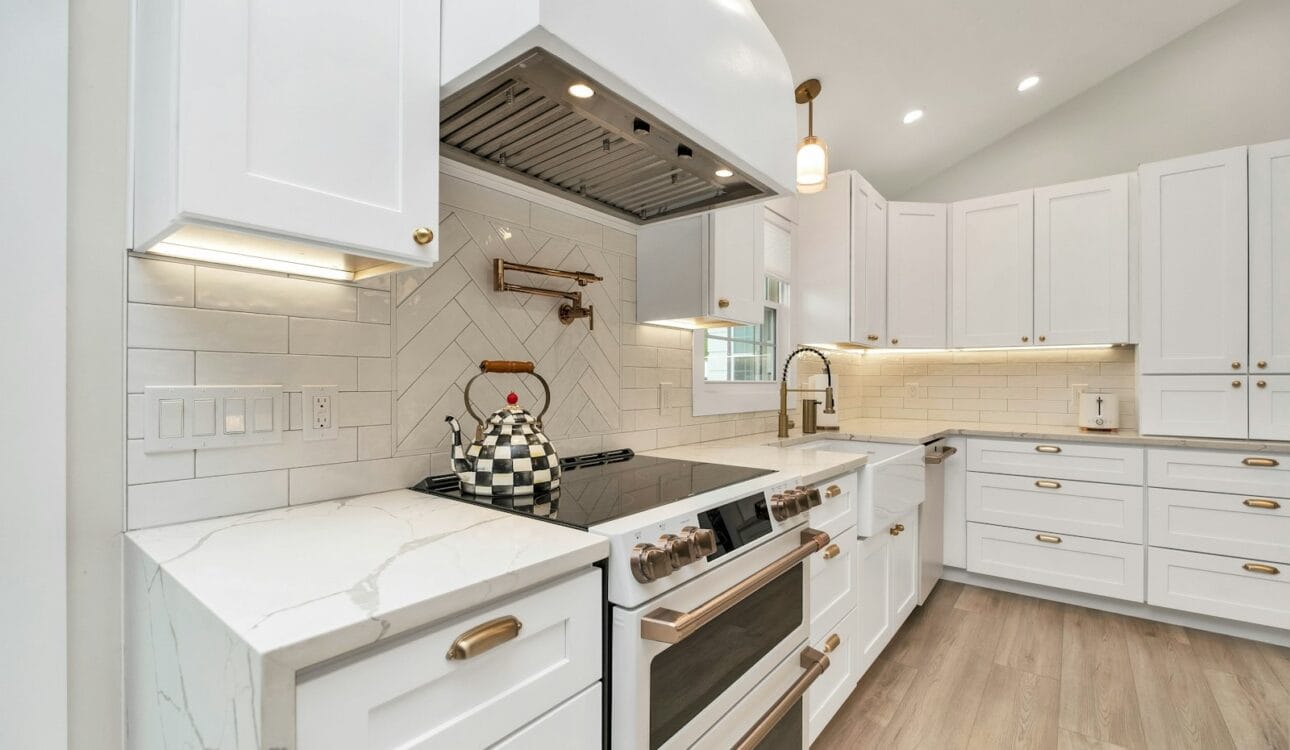
Ask anyone who has lived with a poorly ventilated kitchen and they will tell you the same story: the smell of frying reaches the bedrooms, a sticky film forms on the top of the wall cabinets, the ceiling above the cooktop slowly turns yellow, and on summer days the kitchen becomes the hottest room in the house. None of this is about the quality of the cabinets. It is about air.
Ventilation is the most underestimated part of kitchen design. It is invisible in photographs, rarely discussed in showrooms, and often left to the last minute, when the only remaining option is a hood that looks good but barely works. In Saudi homes, where daily cooking often involves frying, spices, large pots and long cooking times, good extraction is not a luxury. It protects your health, your furniture and your kitchen itself.
This guide explains how kitchen ventilation works, the types of hoods available, how to size them, how to plan the duct, and how to integrate everything into the kitchen design. It is written from the experience of a Riyadh kitchen factory that has installed more than 5,000 kitchens since 2015 — and has seen what happens to cabinets, ceilings and worktops when ventilation is an afterthought.
What a kitchen hood actually has to remove
Cooking releases several things into the air at once, and a good ventilation system has to deal with all of them.
- Grease: tiny droplets of oil carried up by steam and heat. If they are not captured, they settle on cabinets, walls, ceilings and light fittings, forming the sticky film that is so hard to clean.
- Smoke and smells: from frying, grilling and spices. In open kitchens they travel quickly into living areas.
- Moisture: boiling and steaming release large amounts of water vapour, which condenses on cold surfaces and, over time, can affect finishes and encourage mould.
- Heat: cooktops and ovens heat the room, making the kitchen uncomfortable and forcing the air conditioning to work harder.
- Combustion products: gas burners produce combustion gases that should be removed from the living space.
A hood that only filters and recirculates air can catch much of the grease, and charcoal filters reduce smells, but heat and much of the moisture stay in the room. That is the fundamental reason why ducted extraction is almost always the better choice.
Ducted versus recirculating hoods
Ducted (extraction) hoods
A ducted hood draws air through grease filters and pushes it through a duct to the outside of the building. It removes grease, smoke, smells, moisture and heat. Its effectiveness depends on the motor, the size of the hood and — critically — the design of the duct.
Recirculating (filtering) hoods
A recirculating hood draws air through grease filters and then through charcoal filters that absorb smells, and returns the air to the kitchen. It is easier to install because it needs no duct, but it does not remove heat or much moisture, and its charcoal filters must be replaced regularly to keep working.
Which one should you choose?
If there is any reasonable way to duct the hood to the outside, choose ducted extraction. Recirculating hoods make sense only when ducting is truly impossible — for example in some apartments where the building does not allow external openings — or in secondary kitchens with very light use. In our experience, families who cook traditional dishes daily are rarely satisfied with recirculation alone.
Types of hoods and where they fit
Wall-mounted chimney hood
The classic hood fixed to the wall above the cooktop, with a vertical chimney cover that hides the duct. It is efficient, widely available and easy to service. It suits kitchens where the cooktop sits against a wall with no wall cabinet directly above.
Integrated or built-in hood
The motor and filters are hidden inside a wall cabinet above the cooktop, so only a slim panel or glass strip is visible. This gives a clean, furniture-like look that suits modern and open kitchens. The cabinet must be designed around the hood’s dimensions, the duct route and access for filter cleaning.
Slide-out (telescopic) hood
A slim hood fitted under a wall cabinet with a front panel that slides out during cooking to increase the capture area. It is a practical solution for smaller kitchens and apartments.
Island or ceiling hood
Suspended from the ceiling above an island cooktop. Because there is no wall to guide rising air, island hoods need to be larger and more powerful than wall hoods for the same cooktop. Ceiling-flush hoods are elegant but need a strong duct route through the ceiling void.
Downdraft extractor
Built into the worktop or cooktop, it pulls fumes downwards or sideways. It keeps sight lines clear on islands but captures rising steam from tall pots less effectively than an overhead hood, and it takes space inside the cabinet below.
Sizing the hood correctly
Width
The hood should be at least as wide as the cooktop, and ideally slightly wider, so that it captures fumes rising from the outer burners. A 90 cm cooktop pairs well with a 90 cm or wider hood; putting a 60 cm hood above a 90 cm cooktop leaves the outer zones uncaptured.
Extraction capacity
Hood capacity is usually quoted in cubic metres per hour. A widely used rule of thumb is that the hood should be able to replace the air in the kitchen about ten times per hour. To estimate this, multiply the kitchen’s floor area by its ceiling height, then multiply by about 10. For example, a kitchen of 4 by 3.5 metres with a 3-metre ceiling has a volume of 42 cubic metres, suggesting a capacity of roughly 420 cubic metres per hour or more. Open-plan kitchens, where the “kitchen” is really part of a much larger room, and households that fry a lot, benefit from more capacity.
Keep in mind that the published maximum capacity is measured in ideal conditions. A long duct with many bends, a reduced duct diameter or a blocked external cap can cut real performance dramatically. A moderately powerful hood with a good duct usually outperforms a very powerful hood with a poor one.
Mounting height
Always follow the manufacturer’s instructions for your specific hood and cooktop. As a general guide, many manufacturers specify roughly 65 to 75 cm above electric and induction cooktops, and a little higher above gas. Mounting too high reduces capture; mounting too low can be unsafe and makes the cooktop uncomfortable to use.
Planning the duct: where most ventilation fails
The duct is the part nobody sees and the part that decides whether the hood works. Most complaints about weak hoods are really complaints about bad ducts.
- Keep the full diameter. Use the duct size the hood is designed for — commonly around 150 mm — from the hood all the way to the outside. Reducing to a smaller diameter to fit through a gap chokes the airflow.
- Keep it short. Every extra metre adds resistance. The best position for the cooktop is often decided by the shortest route to an external wall.
- Minimise bends. Each 90-degree bend significantly reduces flow. Use gentle, wide bends where a change of direction is unavoidable.
- Use smooth, rigid duct. Long runs of flexible corrugated hose create turbulence and trap grease. Rigid smooth duct performs better and is easier to clean.
- Fit a proper external cap. The outlet should have a backdraft flap to stop outside air, dust and insects coming in when the hood is off, and it should be protected from wind.
- Never duct into a closed ceiling void. The air must reach the outside, not be dumped into the space above a suspended ceiling where grease and moisture accumulate.
Because the duct often passes through a false ceiling or behind cabinets, it must be planned before the ceiling is closed and before the wall cabinets are finalised. This is one of the reasons we discuss ventilation during the very first measuring visit.
Make-up air: the forgotten half of ventilation
A hood cannot remove air from a room unless replacement air can enter. In modern homes with well-sealed windows and doors, a strong hood may struggle simply because there is nowhere for fresh air to come from. The symptoms are a noisy hood that does not seem to extract much, doors that whistle, and smells that linger.
The solution can be as simple as slightly opening a window near the kitchen while cooking, or as planned as a dedicated fresh-air inlet. If the home has gas appliances or a water heater with a flue nearby, make-up air becomes a safety issue as well, because a strong hood could draw combustion gases back into the room. In such cases, qualified installers should assess the arrangement.
Filters and maintenance
Grease filters
Most hoods use metal mesh or baffle filters to catch grease. In a kitchen with daily cooking they typically need cleaning every few weeks. Many are dishwasher-safe. Baffle filters, common in professional-style hoods, are especially good at trapping grease and are easy to wash.
Charcoal filters
Recirculating hoods use charcoal filters to absorb smells. They cannot be cleaned and must be replaced on the manufacturer’s schedule. An exhausted charcoal filter does almost nothing for smells.
Why maintenance matters
Clogged filters reduce airflow, make the hood louder, and allow more grease to reach the cabinets and ceiling. A grease-saturated filter above a hot cooktop is also a fire risk. We recommend setting a simple reminder and making filter access easy when designing the cabinet around an integrated hood.
Noise: choosing a hood you will actually switch on
A hood that is too loud stays off. Noise levels are published in decibels, usually for different speed settings. Compare the figures at the speed you will use most, not only the lowest. Larger ducts, shorter runs and good installation all reduce noise, because the motor does not have to fight resistance. Some hoods offer external or remote motors placed further along the duct, which make the kitchen much quieter — useful in open-plan layouts.
How ventilation affects your cabinets and worktops
As a kitchen manufacturer, we see the long-term effect of ventilation on materials. Grease that is not captured settles first on the tops and sides of wall cabinets near the cooktop, then on the ceiling and light fittings. Moisture from boiling condenses on the underside of wall cabinets and on the hood cabinet itself.
- Cabinets next to the cooktop should use finishes that are easy to clean. Glossy acrylic and glass wipe clean easily but show grease film more visibly if extraction is weak.
- Carcasses around the cooktop and hood benefit from moisture-resistant structures such as aluminium or saj, especially in kitchens with heavy steam.
- Wood near the cooktop should be properly sealed and kept away from direct heat, with good extraction to limit grease build-up.
- The backsplash behind the cooktop should be non-porous and heat resistant; porcelain, glass and quartz-type surfaces are easy to clean. See our worktop comparison for details.
Ventilation in open-plan kitchens
Open kitchens raise the stakes. Smells and grease no longer stay in the kitchen; they reach sofas, curtains and rugs. For open layouts we recommend: a ducted hood without exception, a hood wider than the cooktop, placing the main cooktop against a wall rather than on an island facing the seating area, and — where heavy cooking is frequent — a sliding partition or a separate back kitchen. Our guide to open-plan American kitchens explains these options in detail.
Ventilation for island cooktops
Cooking on an island is attractive but demanding. Without a wall behind the cooktop, rising fumes spread more easily, so island hoods need a larger capture area and more capacity. The duct must run through the ceiling to an external wall or roof, which requires a suitable ceiling void and planning before the ceiling is finished. Downdraft systems are an alternative where a ceiling hood is not possible, but they are less effective with tall pots and heavy steam. If ducting from the island is not feasible, keep the cooktop on the wall. Read more in our kitchen island guide.
Building the hood into the kitchen design
The hood is not an accessory added at the end; it is part of the kitchen’s architecture. When we design a kitchen, we decide together:
- The cooktop position, based partly on the shortest duct route to the outside.
- The hood type, chimney, integrated, slide-out or ceiling, according to the style and the layout.
- The cabinet around the hood, with exact dimensions, access for filters, and space for the duct.
- The duct route, through the ceiling or wall, coordinated with your contractor before the ceiling is closed.
- The power point, positioned inside the hood cabinet or chimney where it is safe and accessible.
- Lighting, as many hoods include task lights, while others need separate under-cabinet lighting.
All of this appears in the 3D design before manufacturing, so there are no surprises when the kitchen is installed.
Apartments and ventilation: what to do when ducting is difficult
Apartment owners often face the hardest ventilation decisions, because the building may not allow new openings in external walls, and the kitchen may be deep inside the floor plan. Before settling for recirculation, check the options. Many apartment kitchens already have a small window or an existing vent opening that can be used for the hood duct with the right fittings. Some buildings have a shared vertical shaft intended for kitchen or bathroom extraction; whether a hood may connect to it depends on the building’s design and management rules. If neither exists and no opening is allowed, a good recirculating hood with quality grease and charcoal filters, combined with an opening window while cooking and a strict filter replacement routine, is the best available compromise. In that case we also recommend easy-clean finishes near the cooktop and a slightly lower cooking intensity where possible, such as using lids and moderate heat for frying.
Common ventilation mistakes
- Choosing a recirculating hood for heavy daily cooking because ducting was not planned.
- Reducing the duct diameter to fit through a gap.
- Long flexible ducts with several bends.
- Ducting into the false ceiling instead of to the outside.
- A hood narrower than the cooktop.
- Mounting the hood too high for effective capture.
- No access to the filters in an integrated hood cabinet.
- Ignoring make-up air in a tightly sealed home.
- Choosing a hood so loud that the family never uses it.
Daily habits for better ventilation
- Switch the hood on a few minutes before you start cooking so air is already moving.
- Use the back burners where possible; hoods capture fumes from the rear more effectively.
- Use lids on pots to reduce steam.
- Leave the hood running for 10 to 15 minutes after cooking to clear residual smells and moisture.
- Clean grease filters regularly and wipe the hood and nearby cabinets weekly.
Ventilation and the Saudi climate
In Riyadh summers, the kitchen is often the hottest room in the house. Ovens and cooktops add significant heat, and a recirculating hood simply moves that heat around. Ducted extraction removes hot air at its source, reducing the load on the air conditioning. At the same time, the external outlet must be protected against dust storms: a good backdraft flap and a well-sealed cap keep dust out when the hood is off. In more humid areas such as Al-Ahsa, extracting steam quickly helps protect finishes and prevents condensation on cabinets and ceilings.
Checklist before approving your kitchen design
- Is the hood ducted to the outside?
- Is the duct the full diameter recommended by the manufacturer, short and with few bends?
- Is the hood at least as wide as the cooktop?
- Is the capacity suitable for the kitchen’s volume and your cooking style?
- Is the mounting height within the manufacturer’s range?
- Can you reach the filters easily for cleaning?
- Is there a source of make-up air?
- Is the noise level acceptable at the speed you will use most?
- Has the duct route been coordinated before the ceiling is closed?
Good ventilation is invisible when it works. You notice only what is missing: no smell in the bedrooms, no sticky film on the cabinets, no yellow ceiling, and a kitchen that stays comfortable while you cook. Planned from the start, it is one of the best investments you can make in your kitchen.
Frequently asked questions
Is a ducted hood really better than a recirculating one?
Yes, for most Saudi kitchens. A ducted hood removes smoke, grease, heat and moisture from the house entirely. A recirculating hood only passes air through grease and charcoal filters and returns it to the room, so heat and much of the moisture stay inside. Recirculation is a fallback when ducting is impossible, not an equal alternative.
How high should the hood be above the cooktop?
Always follow the manufacturer’s instructions for your specific hood and cooktop. As a general guide, many manufacturers specify roughly 65 to 75 cm above electric and induction cooktops and a little higher above gas burners. Too high reduces capture; too low can be unsafe and uncomfortable.
What duct size should I use?
Use the duct diameter the hood is designed for — commonly around 150 mm for domestic hoods — and never reduce it. Keep the duct as short and straight as possible, use smooth rigid duct rather than long flexible hoses, and finish with an external cap that has a backdraft flap.
How powerful should my kitchen hood be?
A common rule of thumb is that the hood should be able to change the air in the kitchen about ten times per hour. Multiply the kitchen’s floor area by its ceiling height to get the volume, then multiply by about 10. Open-plan kitchens and heavy frying need more capacity, but a well-designed duct matters as much as the motor rating.
How often should I clean the hood filters?
Metal grease filters in a kitchen with daily cooking usually need washing every few weeks; many are dishwasher-safe. Charcoal filters in recirculating hoods cannot be washed and must be replaced according to the manufacturer’s schedule. Clogged filters reduce performance and can become a fire risk.
Can Modern Palace integrate the hood into my kitchen design?
Yes. We plan the hood position, the cabinet around it and the duct route during the free measuring visit, and show everything in the 3D design. Integrated and slim hoods can be built into wall cabinets so the kitchen looks clean while the extraction works properly.
Planning a kitchen with proper ventilation?
We measure for free, plan the hood, cabinet and duct route together, and show everything in a 3D design before manufacturing. Riyadh, Al-Ahsa, Buraidah and Hail.