
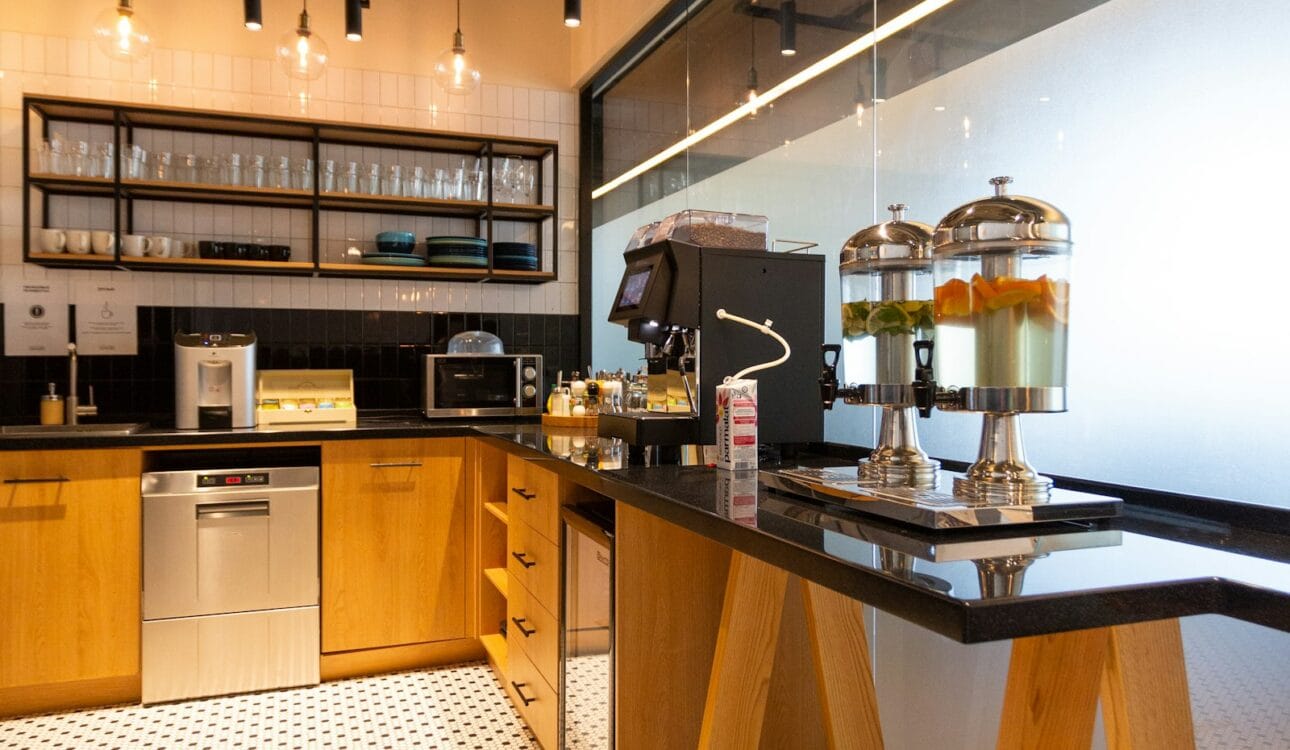
In Saudi homes, coffee is much more than a drink. Serving Arabic coffee with dates to guests is a daily expression of hospitality, and many families also enjoy espresso, tea and specialty coffee throughout the day. That is why the coffee corner has become one of the most requested features in new kitchens in Riyadh. A well-designed coffee corner keeps everything you need in one organised place, makes serving guests quick and elegant, and keeps the main cooking area free. This guide explains where to place a coffee corner, what dimensions and services it needs, how to organise storage, and which materials and lighting make it both practical and beautiful.
At Modern Palace we have designed and manufactured more than 5,000 custom kitchens since 2015, and a dedicated coffee corner is now part of many of our designs, whether as a section of the main kitchen, a tall unit with hidden doors, or a separate piece near the majlis or living room.
Why a dedicated coffee corner?
- Faster hospitality: everything for coffee, tea and dates is ready in one place, so guests can be served within minutes.
- A tidier kitchen: coffee machines, grinders, kettles and thermoses no longer occupy the main worktop.
- Less traffic in the cooking area: family members or helpers can prepare coffee without interrupting whoever is cooking.
- A decorative focal point: a well-lit coffee corner with beautiful cups and dallahs on display adds character to the kitchen or living area.
Where to place the coffee corner
The right location depends on your layout and how you receive guests. Common options:
- At the end of the kitchen run closest to the living room: guests can be served without walking through the cooking area. This works well in L-shaped and one-wall kitchens.
- On a peninsula or island facing the living area: ideal for open kitchens; the coffee corner becomes part of the social space.
- Inside a tall unit: a tall cabinet with pocket or bi-fold doors hides the coffee station completely when it is not in use — perfect for minimal and Italian-style kitchens.
- Outside the kitchen: a separate coffee unit in the dining room, near the majlis entrance or in a corridor serving the guest area. This is common in villas where the main kitchen is far from the guest rooms.
- In the back kitchen: for families who prepare large quantities of Arabic coffee for gatherings, a practical station in the back kitchen with a water point and heavy-duty storage can complement a smaller display corner in the front.
When choosing the location, think about the route: where the coffee is prepared, where cups are washed, and how trays are carried to guests. The shorter and clearer this route, the easier daily hospitality becomes. Our kitchen layouts guide can help you see where a coffee corner fits in your layout.
Recommended dimensions
The size of a coffee corner depends on the equipment and how many guests you usually serve. As a general guide:
- Compact corner: about 60–90 cm of worktop, enough for one machine, a kettle and a small tray area.
- Standard corner: about 90–150 cm, allowing an espresso machine, a grinder, a kettle or Arabic coffee maker, and space to prepare trays.
- Large station: 150 cm or more, often with a small sink, an under-counter fridge for milk and water, and wall or tall storage for cups and supplies.
Worktop depth is usually the standard 60 cm, but check the depth of your coffee machine, especially if it has a water tank at the back or if you want to slide it forward for use. If the corner is inside a tall unit, the internal height between the worktop surface and the upper shelf should allow the machine to operate comfortably and steam to escape — typically at least 45–55 cm, depending on the equipment.
Electrical points and water
A coffee corner needs services, and these must be planned before the kitchen is manufactured:
- Sockets: plan at least two to four sockets for the machine, grinder, kettle and Arabic coffee maker. Place them above the worktop at a convenient height, or inside the tall unit so cables are hidden. Heavy appliances such as espresso machines and kettles draw significant power, so ask your electrician to confirm the circuit capacity.
- Water supply: some espresso machines can be plumbed directly to a water line; if not, a nearby water point makes filling tanks and kettles easier.
- Small sink: a compact sink in the coffee corner is very useful for rinsing cups and dallahs, especially if the corner is far from the main sink. It requires water supply and drainage.
- Under-counter fridge: for milk, cold water and juices, a small fridge in the corner saves trips to the main fridge.
- Ventilation: machines and kettles produce steam and heat. In an enclosed tall unit, allow space above the machines and consider heat-resistant surfaces.
Our electrical and plumbing preparation guide explains how to plan these points with your contractor before installation.
Storage: what goes where
The secret of a good coffee corner is that every item has a place within arm’s reach. Typical storage plan:
- Top drawer: spoons, coffee scoops, filters, tamper, small tools and napkins, with organisers.
- Second drawer: coffee beans, ground coffee, cardamom, saffron, cloves, tea bags and sugar, in airtight containers.
- Deep drawer or cabinet: dallahs, thermoses, teapots and serving trays.
- Wall shelves or a glass cabinet: finjan cups, tea glasses and saucers, displayed neatly.
- Date storage: a drawer or shelf for date containers and serving bowls.
- Waste: a small pull-out bin for coffee grounds and packaging.
Pull-out trays, drawer dividers and vertical tray holders keep everything organised. Our storage accessories guide shows options that work well in coffee corners.
Design styles for the coffee corner
Hidden coffee station
A tall unit with pocket doors that slide back into the cabinet sides. When open, the full station is available; when closed, the wall looks like a clean row of cabinets. This is ideal for open kitchens and minimal designs, and it keeps dust off the equipment.
Open display corner
A section of worktop with a feature splashback, open shelves above and lighting that highlights cups and dallahs. It celebrates hospitality and becomes a decorative feature, but needs regular dusting and tidy display.
Coffee bar on the island or peninsula
Part of the island is dedicated to coffee, facing the living area. Guests can sit at the island while coffee is prepared, turning the service into a social moment.
Separate coffee unit
A freestanding or built-in unit outside the kitchen, often near the majlis or dining room. It can be designed to match the room’s furniture rather than the kitchen, with wood, glass and metal details.
Materials and finishes
Coffee corners face heat, steam, water drops and coffee stains, so finishes should be durable and easy to clean:
- Worktop: quartz, porcelain or other stain-resistant surfaces are practical. Coffee and tea can stain porous surfaces if left for long.
- Splashback: glass, porcelain slabs or ceramic tiles are easy to wipe. A contrasting splashback defines the corner visually.
- Cabinet fronts: acrylic and formica are easy to clean; wood adds warmth to a display corner; glass fronts are ideal for cup cabinets.
- Inside tall units: moisture-resistant materials such as aluminium are a good choice where steam is present.
Lighting the coffee corner
Lighting makes the coffee corner both practical and inviting. Under-shelf or under-cabinet LED strips light the worktop for preparation. Lighting inside glass cabinets or behind open shelves highlights cups and dallahs in the evening. In a hidden tall-unit station, an automatic light that switches on when the doors open is very convenient. Choose warm white light for a welcoming atmosphere, especially if the corner is visible from the living area. Our lighting guide explains colour temperatures and placement.
Designing for Arabic coffee and modern coffee together
Many Saudi families prepare both traditional Arabic coffee and modern espresso-based drinks. Each has its own tools, so the corner should be organised to support both without clutter:
- Arabic coffee zone: an Arabic coffee maker or kettle and stove area, storage for dallahs and thermoses, containers for coffee, cardamom and saffron, and space to prepare trays with finjan cups and dates.
- Espresso zone: the espresso machine, grinder, milk jug, cups and a knock box for used grounds.
- Tea zone: a kettle, teapots, tea glasses, tea leaves and mint storage.
In a larger station, these zones can sit side by side on a continuous worktop. In a compact corner, drawers can be dedicated to each drink so the worktop holds only the machines used daily.
The coffee corner in different kitchen styles
- Modern: handleless tall unit with pocket doors, matte finishes and integrated lighting.
- Italian-style: part of the tall unit wall, aligned with ovens and fridge, with a stone-effect interior back panel. See our Italian-style kitchens guide.
- Classic: framed doors, glass cabinets with mullions, decorative handles and a warm wood or cream finish.
- Arabic-inspired: geometric tile splashback, brass or bronze details, and a display of traditional dallahs.
Common mistakes to avoid
- Too few sockets: leading to extension cables on the worktop. Plan all sockets during design.
- No space for steam and heat: machines inside tight enclosed cabinets can damage finishes over time.
- Too far from water: carrying water and cups across the kitchen quickly becomes tiring.
- Overloaded open shelves: too many items on display look cluttered and collect dust.
- Ignoring the serving route: the corner should be placed so trays can be carried easily to guests.
- Choosing porous surfaces: coffee and tea stains can mark some materials if not wiped promptly.
Cleaning and maintenance
- Wipe the worktop and splashback daily after use to prevent stains.
- Descale machines and kettles regularly, especially with hard water.
- Empty and clean the drip tray and grounds container frequently to avoid odours.
- Keep coffee, spices and tea in airtight containers away from heat and direct sunlight to preserve flavour.
- Dust open shelves and displayed items weekly, which is especially important in Riyadh.
Coffee corners for apartments and small kitchens
You do not need a large villa to enjoy a proper coffee corner. In an apartment, a compact station of 60–90 cm can be very effective if it is planned carefully. Consider these ideas:
- A tall appliance unit with a coffee niche: the machine sits at worktop height inside a tall cabinet, with cups above and supplies below, and the doors close over everything.
- An appliance garage: a small unit on the worktop with a lift-up or roller door hides the machine and kettle when not in use.
- A slim pull-out: a 15–20 cm pull-out beside the station holds coffee, cardamom and tea containers.
- Wall rails or a narrow shelf: a single shelf with a few beautiful cups gives the corner character without clutter.
- Multi-purpose use: the coffee corner can double as a breakfast station with a toaster and cereal storage.
Coffee corners for large gatherings
Families who host large gatherings, weddings or Ramadan evenings often need a more robust setup. Useful features include a larger worktop for preparing many trays at once, storage for multiple thermoses and large dallahs, a dedicated sink with a deeper bowl for washing many cups, an under-counter dishwasher or glass washer nearby, and a strong circuit that can run several kettles and machines at the same time. In many villas, the best solution is a combination: a heavy-duty station in the back kitchen for preparing large quantities, and an elegant display corner near the guest area for serving.
Planning checklist
- Decide which drinks you prepare most: Arabic coffee, espresso, tea or all three.
- List the equipment and measure each item: height, width, depth and door or lid opening.
- Choose the location based on the serving route to guests.
- Plan sockets, water supply, drainage and a small fridge if needed.
- Decide between a hidden station and an open display corner.
- Plan drawers and shelves for every item.
- Choose durable, stain-resistant worktop and splashback materials.
- Add task and accent lighting.
- Review the corner in the 3D design before manufacturing.
Choosing coffee equipment with the design in mind
The equipment you choose affects the design of the corner, so it is best to decide on your machines before the cabinets are manufactured. Built-in coffee machines are designed to fit inside tall units at a fixed height, giving a very integrated look; they require an exact niche size, ventilation and a dedicated socket. Freestanding espresso machines vary widely in size, so measure the height with the bean hopper and the lid open, and the depth including the water tank and cables. Grinders need space above for the hopper and in front for the portafilter. Arabic coffee makers and electric kettles need a heat-resistant surface and clearance above for steam. If you plan to upgrade your machine in the future, leave a little extra space in width and height so a larger model can fit without changing the cabinets.
Safety considerations
Coffee corners combine electricity, water and heat, so a few safety points matter. Keep sockets away from the sink and water outlets, and use appropriate protection as advised by your electrician. Avoid placing kettles and hot machines directly under wall cabinets that do not have enough clearance, as steam can damage finishes and create condensation. If children live in the home, keep hot equipment towards the back of the worktop, place cords out of reach, and consider child locks for drawers that contain sharp tools or cleaning tablets for the machine. In a hidden tall unit, make sure the doors cannot be closed while a machine is operating, or use a switch that turns off power when the doors are closed.
Serving trays and the final touch
The way coffee reaches your guests is part of the experience. Plan a place to prepare and store serving trays — a vertical tray divider in a base cabinet is ideal, keeping trays upright and easy to pull out. Keep a small stock of napkins, date bowls and small plates in the same area, so a complete tray can be prepared without moving around the kitchen. If the coffee corner is visible from the living area, a beautiful tray with a dallah and a few cups on display can be a simple, welcoming decorative touch that reflects the hospitality of the home.
Small details like these turn a coffee corner from a place that simply stores equipment into a space that supports the rituals of the home — the morning coffee with family, the afternoon tea, and the warm welcome offered to every guest who walks through the door.
Budget considerations
The cost of a coffee corner depends on its size, the type of cabinets, the materials, the hardware and the services required. A simple open section of worktop with a shelf is the most economical option. A tall unit with pocket doors adds the cost of the special hardware, but gives a very clean result. Adding a sink, a water line and an under-counter fridge increases both cabinet and plumbing costs. Glass display cabinets with internal lighting add a premium touch. To keep the budget under control, decide first what you truly use every day, and invest in durable surfaces and good organisation rather than extra decorative elements.
Linking the coffee corner with the rest of the kitchen
A coffee corner should feel like part of the kitchen design, not an afterthought. Use the same or complementary materials, align its height and lines with the surrounding cabinets, and repeat the handle finish and lighting style. If you want the corner to stand out, change only one element — for example the splashback or the cabinet colour — while keeping the rest consistent. This makes the corner distinctive but harmonious. Our kitchen decor ideas guide offers more ways to create a coherent look.
How we design coffee corners
During the free site visit we ask how your family serves coffee and tea, how often you host guests, and which equipment you use. We measure each machine, plan sockets, water and drainage with you, and show the coffee corner in the free 3D design — including drawers, shelves, lighting and doors. Once approved, the kitchen and coffee corner are manufactured in our Riyadh factory and installed by our own team, with a 10-year written warranty. We serve Riyadh, Al-Ahsa, Buraidah and Hail. See examples in our virtual showroom.
Summary
A well-designed coffee corner makes hospitality easier, keeps the kitchen tidy and adds character to your home. Choose a location on a short route to your guests, size it for your equipment, plan sockets, water and lighting in advance, organise storage for every item, and choose durable, easy-to-clean materials. Whether hidden behind pocket doors or displayed proudly, the coffee corner can become one of the most loved parts of your kitchen.
Frequently asked questions
What is the ideal size for a kitchen coffee corner?
A compact corner needs about 60–90 cm of worktop, a standard corner about 90–150 cm, and a full station with a sink and small fridge 150 cm or more. The right size depends on your equipment and how many guests you serve.
Where should I place the coffee corner?
Ideally on a short, clear route to where guests are served — often at the end of the kitchen closest to the living room, on an island or peninsula, inside a tall unit, or in a separate unit near the majlis.
How many sockets does a coffee corner need?
Usually two to four sockets for the machine, grinder, kettle and Arabic coffee maker. Confirm the circuit capacity with your electrician because these appliances draw significant power.
Can a coffee corner be hidden?
Yes. A tall unit with pocket doors or an appliance garage hides the coffee station completely when not in use, which suits modern and open kitchens.
Which worktop is best for a coffee corner?
Stain-resistant surfaces such as quartz or porcelain are practical, because coffee and tea can mark porous surfaces if not wiped quickly.
Planning a coffee corner?
Book a free measurement and 3D design, and we will plan the right size, storage, sockets and lighting for your coffee corner.