
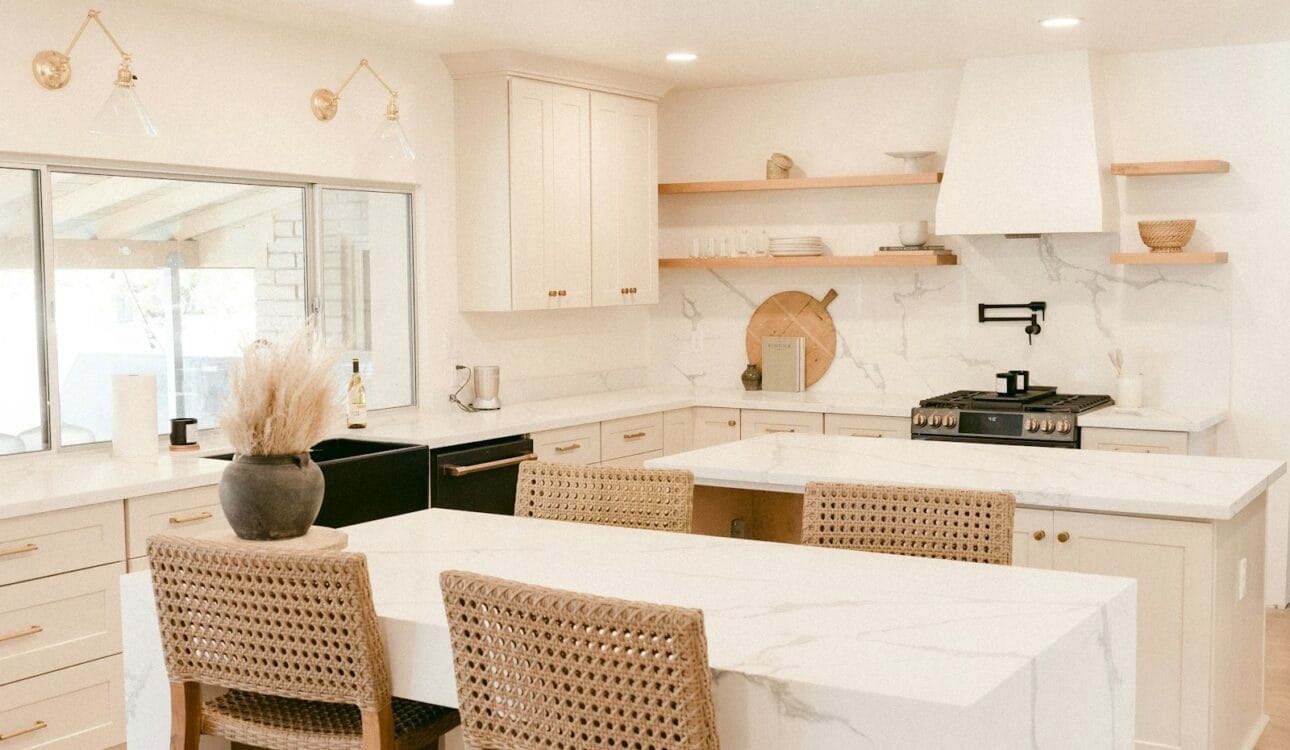
Buying a new kitchen is a significant investment, and most families do it only once or twice in a lifetime. It is natural to visit several showrooms and request quotations from more than one supplier. But comparing kitchens is not easy: every company uses different materials, hardware, terminology and pricing methods, and two quotations that look similar on the surface can describe very different products. This guide explains how to prepare before visiting a showroom, what to look at and ask during the visit, and how to compare quotations line by line so that you choose the best value — not just the lowest number.
At Modern Palace we have manufactured more than 5,000 custom kitchens in Riyadh since 2015. We encourage clients to compare carefully, because an informed client understands the difference that materials, hardware and workmanship make.
Before you visit: prepare your information
A showroom visit is much more productive when you arrive prepared. Bring or prepare:
- Approximate room dimensions: wall lengths, ceiling height, window and door positions, and any columns. A simple sketch with measurements is enough for a first discussion; a precise site measurement will follow.
- Photos of the space: including the positions of water, drainage, gas and electrical points.
- Inspiration images: kitchens you like, with notes on what attracts you — colour, layout, handles, island, lighting.
- A list of needs: how many people cook, what appliances you plan to use, whether you need a coffee corner, a pantry or a second kitchen.
- A budget range: knowing your range helps the designer suggest suitable materials and avoid wasting time on options outside it.
- Appliance information: if you have chosen appliances, bring their models or dimensions.
Our guide to planning a new kitchen explains these preparation steps in more detail.
What to check in the showroom
Showrooms are designed to impress, with professional lighting and perfect styling. Look beyond the overall impression and examine the details:
- Open and close doors and drawers: do they move smoothly and close softly? Do drawers extend fully? Do they feel solid when loaded?
- Look at the edges: are the edge bands well applied, straight and sealed? Are there gaps or glue marks?
- Check the gaps: are the spaces between doors even and consistent?
- Look inside the cabinets: what is the carcass material and thickness? How are shelves supported? Is the back panel solid?
- Examine the sink cabinet: what material is used, and how is it protected from water?
- Touch the finishes: how do matte and gloss surfaces feel? Do they show fingerprints easily?
- Look at the worktop samples: ask about heat, stain and scratch resistance.
- Ask to see real projects: photos or visits to completed kitchens show how the company’s work looks in real homes.
Questions to ask the supplier
- Do you manufacture the kitchen yourselves, or do you import or subcontract it?
- Who measures the site, and who installs the kitchen — your own team or a contractor?
- What materials are used for the carcass, the doors, and the sink cabinet?
- Which brands and types of hinges and drawer runners do you use? What load can the drawers carry?
- Is the worktop included? What material and thickness? Who templates and installs it?
- What is the manufacturing and installation timeline after design approval?
- What does the warranty cover, for how long, and is it written?
- How do you handle adjustments after installation?
- Do you provide a 3D design before manufacturing, and how many revisions are included?
- What are the payment terms and milestones?
Why the cheapest quote is not always the lowest cost
When quotations differ significantly in price, there is almost always a reason. Common reasons include:
- Different carcass materials: thinner or lower-density boards, or boards that are not moisture resistant in the sink area.
- Different hardware: basic hinges and runners versus soft-close, high-capacity hardware from recognised manufacturers.
- Worktop not included: some quotations show the cabinets only, with the worktop priced separately or left to you.
- Installation not included, or carried out by a separate contractor with no responsibility for the product.
- Missing items: filler panels, end panels, plinths, cornices, lighting or internal accessories not listed.
- Fewer units: a smaller number of cabinets or fewer drawers than your needs require.
- Shorter warranty, or a warranty that is not written or does not specify what is covered.
A kitchen that costs less today but needs repairs, adjustments or replacement parts within a few years may cost more over its life. Our guide to ready-made versus custom kitchens explains how to think about total cost of ownership.
How to compare quotations line by line
The most reliable way to compare is to put the quotations side by side in a simple table and check each item. Ask each supplier to provide the following information in writing:
| Item | What to check |
|---|---|
| Carcass | Material, thickness, moisture resistance (especially sink cabinet), colour inside |
| Doors and drawer fronts | Material, finish (gloss/matte), edge type, thickness |
| Number and size of units | Base, wall and tall units; number of drawers; matches the approved design |
| Hardware | Hinge and runner type and brand, soft-close, load rating, corner mechanisms |
| Internal accessories | Cutlery organisers, pull-out pantry, corner units, bins, tray dividers |
| Worktop | Material, thickness, total length, edge profile, cut-outs, splashback |
| Sink and tap | Included or not; model and material |
| Lighting | Under-cabinet LED, internal lighting, drivers, switches |
| Finishing parts | Filler panels, end panels, plinths, cornices |
| Measurement and design | Site measurement, 3D design, number of revisions |
| Installation | Included; by own team or contractor; removal of old kitchen |
| Timeline | Manufacturing and installation durations, written in the contract |
| Warranty | Duration, coverage, written terms, after-sales contact |
| Payment terms | Deposit, milestones, final payment after handover |
If one quotation is missing information, ask for it before deciding. A supplier who is confident in their product will be happy to specify every detail.
Make sure you are comparing the same design
Quotations are only comparable if they are based on the same layout, the same number of units and similar specifications. If each supplier has designed a different kitchen, compare the designs first: which one uses the space better, gives more storage, and suits your family? Then compare prices for designs of similar scope. It can help to give each supplier the same list of requirements — for example “tall pantry, coffee corner, five drawers near the hob, integrated fridge” — so the designs are closer.
Understanding the 3D design
A 3D design is one of the most useful tools in the buying process. Review it carefully before approving:
- Check that the dimensions match your room, including windows, columns and doors.
- Check the positions of the sink, hob, fridge, oven and dishwasher against the water, gas and electrical points.
- Look at door and drawer opening directions and clearances.
- Check the height of wall cabinets and the hood.
- Confirm the colours and materials shown match the samples you chose.
- Ask for changes until the design fits your needs — revisions at this stage cost nothing compared with changes after manufacturing.
Red flags to watch for
- Vague quotations: descriptions such as “high-quality material” or “excellent hardware” without specific names, thicknesses or brands.
- No site measurement before the final price: a final price based only on rough dimensions often changes later.
- Pressure to decide immediately: limited-time discounts that push you to sign before comparing.
- Large deposits with no clear milestones: payment terms should be linked to clear stages such as design approval, manufacturing and installation.
- No written warranty: verbal promises are difficult to enforce.
- No clear after-sales contact: you should know who to call if a door needs adjusting after installation.
- Unwillingness to show real projects or answer detailed questions about materials.
Understanding materials when comparing
Different suppliers may offer the same material names at different quality levels. When comparing, ask for samples and specifications:
- Acrylic: check the thickness of the acrylic layer, the edge finish and whether it is gloss or matte.
- Formica: ask about the laminate thickness and the board beneath it.
- Wood: ask whether it is solid wood, veneer or a wood-effect finish, and how it is sealed.
- Glass: confirm that it is tempered safety glass and ask about frame materials.
- Aluminium and saj: ask about profile thickness and panel materials.
- Acrylic with formica: confirm which parts use which material.
The contract: what it should include
Once you have chosen a supplier, make sure the contract includes:
- The approved 3D design and drawings, attached or referenced.
- A complete specification of materials, colours, hardware, accessories, worktop, sink and lighting.
- The total price and what it includes and excludes.
- Payment milestones.
- Manufacturing and installation timelines.
- Responsibilities for site preparation — plumbing, electrical, flooring and wall finishing — and who does what.
- Warranty terms and after-sales procedures.
- The handover process, including a final inspection. Our handover checklist helps with this step.
Timing your decision
Allow enough time for the whole process: visiting showrooms, site measurement, design revisions, comparing quotations and signing the contract, followed by manufacturing and installation. If you are building or renovating, coordinate the kitchen timeline with other works: plumbing and electrical preparation, flooring, wall finishing and painting should usually be completed before installation. Our preparation guide explains what should be ready on site.
Virtual showrooms and online research
Before visiting in person, online research can save time. Look at completed projects on suppliers’ websites and social media, check whether the photos show real homes or only showroom displays, and read how each company describes its materials and process. A virtual showroom lets you browse many designs and materials from home and shortlist ideas before your visit. You can explore our virtual showroom to see examples of kitchens in different materials and styles. Online research, however, should complement — not replace — seeing and touching real samples, because colours and textures often look different on screen.
Comparing after-sales service
After-sales service is often forgotten during comparison, but it matters for years. Ask each supplier: How quickly do you respond to adjustment requests? Is there a charge for adjustments after installation? Can you supply matching doors or units if something is damaged or if I want to extend the kitchen later? Is the factory local, so that parts and service are easily available? A supplier who manufactures locally and keeps records of your kitchen’s specifications can usually respond faster and supply matching parts more easily than one who relies on imported components.
Balancing budget and quality
If the quotation for the kitchen you want is above your budget, there are smart ways to reduce the cost without sacrificing what matters most:
- Keep premium finishes for the most visible areas, such as the island or the fronts facing the living room, and use more economical finishes elsewhere.
- Keep quality hardware — it has the greatest effect on daily use and durability.
- Simplify the design: fewer special units, fewer glass cabinets and simpler door styles reduce cost.
- Choose a durable but economical worktop.
- Prioritise internal accessories: choose the organisers you will use daily and add others later.
Avoid cutting costs on the carcass material, the sink cabinet’s moisture resistance, the hardware and the installation quality. These are the areas where savings most often lead to problems later.
Understanding site measurement
A professional site measurement is the foundation of an accurate quotation. During the visit, the measurer records wall lengths at several heights, because walls are rarely perfectly straight; the ceiling height; the size and position of windows and doors, including sill heights and opening directions; columns, beams and boxed-in pipes; and the exact positions of water supply, drainage, gas, electrical sockets, switches and air-conditioning units. They also check whether the floor is level and whether walls are square at the corners. These details allow the designer to plan fillers, adjust unit sizes and avoid surprises at installation. If a supplier gives a final price without measuring, ask how they will handle differences found later — and whether the price may change.
Samples: take them home if you can
Colours and finishes look different under showroom lighting than in your home. Whenever possible, ask for small samples of the door finish, worktop and handles, and look at them in your kitchen at different times of day — in bright morning sun, in the afternoon, and under your evening lighting. Place the door sample next to your floor tiles and wall colour. This simple step prevents one of the most common regrets: a colour that looked perfect in the showroom but feels too dark, too cold or too bright at home.
Keeping records
Throughout the process, keep a simple folder — paper or digital — with the designs, quotations, sample references, messages and the final contract. Note the names of the people you dealt with and the dates of key decisions. When comparing suppliers, this makes it easy to check what each one offered. After installation, the same folder helps with warranty claims, future maintenance or adding matching units years later.
Understanding payment terms
Payment terms protect both you and the supplier when they are clear and linked to real progress. A typical structure includes a deposit when the contract is signed and the design is approved, a further payment when manufacturing is under way or completed, and a final payment after installation and handover. Be cautious if a supplier asks for most of the price before any work has started. Make sure every payment is documented with a receipt that references the contract, and that the final payment is linked to a successful handover inspection. If changes are made to the design after signing, ask for a written variation showing any price difference before the change is carried out.
Involving the whole family
A kitchen is used by the whole household, so it helps to involve the main users in key decisions — especially the design review and the choice of finishes. Different family members notice different things: one may focus on storage, another on appearance, another on ease of cleaning. Bringing them to the showroom or reviewing the 3D design together avoids disagreements later and ensures the final kitchen reflects everyone’s needs. It also makes the comparison between suppliers more balanced, because you are judging each offer against a shared list of priorities.
After you sign: staying informed
Once the contract is signed, ask the supplier to keep you informed at each stage: final design confirmation, manufacturing start, expected delivery date and installation schedule. Confirm the site is ready before the installation date — plumbing and electrical points in place, walls finished and floors laid. Clear communication during this period prevents delays and ensures that the installation team can work efficiently from the first day.
Trust your judgement
After all the comparisons, tables and questions, pay attention to how each supplier treated you during the process. Did they listen to your needs, answer questions clearly and patiently, and respect your time? Did they explain the differences between options honestly, including the limitations of their own products? The way a company communicates before you sign is usually a good indication of how it will communicate during manufacturing, installation and after-sales service. A kitchen is a long relationship with the company that made it, so choose a partner you are comfortable working with for years.
Taking the time to choose carefully now means years of enjoying a kitchen that works exactly as you hoped.
A step-by-step buying process
- Research online and shortlist two to four suppliers.
- Prepare your information: dimensions, photos, inspiration, needs and budget range.
- Visit showrooms and examine samples and workmanship.
- Book site measurements with the shortlisted suppliers.
- Review 3D designs and request revisions until each design meets your needs.
- Request detailed, itemised quotations based on the designs.
- Compare line by line using the table above.
- Clarify any missing details in writing.
- Review the contract carefully before signing.
- Prepare the site according to the agreed plan.
- Inspect at handover using a checklist.
How we prepare quotations
At Modern Palace, every quotation follows a free site measurement and a free 3D design, so the price reflects your actual room and your approved layout. Our quotations list the materials, hardware, accessories, worktop and installation clearly, together with the manufacturing and installation timeline. The kitchen is made in our Riyadh factory and installed by our own team, and every kitchen comes with a 10-year written warranty. We serve Riyadh, Al-Ahsa, Buraidah and Hail, and we are happy to explain every line of our quotation so you can compare it confidently with any other offer.
Summary
Comparing kitchens correctly takes a little effort but protects a significant investment. Prepare before visiting showrooms, examine the details rather than the overall impression, ask specific questions, and insist on detailed, itemised quotations based on a site measurement and an approved design. Compare line by line, watch for red flags, and make sure everything — materials, hardware, timeline, warranty and payments — is written in the contract. The best choice is the kitchen that offers the right design, the right quality and reliable service at a fair price.
Frequently asked questions
How many kitchen quotations should I get?
Two to four detailed quotations are usually enough to understand the market without becoming overwhelmed. What matters most is that each quotation is itemised and based on a site measurement and design.
Why are kitchen quotations so different in price?
Differences usually come from carcass materials, hardware quality, whether the worktop and installation are included, missing finishing parts, the number of units and the warranty terms.
What should a kitchen quotation include?
Materials for carcass and doors, number and sizes of units, hardware type, internal accessories, worktop, sink and tap, lighting, finishing parts, measurement and design, installation, timeline, warranty and payment terms.
What should I check in a kitchen showroom?
Open and close doors and drawers, examine edges and gaps, look inside cabinets, check the sink cabinet material, touch the finishes and ask to see completed projects.
Is the cheapest kitchen quote the best value?
Not always. A lower price may reflect thinner materials, basic hardware or missing items. Compare total value, durability and warranty, not only the headline price.
Want a clear, itemised kitchen quotation?
Book a free measurement and 3D design, and receive a detailed quotation you can compare line by line with any other offer.