
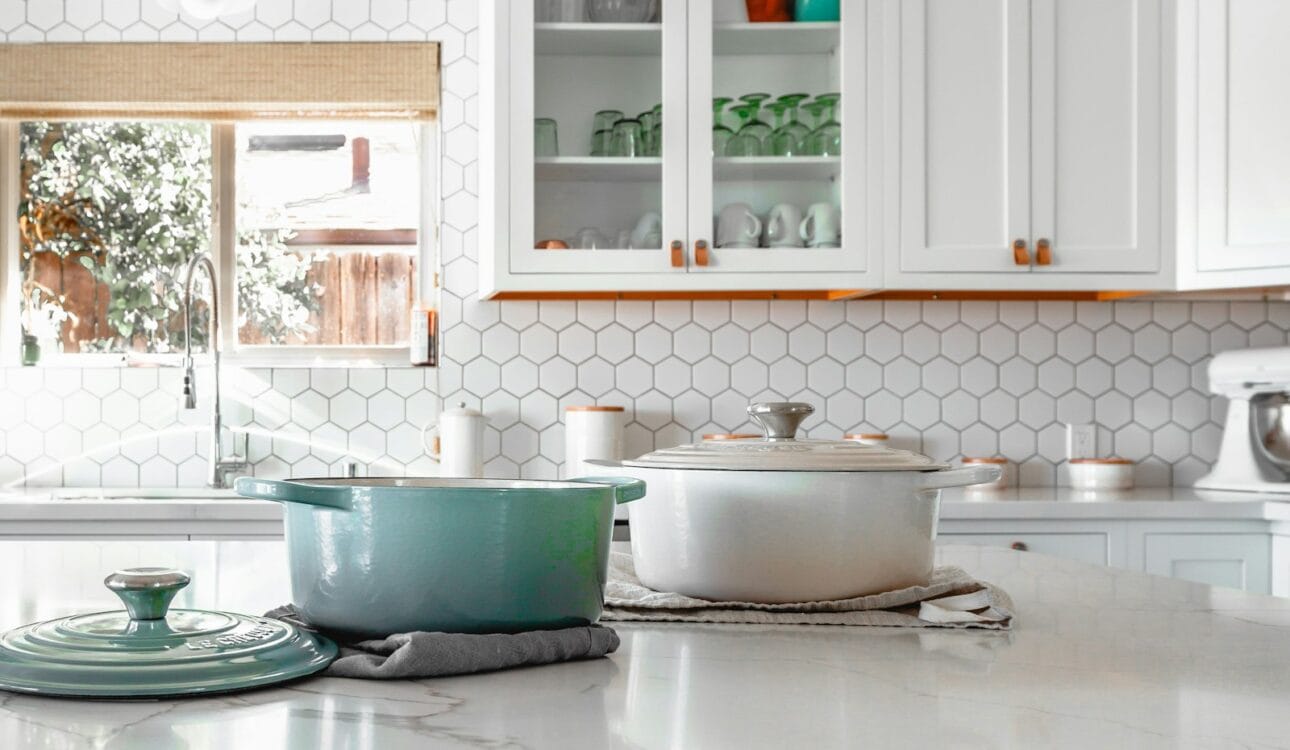
When people start looking for a new kitchen, they quickly find two very different paths. On one side are ready-made kitchens: standard cabinets in fixed sizes, sold from stock or from catalogues, often at attractive prices and with short delivery times. On the other are custom, made-to-measure kitchens: every cabinet designed and manufactured for a specific room, with the materials, colours and layout chosen by the client. Both have their place. The right choice depends on your room, your budget, your timeline and how long you plan to live with the kitchen.
This article compares the two honestly. We are a Riyadh factory that manufactures custom kitchens, so we have an obvious perspective, but we also see many clients who come to us after a ready-made kitchen did not work in their space, and others for whom a ready-made kitchen would have been perfectly adequate. Our aim is to help you understand the real differences — not only in price, but in fit, quality, flexibility, installation and long-term value — so that you can decide with confidence.
What exactly is a ready-made kitchen?
A ready-made kitchen, sometimes called a flat-pack or modular kitchen, is built from standard cabinet units in fixed widths, heights and depths. Widths typically come in steps such as 30, 40, 45, 60, 80 and 90 cm. The buyer or the seller selects units that fill the wall as closely as possible, and any remaining gaps are closed with filler panels. The units may be sold assembled or flat-packed for assembly on site. Fronts, handles and worktops are chosen from a defined range.
Ready-made kitchens are produced in large volumes, which keeps prices down and allows quick delivery from stock. Their quality ranges from very basic to good, depending on the manufacturer and the range.
What exactly is a custom kitchen?
A custom kitchen is designed for a particular room and manufactured to its exact measurements. The process usually starts with a site measurement, followed by a design tailored to the family’s needs, a 3D presentation, an itemised quotation, manufacturing in a factory, and installation by the maker’s team. Each cabinet can be any width within practical limits, and the worktop height, wall cabinet positions, materials, colours and internal accessories are chosen for the specific household.
In Saudi Arabia, the term “تفصيل مطابخ” — kitchen detailing or tailoring — describes exactly this: a kitchen tailored like a garment to its owner and space.
Fit: the biggest practical difference
Real rooms are rarely perfect rectangles. Walls lean slightly, corners are not exactly ninety degrees, columns and beams interrupt runs, windows sit at awkward heights, and pipes and drains appear where you would least want them. A custom kitchen is designed around all of this. A cabinet can be made 73 cm wide if that is what the wall allows; a column can be wrapped into a tall unit; a low window can have a specially sized cabinet beneath it.
A ready-made kitchen has to approximate. The nearest combination of standard widths is chosen, and the leftover space becomes filler panels. In a simple room this works well. In an irregular room the result can be several blank fillers, lost storage, awkward corners and a less precise look. Over the length of a whole kitchen, those lost centimetres can add up to a full cabinet’s worth of storage.
Design and personalisation
With a ready-made kitchen, you choose from what the range offers: a set of door styles, colours, handle options and worktops. That can be enough, especially if you like one of the available styles. But you cannot usually change the depth of a unit, the height of the worktop, the internal layout of a drawer stack, or the exact colour of a front outside the range.
A custom kitchen lets you decide these details. Taller family members can have a higher worktop. Older family members can have wall cabinets set a little lower and ovens at waist height. A family that cooks large meals can have extra-wide pot drawers. A coffee corner can be designed around the exact machine you own. The materials can be chosen to match the function of each zone — for example, water-resistant structures such as aluminium or saj around the sink and dishwasher, and wood or acrylic fronts where appearance matters most.
Materials and build quality
Quality varies widely in both categories, so it is better to compare specific products than categories. That said, a few patterns are common. Many entry-level ready-made kitchens use thinner boards, basic edge banding and simple hardware to keep prices low. Mid- and upper-range ready-made kitchens can be well built. Custom kitchens are made to the specification you approve, so the quality depends on the maker and on the choices in your quotation.
Whichever route you choose, ask the same questions: What is the carcass made of, and how thick is it? How are the edges sealed? Is the structure resistant to water near the sink? Which hinges and drawer runners are used, with what extension and load rating? How are wall cabinets fixed? What warranty covers the cabinets, and is it written? Our guide to kitchen materials and hardware guide explain what to look for.
The Saudi climate factor
Climate matters more than many buyers realise. Many ready-made kitchens are designed for markets with mild, stable conditions. In Saudi Arabia, kitchens face heat, dust, strong sunlight, frequent floor washing, heavy cooking with steam and grease, and — in places like Al-Ahsa — humidity. Materials that perform well in a mild European kitchen may swell near a Saudi sink or fade in strong sunlight. A local custom maker can choose structures, finishes and hardware that respond to these conditions, and can place them where they are most needed.
Price: comparing like with like
At the entry level, ready-made kitchens are usually cheaper. But comparing a basic ready-made kitchen with a well-specified custom kitchen is not a fair comparison. When you compare kitchens of similar materials, drawers, hardware and finish, the gap narrows considerably, and sometimes disappears once you account for everything a ready-made kitchen needs to fit a real room: filler panels, adaptations, extra end panels, a separate installer, and sometimes a separate designer.
The cost of a custom kitchen depends mainly on its size, materials, the number of drawers compared with doors, the internal accessories, the worktop and the hardware — not on the fact that it is made to measure. An itemised quotation lets you see each of these and adjust them to your budget, for example by choosing economical fronts such as formica or acrylic with formica while keeping quality hardware. Our pricing guide explains in detail how kitchen prices are calculated.
Time and convenience
Ready-made kitchens in stock can be delivered and installed quickly, which is useful when time is short. A custom kitchen needs measurement, design, approval and manufacturing, typically over several weeks. If you plan early — ideally during construction or before you move — the timeline is rarely a problem. The design phase can proceed while other work in the house is still under way.
Convenience also includes who is responsible. With a ready-made kitchen, the buyer often coordinates between the seller, a separate installer and other trades. With a custom kitchen from a maker who measures, designs, manufactures and installs, one company is responsible for the whole result, which simplifies problem-solving if anything needs adjustment.
Installation and finishing
A kitchen is only as good as its installation. Ready-made kitchens are sometimes installed by general handymen rather than specialist kitchen installers, and the fit to uneven walls and floors depends on their skill. Custom kitchens are designed with the room’s irregularities already accounted for and are usually installed by the maker’s own trained teams, with scribed fillers, levelled bases and precise gaps. The finishing details — end panels, plinths, ceiling details, worktop joints — are what separate a kitchen that looks built-in from one that looks assembled.
Long-term value
A kitchen is used several times a day for many years. When you divide the cost by the years of use, the difference between a kitchen that lasts and one that needs replacing early becomes significant. Durability, adjustable and replaceable hardware, water-resistant structures in the right places, and a written warranty all contribute to long-term value. A well-designed kitchen also adds appeal to a home when it is sold or rented.
When a ready-made kitchen is the right choice
- A rental property or short-term home where a long lifespan is not the priority.
- A very simple, square room whose walls match standard module widths.
- A very tight budget where speed and price outweigh fit and personalisation.
- A secondary space such as a small pantry, laundry or outdoor area.
When a custom kitchen is the right choice
- Your own home, where you will live with the kitchen for many years.
- A room with irregular walls, columns, low windows or awkward services.
- A family with specific needs: heavy cooking, frequent hosting, older members, tall members, many small appliances.
- An open kitchen that must match the living room’s style and materials.
- A wish for particular materials, colours or handleless designs outside standard ranges.
- A preference for one company to be responsible for design, manufacturing and installation.
Hybrid approaches
Some clients combine the two: a custom main kitchen designed around the family’s needs, and a simpler, more economical back kitchen or laundry. Others choose custom cabinets with standard appliances and worktops to balance cost. There is no single right answer; the aim is to invest where the kitchen is seen and used most.
Questions to ask either supplier
- Who measures the room, and is the final design based on a site measurement?
- Will I see a 3D design and drawings before manufacturing?
- What materials are the carcass, fronts and edges made of?
- Which hardware brands and models are included?
- Who installs the kitchen, and are they the supplier’s own team?
- Is the quotation itemised, and what exactly does it include?
- What is the warranty, is it written, and what does it cover?
- How are problems after installation handled?
A closer look at hidden costs
The advertised price of a ready-made kitchen often covers only the cabinet units themselves. When the kitchen reaches a real room, other costs appear. Filler panels and extra end panels are needed to close gaps and finish visible sides. Plinths, cornices and light rails may be sold separately. Worktops are often priced separately and may require a different supplier for templating and cutting. Installation, if not included, needs a separate installer, and adaptations for pipes, columns or uneven walls may be charged as extras. Appliance housings, sink cabinets with special bases, and corner solutions may cost more than the basic units shown in the catalogue. Delivery and removal of the old kitchen can add further costs.
None of these costs are unreasonable on their own, but together they can change the comparison significantly. That is why the most useful way to compare is to ask each supplier for a complete, itemised price for your specific room, including installation, worktop, fillers, end panels and any adaptations, and to compare those totals line by line.
Quality you can see and quality you cannot
In a showroom, two kitchens can look almost identical. The differences appear in places you do not see at first glance: the thickness and density of the carcass boards, the quality of the edge sealing, the fixings that hold wall cabinets, the rating of the drawer runners, the precision of the gaps, and the materials used in the sink cabinet. These are the details that decide whether doors stay aligned, drawers stay smooth, and the sink cabinet survives the first small leak. When comparing, open drawers, press on shelves, look at the back and underside of cabinets, and ask what each hidden component is made of. A reputable supplier, whether ready-made or custom, will answer these questions clearly.
Flexibility after installation
Families change, and kitchens sometimes need to change with them. A new appliance arrives, children grow, an older parent moves in, or a wall is opened to connect the kitchen with the living room. A custom maker who designed and built the kitchen can usually add or modify cabinets in matching materials, because they know the original specification and can manufacture new units to fit. With ready-made ranges, a discontinued door style or colour can make later additions difficult to match. This long-term flexibility is rarely considered at the time of purchase, but it can matter a great deal over the life of a kitchen.
What our clients usually ask us
Clients often ask whether a custom kitchen is “worth it” for an apartment, or whether it only makes sense for large villas. In our experience, the benefits of a custom kitchen are often greatest in smaller spaces, where every centimetre matters and a ready-made layout wastes a larger proportion of the room. Others ask whether custom means complicated. It does not have to: a clear process — measure, design, approve, manufacture, install — keeps decisions manageable, and a 3D design removes most of the uncertainty. And many ask whether they can see the materials before deciding. Samples, a visit to see finishes, and our virtual showroom all help you choose with confidence.
Common misconceptions about custom kitchens
“Custom always takes months.” Manufacturing time depends on the material and the size of the project, but a well-organised factory with its own production line can deliver a custom kitchen within a clear, agreed timeline. The key is that the timeline is written in the contract and that each stage — measurement, design approval, manufacturing, installation — has a defined duration.
“Custom is only for luxury projects.” Custom manufacturing covers a wide range of budgets. The price depends mainly on the material chosen, the number of units, the hardware and the worktop. A practical formica or aluminium kitchen built to measure can be very reasonable, while a large acrylic kitchen with premium accessories will cost more. What custom offers at every level is fit and control over the specification.
“Ready-made is always cheaper.” For simple, standard rooms this is often true. For rooms with columns, sloping ceilings, unusual lengths or specific storage needs, the extra fillers, adaptations and compromises can narrow the difference — and sometimes reverse it once you consider durability and lifespan.
“If I choose custom, I lose the ability to see the product first.” A detailed 3D design, physical samples of doors, worktops and handles, and a look at completed projects give you a very clear picture before anything is manufactured. You approve the design before production starts, so there are no surprises at installation.
A simple decision checklist
- Is my room a standard shape with no columns, pipes or unusual dimensions? If not, custom will usually fit better.
- Do I need specific storage — large pots, a coffee corner, a tall pantry, built-in appliances? Custom makes this easier.
- How long do I plan to use this kitchen? The longer the horizon, the more material quality and warranty matter.
- Have I compared complete, itemised prices, including installation and worktops, not just cabinet prices?
- Is the warranty written, and does it clearly state what is covered and for how long?
- Who will I call if something needs adjusting after installation?
How we build custom kitchens at Modern Palace
Since 2015 we have manufactured more than 5,000 made-to-measure kitchens in our own Riyadh factory, in seven materials: wood, tempered glass, aluminium, acrylic, formica, acrylic with formica, and saj. Every project begins with a free site measurement and a conversation about how the family lives. Our designers prepare a 3D design, you receive an itemised written quotation, and our own teams install the kitchen, backed by a written 10-year warranty. We serve Riyadh, Al-Ahsa, Buraidah and Hail. For the full process, read how to plan a new kitchen step by step and how to choose a kitchen factory.
Ready-made and custom kitchens each serve a purpose. If the kitchen is for your own home and you expect to live with it for years, the fit, durability and personalisation of a custom kitchen usually repay the extra planning. If speed and entry price are what matter most, a good ready-made kitchen can be a sensible choice. Either way, the key is to compare specifications, not labels.
Frequently asked questions
Is a custom kitchen always more expensive than a ready-made one?
Not necessarily. A basic ready-made kitchen is usually cheaper at the entry level, but once you add filler panels, adaptations, better hardware and installation, the gap narrows. A custom kitchen uses every centimetre of the wall for useful storage, and its cost depends mainly on materials, drawers, accessories and hardware rather than on the fact that it is made to measure.
When does a ready-made kitchen make sense?
For temporary homes, rental properties, very simple square rooms that match standard module sizes, or tight budgets where speed matters more than a perfect fit. It can also suit secondary spaces such as a small pantry or laundry.
What are the main advantages of a custom kitchen?
It fits the room exactly, including out-of-square walls, columns and pipes; it allows the worktop height and storage to suit your family; it gives you a free choice of materials, colours and hardware; and it usually includes professional design, measurement and installation by the same company.
How long does a custom kitchen take compared with ready-made?
Ready-made kitchens in stock can be delivered quickly. A custom kitchen needs measuring, design, approval and manufacturing, which typically takes several weeks. Planning early removes most of the time pressure.
Can a custom kitchen be installed in an existing home?
Yes. Custom kitchens are especially useful in existing homes, because they adapt to the room as it is, including irregular walls and existing services.
Does Modern Palace make custom kitchens?
Yes. We manufacture made-to-measure kitchens in our own Riyadh factory in seven materials, with free measurement, 3D design, an itemised quotation, installation by our own teams and a written 10-year warranty.
Thinking about a made-to-measure kitchen?
We measure for free, design around your room and family, and show the result in a 3D design before manufacturing in our Riyadh factory. Riyadh, Al-Ahsa, Buraidah and Hail.