
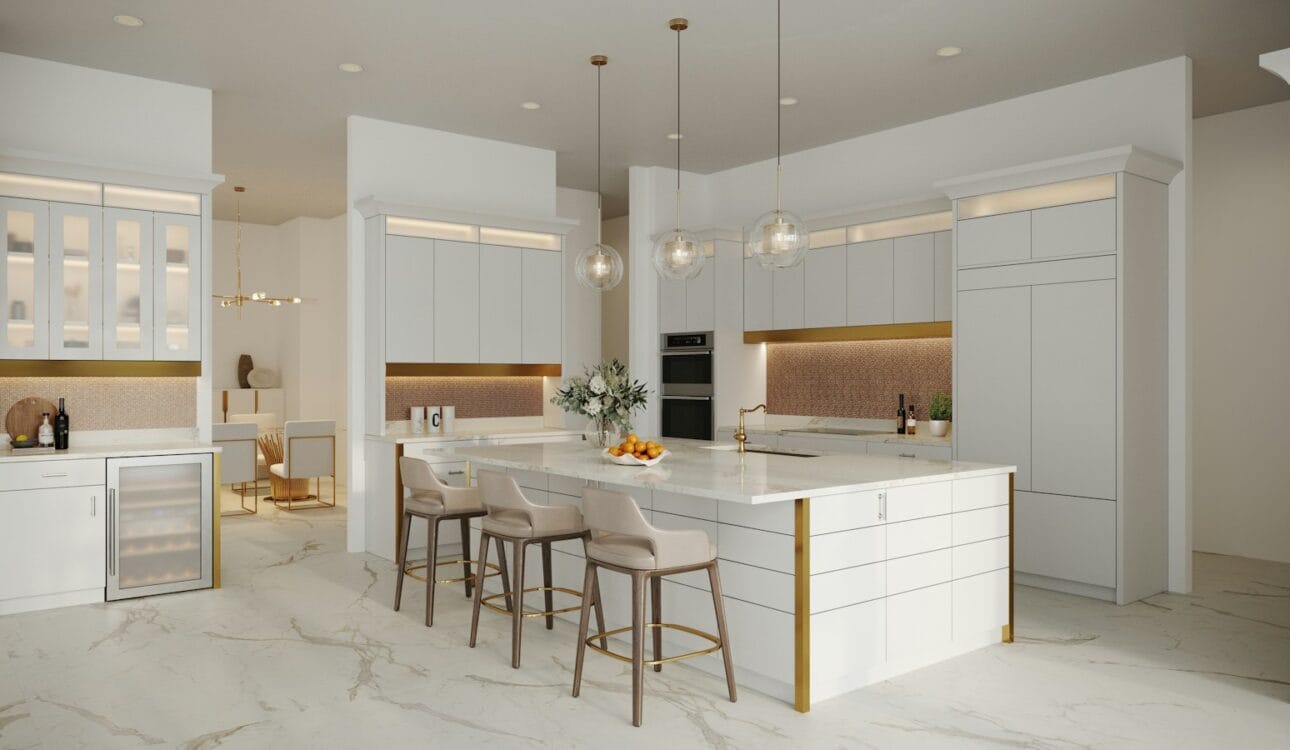
“Italian kitchen” is one of the most searched phrases among homeowners planning a new kitchen in Riyadh. For many people it means elegance, clean lines, rich materials and precise craftsmanship. But what exactly makes a kitchen “Italian” in style, and do you need to import one to get that look? In this guide we explain the design principles behind the Italian kitchen style, how it differs from other modern styles, which materials and colours create it, and how a locally manufactured custom kitchen can achieve the same design language while being built precisely for your room, your family and the Saudi climate.
At Modern Palace we have manufactured more than 5,000 custom kitchens in Riyadh since 2015. We do not sell imported Italian brands; we design and build our own kitchens in our Riyadh factory. What we can do — and what this guide focuses on — is apply the design principles that people love in Italian-style kitchens to a kitchen made to measure, with a 10-year written warranty and local after-sales service.
What is an Italian-style kitchen?
The term “Italian kitchen” is used loosely. In practice it usually refers to a contemporary European design language that became famous through Italian kitchen designers and manufacturers. Its main features are:
- Clean, architectural lines: flat or slim-frame doors, long horizontal runs, and a strong sense of proportion.
- Integrated design: appliances hidden behind matching fronts, handles integrated or minimal, and the kitchen treated as part of the interior architecture rather than a separate utility room.
- Rich but restrained materials: matte lacquers, wood veneers, stone or stone-effect worktops, glass, and metal details used with restraint.
- Attention to detail: precise gaps, aligned lines between doors and drawers, thin worktops or waterfall edges, and carefully designed internal storage.
- Harmony with living spaces: Italian-style kitchens are often designed for open-plan living, with islands and tall units that feel like furniture.
There is also a traditional or rustic side to Italian kitchens — warm wood, decorative mouldings, terracotta colours and open shelves — often described as “Tuscan” or “country Italian”. When most clients in Riyadh ask for an Italian kitchen today, however, they usually mean the contemporary style described above. We cover both in this guide.
Contemporary Italian style: key design elements
1. Proportion and horizontal lines
Contemporary Italian design pays great attention to proportion. Long, uninterrupted horizontal lines — created by drawer fronts, channel profiles and continuous worktops — make the kitchen look calm and wide. Wall cabinets are often reduced or replaced by a single run of tall units, so that the main wall remains open and elegant. When wall cabinets are used, they align precisely with the tall units and the hood.
2. Handleless or minimal handles
Many Italian-style kitchens use channel (gola) systems or push-to-open fronts, or very slim profile handles. The goal is to let the material and colour of the doors speak. Our handleless kitchens guide explains the systems in detail.
3. Tall unit walls
A wall of tall units that houses the fridge, ovens, microwave, pantry and sometimes a coffee station is a signature element. It concentrates storage in one place, hides appliances behind matching doors, and leaves the rest of the kitchen open.
4. The island as the centrepiece
In open-plan homes, the island is the heart of an Italian-style kitchen. It may hold the hob or sink, or serve as a preparation and social space. Waterfall edges — where the worktop material continues down the sides of the island to the floor — are a popular detail. See our kitchen island guide for dimensions and clearances.
5. Thin, strong worktops
Slim worktops in quartz, porcelain or stone-effect materials give a refined look. Some designs match the worktop with the splashback for a continuous surface. Our worktops comparison explains the options and their durability.
6. Integrated lighting
LED strips under wall units, inside channels, in open niches and inside tall units highlight the architecture of the kitchen and provide practical task lighting. Lighting is designed together with the cabinets, not added afterwards.
Colours of the Italian-style kitchen
Italian-style kitchens are known for sophisticated, balanced colour palettes rather than bright contrasts. Common directions include:
- Warm neutrals: greige, sand, cashmere, taupe and soft beige, often in matte finishes. These colours feel calm and timeless and suit both modern and classic interiors.
- Deep, elegant tones: anthracite, graphite, charcoal, dark olive, deep blue and bronze. Dark kitchens look luxurious, especially when combined with light worktops or warm wood.
- Wood and wood-effect finishes: oak, walnut and similar tones are used on islands, tall units or open shelves to add warmth to minimal designs.
- White and off-white: matte white or ivory kitchens with stone-effect worktops remain popular for bright, spacious rooms.
- Metal accents: champagne, bronze, black or brushed steel details on profiles, handles, shelves and taps.
The key is balance. A typical Italian-style palette uses one main colour for most of the cabinets, a second material for the island or tall units, and a worktop that ties them together. Too many colours or finishes break the calm, architectural feeling that defines the style.
Materials that create the Italian look
You do not need exotic imported materials to create an Italian-style kitchen. What matters is choosing finishes with the right texture and applying them with precision. Among the materials we manufacture:
- Acrylic in matte or high-gloss finishes is excellent for the smooth, flat fronts typical of contemporary Italian design. Matte acrylic in greige, anthracite or deep colours is particularly close to the look of Italian lacquered kitchens.
- Wood gives warmth and works beautifully on islands, tall units or as a contrast to painted fronts.
- Tempered glass fronts, especially in matte or tinted glass, create a refined, reflective finish and are often used on wall units or display cabinets with internal lighting.
- Formica offers a wide range of textures, including wood and stone effects, with high durability — a practical way to achieve a premium look on a controlled budget.
- Acrylic with formica allows a mix of finishes, for example acrylic on visible fronts and formica on working areas.
- Aluminium frames and profiles contribute to the precise, architectural details that define the style, and aluminium is very practical in humid areas.
Layouts that suit the Italian style
Italian-style design works best when the layout is simple and ordered. The most typical layouts are:
- One-wall kitchen with island: a clean wall of base units and tall units, with an island in front. This is the most iconic Italian open-plan layout.
- Tall unit wall plus island: all storage and appliances in one tall wall, with the island holding the hob or sink. The rest of the room stays open.
- L-shaped kitchen with island: a practical choice for family homes, combining generous storage with a social island.
- Parallel layout: one run of tall units facing a run of base units or an island; very efficient and visually symmetrical.
Our kitchen layouts guide explains dimensions and walkway widths for each layout.
Traditional (classic) Italian kitchens
Not every Italian kitchen is minimal. The classic Italian style — sometimes called country or Tuscan — uses framed or raised-panel doors, decorative cornices, warm wood tones, cream or ivory paint, open shelves, and ornate handles in brass or aged metal. Worktops are often stone or stone-effect, and range hoods may be designed as decorative features. This style suits villas with classic interiors and families who prefer a warm, traditional atmosphere.
Classic Italian kitchens need careful proportion so that the decoration does not feel heavy. In Riyadh homes, a popular approach is a “modern classic” or neoclassical kitchen: simple framed doors, refined mouldings and elegant handles combined with modern appliances and practical storage. Our modern vs classic kitchen guide compares the two styles in more detail.
Imported Italian kitchen or locally made Italian-style kitchen?
Some homeowners consider importing a kitchen from an Italian brand. This can be a valid choice for certain projects, but it is worth understanding the practical differences before deciding:
| Factor | Imported brand kitchen | Locally made custom kitchen in Italian style |
|---|---|---|
| Fit to the room | Modular sizes adapted to the room, with fillers where needed | Manufactured to the exact measurements of your room |
| Lead time | Includes international shipping and customs | Manufactured locally within an agreed timeline |
| After-sales service | Depends on the local distributor and spare-parts availability | Direct service from the factory that made the kitchen |
| Changes and additions later | May require ordering and shipping new units | New units manufactured locally in matching materials |
| Adaptation to local use | Designed for European cooking habits | Designed for Saudi family cooking, large pots, coffee corners and back kitchens |
| Warranty | Varies by brand and distributor | 10-year written warranty at Modern Palace |
The honest conclusion is that the “Italian look” is a design language, not a place of manufacture. With the right materials, precise manufacturing and careful design, a custom kitchen made in Riyadh can achieve the same clean lines and refined details, while fitting your room exactly and being supported locally for years.
Adapting Italian style to Saudi homes
Italian-style kitchens were originally designed around European cooking, which is often lighter and uses smaller cookware. Saudi homes have different needs, and a good design adapts the style without losing its elegance:
- Stronger ventilation: Saudi cooking often involves frying, grilling and slow cooking with strong aromas. An elegant integrated hood must still be powerful enough, with a short duct to the outside. See our ventilation guide.
- Larger drawers: big pots and trays for family meals need wide, deep drawers with high-capacity runners, even in a minimal design.
- A second kitchen: many villas combine an Italian-style show kitchen in the open living area with a practical back kitchen for heavy cooking. This lets the open kitchen stay clean and elegant.
- Coffee and tea corner: a dedicated coffee station inside a tall unit with pocket doors fits the Italian style perfectly and keeps the hospitality area tidy.
- Climate and dust: matte finishes and closed storage reduce visible dust, and materials must handle heat from strong sunlight.
Budget: where to invest in an Italian-style kitchen
An Italian-style kitchen does not have to be the most expensive option. The look depends more on design and precision than on the price of each component. If you need to balance the budget, invest first in:
- Precise manufacturing and installation — even gaps and aligned lines are the essence of the style.
- Quality hardware — soft-close hinges and high-capacity drawer runners that keep doors aligned for years. See our hinges and runners guide.
- The worktop — a refined worktop lifts the entire kitchen.
- The most visible fronts — use premium finishes on the island and the tall unit wall, and more practical finishes on less visible areas.
- Lighting — integrated LED lighting adds a premium feel at a relatively modest cost.
Italian style in apartments and small kitchens
The Italian look is not only for large villas. In fact, its principles — fewer visual interruptions, integrated appliances and a limited palette — are ideal for small kitchens. In an apartment, a one-wall kitchen with a column of tall units at one end, handleless base units and a slim worktop can look elegant and spacious. Light matte colours such as ivory, sand or light greige reflect light and make the room feel larger, while a single wood-effect element adds warmth. Wall cabinets can be taken up to the ceiling with flat fronts so that they read as a single calm surface. If there is space for a small island or a peninsula, it can double as a breakfast counter and connect the kitchen to the living area.
Worktop and splashback choices
The worktop and splashback play a major role in the Italian look. A continuous surface where the splashback uses the same material as the worktop creates a seamless, architectural effect, especially behind the hob and sink. Thin worktops in quartz or porcelain give a refined profile, while thicker stone-effect edges suit more classic designs. On islands, a waterfall edge that continues down to the floor emphasises the island as a sculptural piece. When choosing, consider not only appearance but also resistance to heat, stains and scratches, because Saudi cooking often involves hot pots, spices and oils. Always look at a large sample under your own kitchen lighting before deciding, as veining and colour can look very different from small swatches.
Designing the island
For many families, the island is where the Italian style is most visible. A few design decisions make a big difference: the height of the seating area and the overhang for knees; whether the hob or sink sits on the island, which affects ventilation and plumbing; the finish of the back panel facing the living room; integrated sockets for small appliances and phone charging; and storage on both sides where space allows. Pendant lights above the island should be sized and spaced in proportion to its length. When these details are planned together, the island becomes both the social heart of the home and a highly practical workspace.
A step-by-step approach to planning your Italian-style kitchen
- Collect references: save images of kitchens you like and note what attracts you — the colour, the lines, the island, the lighting or the materials.
- Define your daily needs: how many people cook, how often, what you cook, and whether you need a separate back kitchen.
- Measure precisely: the Italian look depends on proportion, so exact measurements of walls, ceiling height, windows and columns are essential.
- Choose a limited palette: one main colour, one accent material and one worktop.
- Plan storage and appliances together: decide which appliances will be integrated and where the tall unit column will stand.
- Review the 3D design carefully: check the alignment of lines, the island proportions, and the view from the living area.
- Confirm everything in writing: materials, hardware, worktop, lighting, timeline and warranty.
Following these steps keeps the project focused on the qualities that make the style work, and avoids expensive changes after manufacturing has begun.
It also helps to involve every family member who uses the kitchen regularly in reviewing the design. Someone who bakes will notice different needs from someone who prepares coffee for guests or cooks large family meals, and small adjustments at this stage — a deeper drawer, a higher oven, an extra socket on the island — make the finished kitchen feel truly made for your household.
Details that make the difference
- Aligned lines: the tops of tall units, wall cabinets and the hood should align; drawer lines should continue across the run.
- Even gaps: consistent gaps of a few millimetres between all doors and drawers.
- Finished sides: visible side panels, island backs and end panels in the same material as the fronts.
- Thoughtful internal storage: internal drawers, cutlery organisers, pull-out pantry systems and corner solutions. See our storage accessories guide.
- Integrated sockets and lighting: pop-up or hidden sockets on the island, LED strips in niches, and sensors inside tall units.
- Hidden appliances: integrated fridge, dishwasher and ovens aligned in a column.
- Quiet materials: matte finishes, fine textures and restrained metal accents.
Common mistakes when aiming for an Italian look
- Too many materials and colours: mixing four or five finishes breaks the calm, unified look. Two or three well-chosen materials are enough.
- Ignoring proportion: an island that is too big or tall units that are too small for the ceiling height will make the kitchen feel unbalanced.
- Choosing appearance over function: a beautiful hood that cannot extract strong cooking smells, or elegant drawers that are too shallow for large pots, will cause daily frustration.
- Neglecting lighting: without integrated lighting, even the best materials can look flat.
- Imprecise installation: uneven gaps and misaligned doors are immediately visible in a minimal design.
How we design Italian-style kitchens
Our process begins with a free site visit to measure the room precisely and understand how your family cooks and entertains. We then prepare a free 3D design that shows the proportions, lines, colours and materials, often with a comparison between two or three palettes. Once you approve the design, we confirm the materials, hardware, worktop and lighting, and provide a detailed quotation with a clear timeline. The kitchen is manufactured in our Riyadh factory and installed by our own team, with every door and drawer adjusted for even gaps. Every kitchen comes with a 10-year written warranty, and we serve Riyadh, Al-Ahsa, Buraidah and Hail. Browse examples in our virtual showroom.
Summary
The Italian-style kitchen is defined by proportion, clean lines, integrated appliances, refined materials and precise details. It suits open-plan homes especially well, and it can be adapted to Saudi cooking habits with stronger ventilation, larger drawers and a separate back kitchen. You do not need to import a kitchen to achieve the look: a well-designed custom kitchen, made precisely for your room and supported locally, can deliver the same elegance with the practicality your family needs.
Frequently asked questions
What makes a kitchen Italian in style?
Contemporary Italian-style kitchens are defined by clean architectural lines, flat or slim-frame doors, integrated or minimal handles, hidden appliances, refined materials such as matte lacquer, wood and stone-effect worktops, and precise details.
Do I need to import an Italian kitchen to get the look?
No. The Italian look is a design language. A custom kitchen made locally with the right materials and precise manufacturing can achieve the same style while fitting your room exactly and being supported by local after-sales service.
Which colours suit Italian-style kitchens?
Warm neutrals such as greige and sand, deep tones such as anthracite and dark olive, wood finishes, and matte white are all popular. The key is to limit the palette to two or three coordinated finishes.
Is an Italian-style kitchen practical for Saudi cooking?
Yes, if the design is adapted with strong ventilation, deep drawers for large pots, and ideally a separate back kitchen for heavy cooking.
Which material is closest to Italian lacquered kitchens?
Matte acrylic is one of the closest options to the smooth, flat look of Italian lacquered fronts, and it is available in many contemporary colours.
Want an Italian-style kitchen made for your room?
Book a free measurement and 3D design, and see your kitchen in the colours and materials you are considering before anything is built.