
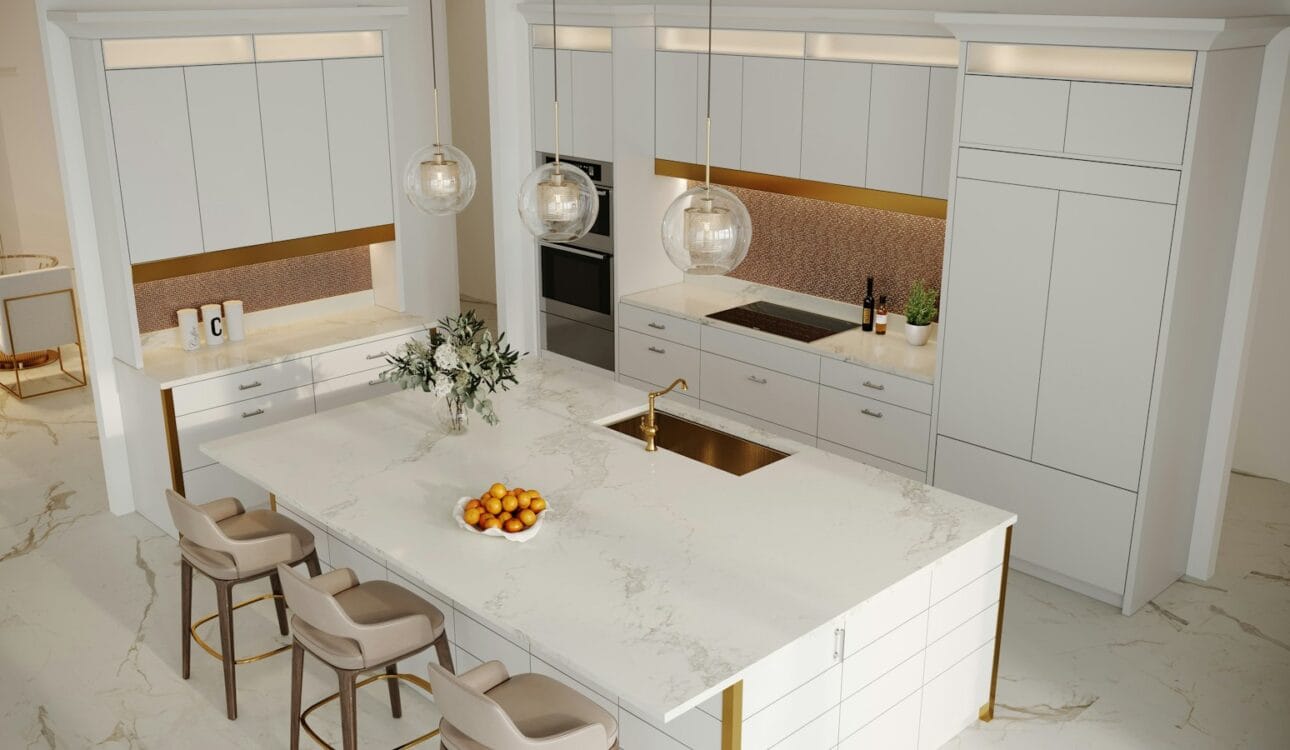
One of the first style decisions in any kitchen project is whether to go modern or classic. Modern kitchens are known for clean lines, flat doors and minimal decoration; classic kitchens for framed doors, mouldings, decorative handles and a warm, traditional character. Between the two lies a popular middle ground — the neoclassical or “modern classic” kitchen — that blends elements of both. Each style has its strengths, and the right choice depends on the architecture and interior of your home, your family’s taste and lifestyle, your budget and how you want the kitchen to feel for years to come. This guide compares the styles in detail and helps you decide.
At Modern Palace we have designed and manufactured more than 5,000 custom kitchens in Riyadh since 2015, in modern, classic and neoclassical styles, using wood, tempered glass, aluminium, acrylic, formica, acrylic with formica and saj.
What defines a modern kitchen?
- Flat or slab doors with no raised panels or mouldings.
- Minimal handles: handleless channels, push-to-open or slim bar handles. See our handleless kitchens guide.
- Clean horizontal lines and a focus on proportion.
- Smooth finishes: high gloss or matte acrylic, lacquer-like surfaces, glass, stone-effect and wood-effect laminates.
- Integrated appliances hidden behind matching fronts.
- Restrained colour palettes: white, grey, greige, black, deep tones and wood accents.
- Integrated LED lighting under cabinets and inside niches.
What defines a classic kitchen?
- Framed doors: raised or recessed panels, sometimes with decorative profiles.
- Decorative details: cornices, pilasters, corbels, turned legs on islands and moulded plinths.
- Traditional handles: knobs, cup handles or ornate pulls in brass, bronze, antique or chrome finishes.
- Warm materials: wood, painted wood-effect finishes, stone or stone-effect worktops.
- Soft, traditional colours: cream, ivory, off-white, soft greys, sage green, navy and natural wood.
- Feature hoods: a decorative hood canopy is often the centrepiece.
- Glass-fronted cabinets with mullions to display china.
The neoclassical (modern classic) kitchen
Neoclassical kitchens are very popular in Riyadh homes because they combine the elegance of classic design with the practicality of modern kitchens. Typical features include simple framed doors (often called shaker-style), fine mouldings instead of heavy decoration, elegant handles in brushed brass, bronze or black, soft or deep colours, stone-effect worktops, and modern integrated appliances. The result feels timeless and refined without being heavy. This style suits villas with classic or transitional interiors, and it pairs well with majlis spaces decorated in traditional styles.
Modern vs classic: side-by-side comparison
| Aspect | Modern | Classic | Neoclassical |
|---|---|---|---|
| Doors | Flat, slab | Framed, raised panels | Simple framed (shaker) |
| Handles | Handleless or slim bars | Knobs, ornate pulls | Elegant bars or cup handles |
| Decoration | Minimal | Cornices, pilasters, corbels | Fine mouldings |
| Colours | White, grey, black, deep tones | Cream, ivory, wood, soft colours | Soft neutrals, sage, navy |
| Materials | Acrylic, glass, formica, aluminium | Wood, painted finishes | Wood, formica, painted-look finishes |
| Cleaning | Very easy — flat surfaces | More effort — grooves and details | Moderate |
| Feeling | Sleek, spacious, contemporary | Warm, traditional, rich | Timeless, elegant |
Match the kitchen to your home’s architecture
The most important rule is harmony with the rest of the home. A kitchen that clashes with the architecture and interior will always feel out of place, especially in open-plan layouts. Consider:
- Contemporary villas and apartments with clean lines, large windows and minimal interiors usually suit modern kitchens.
- Villas with classic interiors — decorative ceilings, mouldings, traditional furniture and chandeliers — suit classic or neoclassical kitchens.
- Transitional interiors that mix modern and traditional furniture suit neoclassical kitchens particularly well.
- Open kitchens must match the living area; closed kitchens give more freedom to choose a different style.
- Back kitchens are often simpler and more practical, even when the front kitchen is classic.
Lifestyle and practicality
Beyond appearance, each style has practical implications:
- Cleaning: flat modern doors are the easiest to wipe. Framed and moulded classic doors have grooves where dust and grease can collect, which requires more attention — especially in Riyadh’s dusty climate and in kitchens with heavy cooking.
- Durability: both styles can be very durable with quality materials and hardware; the difference lies more in materials than in style.
- Children: rounded, simple profiles are safer and easier to clean in busy family kitchens. See our family kitchen guide.
- Storage: both styles can include the same internal accessories; modern kitchens often use more drawers and handleless systems, while classic kitchens often feature display cabinets.
- Timelessness: classic and neoclassical kitchens change slowly with fashion; very trendy modern colours may date faster, while neutral modern kitchens remain timeless.
Materials for each style
Modern
- Acrylic in gloss or matte for smooth, seamless fronts. See our gloss vs matte guide.
- Tempered glass for a reflective, contemporary finish.
- Formica with modern textures and colours.
- Aluminium profiles for architectural details.
Classic and neoclassical
- Wood for authentic warmth, mouldings and carved details.
- Formica in wood or painted-look finishes for a practical classic look.
- Acrylic with formica for neoclassical designs combining refined fronts with durable working areas.
- Glass inserts in framed display cabinets.
Colour choices by style
- Modern: white, off-white, light and dark greys, greige, anthracite, black, navy, olive, and wood accents. Two-tone combinations are popular.
- Classic: cream, ivory, antique white, warm wood tones, soft blue, sage green and deep navy, with brass or bronze accents.
- Neoclassical: soft neutrals, dusty greens and blues, taupe, and navy with brushed brass or black handles.
Our kitchen decor ideas guide explains how to build a balanced colour palette.
Handles and hardware
Handles are one of the quickest ways to shift a kitchen’s style. Slim bar handles or handleless systems push the kitchen towards modern; cup handles and knobs in brass or antique finishes push it towards classic. In neoclassical kitchens, elegant bar handles in brushed brass or matte black on shaker doors create a refined balance. Whatever the style, choose handles that feel comfortable in the hand and hardware — hinges and drawer runners — of good quality. See our hinges and runners guide.
Worktops, splashbacks and sinks by style
- Modern: thin quartz or porcelain worktops, continuous splashbacks in the same material or glass, undermount or integrated sinks, and minimalist taps.
- Classic: thicker stone or stone-effect worktops with profiled edges, tiled splashbacks (for example subway or patterned tiles), ceramic or farmhouse sinks and traditional bridge taps.
- Neoclassical: stone-effect worktops with simple edges, marble-look splashbacks, undermount sinks and elegant taps in brass or matte black.
See our worktops comparison and sink guide for details.
Lighting by style
Modern kitchens favour integrated, hidden lighting: LED strips under wall cabinets, inside channels and niches, and minimal pendant lights. Classic kitchens often feature decorative pendants, lanterns or small chandeliers over the island, with warm light and visible fixtures that are part of the decor. Neoclassical kitchens combine hidden task lighting with elegant pendants in brass or black. In all styles, task lighting over the worktop is essential for safe food preparation. Our lighting guide explains how to plan it.
Cost considerations
Style itself does not determine cost as much as materials, hardware and complexity. That said, classic kitchens with solid wood, carved details, cornices, pilasters and decorative hoods usually require more materials and craftsmanship, which increases cost. Modern kitchens with simple flat doors can be economical, but premium finishes such as high-gloss acrylic, handleless channel systems and integrated lighting also add cost. Neoclassical kitchens often fall in the middle. The best way to compare is through detailed quotations for your specific design. See our guide to comparing quotes.
Mixing styles successfully
Some of the most attractive kitchens mix modern and classic elements — for example, flat modern cabinets with a classic stone-effect worktop and a vintage-inspired pendant, or shaker doors with sleek integrated appliances and minimal lighting. To mix successfully:
- Choose one dominant style and use the other as an accent.
- Keep the colour palette simple and consistent.
- Repeat metal finishes across handles, taps and lighting.
- Use contrasting elements intentionally — for example, a classic island in a modern kitchen — rather than randomly.
Italian, Arabic-inspired and other styles
Beyond modern and classic, many clients ask for specific style influences. Italian-style kitchens are usually a refined form of modern design, with careful proportions, integrated appliances and rich matte finishes; see our Italian-style kitchens guide. Arabic-inspired kitchens may add geometric patterns, warm earthy colours, brass accents and a dedicated coffee corner to either a modern or classic base; see our coffee corner guide. Industrial kitchens use dark colours, metal and exposed lighting. Scandinavian-inspired kitchens use light wood, white and simple forms. These influences can all be expressed through custom design.
Which style suits which family?
A modern kitchen may suit you if:
- Your home has a contemporary design with clean lines.
- You prefer minimal decoration and easy cleaning.
- Your kitchen is open to the living area and you want it to look like sleek furniture.
- You enjoy integrated technology and hidden appliances.
- Your kitchen is small and you want it to feel spacious.
A classic kitchen may suit you if:
- Your villa has traditional or classic interiors with mouldings and ornate details.
- You love warm, rich materials such as wood and decorative hardware.
- You want a kitchen that feels inviting and traditional.
- You enjoy displaying fine china and serving pieces.
A neoclassical kitchen may suit you if:
- You want elegance without heaviness.
- Your interior mixes modern and traditional elements.
- You want a timeless kitchen that will not look dated.
- You like the idea of framed doors but prefer simpler cleaning than ornate classic designs.
Common mistakes when choosing a style
- Following trends blindly: choose what suits your home and taste, not only what is popular on social media.
- Ignoring the rest of the home: an ultra-modern kitchen in a very classic villa, or vice versa, can feel disconnected — unless the contrast is planned carefully.
- Over-decorating classic kitchens: too many mouldings, colours and ornaments make the kitchen feel heavy and hard to clean.
- Making modern kitchens feel cold: without warm materials, textures and lighting, a modern kitchen can feel sterile. Add wood tones, warm light or textured finishes.
- Choosing style before function: the layout, storage and workflow must work first; style is applied on top. See our kitchen layouts guide.
Style and the long term
A kitchen is expected to last many years, so think about how your chosen style will age. Neutral modern kitchens and restrained neoclassical kitchens tend to remain attractive for a long time. Highly fashionable colours or very ornate details may feel dated sooner. One strategy is to keep the cabinets and worktop timeless and express current trends through elements that are easier to change later: handles, lighting fixtures, stools, accessories and wall colours.
Doors in detail: slab, shaker and raised panel
The door style is the single most visible difference between modern and classic kitchens, so it helps to understand the main types. Slab doors are completely flat, with no frame or panel; they are the basis of modern design and work with any finish, from high gloss to wood grain. Shaker doors have a simple flat frame around a recessed centre panel; they are the classic choice for neoclassical and transitional kitchens because they add depth without heavy decoration. Raised-panel doors have a centre panel that is shaped or raised, often with decorative profiles on the frame; they give a rich, traditional look suited to classic interiors. Slim-frame doors — with a narrow frame, sometimes in aluminium, around a panel or glass — are a contemporary take on framed doors that sits comfortably in modern and Italian-style kitchens. When choosing, look at how light falls on each door type: framed doors create shadows and depth, while slab doors show colour and finish more purely.
Islands in modern and classic kitchens
The island often expresses the kitchen style most strongly. In modern kitchens, islands are usually clean-lined blocks, sometimes with waterfall worktop edges, integrated seating and minimal pendant lights. In classic kitchens, islands may look like pieces of furniture, with turned legs, decorative panels, corbels supporting the worktop overhang and a contrasting colour or wood finish. Neoclassical islands combine simple framed panels with elegant proportions and refined lighting. Whatever the style, the island must still meet practical requirements: adequate walkways, comfortable seating overhang and suitable storage. See our kitchen island guide.
Hoods as style statements
The range hood can reinforce the chosen style. Modern kitchens often use integrated or ceiling hoods that almost disappear, or sleek glass and stainless designs. Classic kitchens frequently feature a decorative canopy that becomes the focal point of the cooking wall, sometimes clad in the same material as the cabinets with mouldings. Neoclassical kitchens may use a simple, boxed canopy with a fine moulding. In all cases the hood must provide strong extraction for Saudi cooking; appearance should never come at the expense of performance. Our ventilation guide explains what to look for.
Style for the back kitchen
When a home has both a front and a back kitchen, the two do not need to share the same style. The front kitchen, visible to family and guests, can express the chosen style fully — modern, classic or neoclassical. The back kitchen, designed for heavy cooking, benefits from a simpler, more practical design: flat or simple framed doors that are easy to clean, durable materials such as aluminium or saj, and robust hardware. To keep the home coherent, repeat one or two elements from the front kitchen, such as the colour family or the handle finish. This approach gives you elegance where it is seen and practicality where it is needed.
Style and small kitchens
In small kitchens, style choices have a bigger visual impact. Modern designs with flat, light-coloured doors, integrated handles and wall cabinets up to the ceiling usually make a small room feel larger. Classic designs can also work in small spaces if the decoration is kept light: simple shaker doors in a soft colour, slim mouldings, and a few elegant handles rather than heavy cornices and ornate details. Glass-fronted wall cabinets add depth in both styles. Whatever style you choose, good lighting and a limited colour palette are the keys to making a compact kitchen feel open and inviting.
In every case, the best style is the one that makes you feel at home each time you walk into the kitchen.
A quick style checklist
- Look at your home’s architecture and main living areas: are they modern, classic or transitional?
- Decide whether the kitchen will be open to the living area or closed.
- Consider how much time you want to spend cleaning details and grooves.
- Choose a door style — slab, shaker, raised panel or slim frame — that fits your answers.
- Select a colour palette of two or three coordinated tones.
- Pick handles and metal finishes that reinforce the style.
- Choose a worktop, splashback, sink and lighting that complete the look.
- Review the full design in 3D and adjust until it feels right.
Working through these questions with your designer turns a general preference into a clear, coherent kitchen style.
Remember that there is no single correct answer. Many beautiful kitchens in Riyadh are modern, many are classic, and many sit happily in between. What matters is that the style is chosen intentionally, executed with quality materials and precise craftsmanship, and planned around the way your family actually lives and cooks every day.
If you are still undecided, start by collecting images of kitchens you love and look for the features they share — the answer is often already there.
Bring those images to your design consultation, and the designer can help translate them into a style that fits your room.
Seeing both styles before you decide
Many clients are unsure until they see their own kitchen in both styles. A 3D design can show the same layout with flat modern doors and with framed neoclassical doors, in the colours and materials you are considering. Seeing the options side by side, in your own room dimensions, often makes the choice clear. It is also helpful to look at completed kitchens in both styles and to hold real door samples, because the depth of a framed door and the smoothness of a flat door are best appreciated in person.
How we design modern and classic kitchens
We begin with a free site visit to measure your room and understand the style of your home and your family’s needs. In the free 3D design we can show your kitchen in modern, classic or neoclassical style — or a thoughtful mix — with the materials, colours, handles and lighting you prefer. Once approved, the kitchen is manufactured in our Riyadh factory and installed by our own team, with a 10-year written warranty. We serve Riyadh, Al-Ahsa, Buraidah and Hail. Browse examples of different styles in our virtual showroom.
Summary
Modern kitchens offer clean lines, easy cleaning and a spacious, contemporary feel; classic kitchens offer warmth, richness and traditional elegance; neoclassical kitchens combine the refinement of classic design with the practicality of modern kitchens. Choose the style that harmonises with your home, suits your daily life and will still feel right in ten years. And remember that a custom kitchen lets you blend styles thoughtfully, so the result reflects your taste rather than a catalogue.
Frequently asked questions
What is the difference between a modern and a classic kitchen?
Modern kitchens use flat doors, minimal or hidden handles, smooth finishes and clean lines. Classic kitchens use framed doors, mouldings, decorative handles, warm materials and traditional colours.
What is a neoclassical kitchen?
A neoclassical or modern classic kitchen combines simple framed doors and fine mouldings with modern appliances and practical storage, creating a timeless, elegant look without heavy decoration.
Which kitchen style is easier to clean?
Modern kitchens with flat doors are the easiest to clean. Classic kitchens with grooves and mouldings need more attention to remove dust and grease.
Is a classic kitchen more expensive than a modern one?
Classic kitchens with solid wood and many decorative details usually cost more, but premium modern finishes and systems can also be expensive. The final cost depends on materials, hardware and design complexity.
Can I mix modern and classic styles?
Yes. Choose one dominant style and use the other as an accent, keep the colour palette simple, and repeat metal finishes consistently.
Not sure whether modern or classic suits your home?
Book a free measurement and 3D design, and see your kitchen in both styles before deciding.