
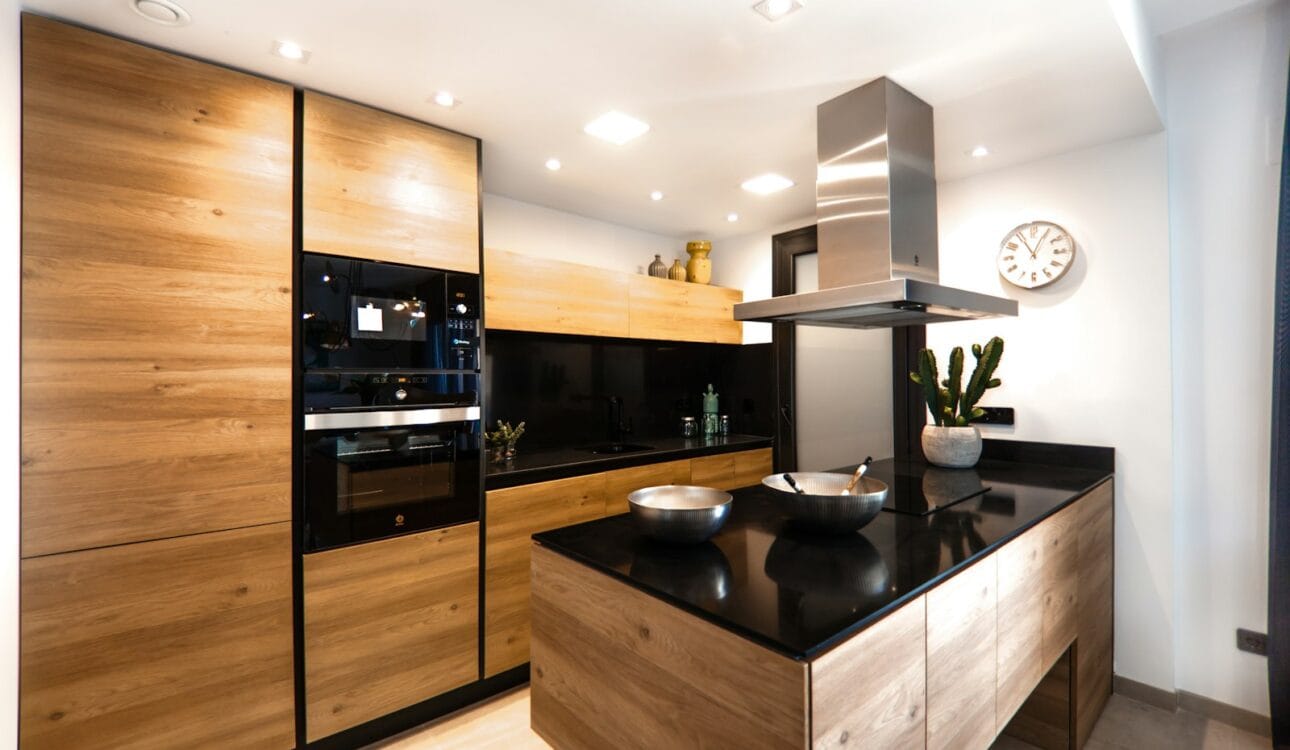
Once you have chosen the material and colour of your kitchen cabinets, one more decision has a surprisingly large effect on how the kitchen looks and feels every day: the finish. Should the doors be high gloss, reflecting light like glass, or matte, with a soft, velvety surface? Both finishes can look beautiful, and both have practical advantages and drawbacks. The right choice depends on your room, your lighting, your family’s habits and the style you want. This guide compares gloss and matte finishes honestly — appearance, fingerprints, scratches, cleaning and durability — and explains how to decide, including options that combine both.
At Modern Palace we manufacture kitchens in seven materials, and finishes such as gloss and matte are available in several of them, particularly acrylic and formica. We regularly help clients choose between the two by comparing real samples in their own lighting.
What do gloss and matte mean?
High gloss finishes have a smooth, highly reflective surface. Light bounces off the doors, creating reflections and a sense of depth. Gloss finishes are strongly associated with modern and contemporary kitchens.
Matte finishes have a low-reflection surface that diffuses light. Colours look soft and even, and the surface has a calm, understated appearance. Matte finishes suit modern, minimal, Italian-style and warm contemporary kitchens. There are also intermediate finishes — sometimes called satin or semi-gloss — and “super-matte” finishes with an especially soft, velvety touch.
Appearance and atmosphere
Gloss
- Reflects light, making the kitchen feel brighter and more spacious — especially useful in small or dim kitchens.
- Colours appear more intense and vibrant.
- Creates a sleek, dramatic, modern look.
- Reflections can emphasise the kitchen’s lines and make it look larger.
Matte
- Absorbs and diffuses light, creating a calm, sophisticated atmosphere.
- Colours look softer and more refined, particularly deep tones such as navy, olive, anthracite and greige.
- Suits minimal, Italian-style and warm modern designs. See our Italian-style kitchens guide.
- Pairs beautifully with natural textures such as wood and stone.
Fingerprints and marks
This is often the deciding factor for families. Gloss surfaces show fingerprints, smudges and water spots more clearly, especially on dark colours and around handles or push-to-open areas. Matte surfaces hide fingerprints better in general, although some matte finishes can show greasy marks if touched with oily hands, and very dark matte colours may show residues. Many modern matte finishes include anti-fingerprint technology that significantly reduces visible marks. If you have young children or a busy family kitchen, matte or anti-fingerprint finishes are usually easier to live with. Our family kitchen guide discusses durable choices in more detail.
Scratches and wear
Fine scratches are more visible on high gloss surfaces, because they interrupt the reflection. Over years of use, gloss doors in busy areas may show small swirl marks from cleaning. Matte finishes tend to hide fine scratches better. However, some matte finishes can develop shiny spots (“burnishing”) if rubbed repeatedly in the same place, for example around frequently touched areas. Quality varies considerably between products, so ask about scratch resistance and the availability of repair methods for the specific finish you choose.
Cleaning and care
- Gloss: easy to wipe, but needs a soft microfibre cloth and gentle cleaners to avoid streaks and micro-scratches. Drying after cleaning prevents water marks.
- Matte: clean with a soft, damp cloth and mild detergent. Avoid abrasive pads and polishing products, which can create shiny patches. Wipe grease promptly, especially near the hob.
For both finishes, avoid strong solvents, bleach-based products and abrasive powders. Our cleaning and care guide gives a detailed routine.
Gloss vs matte: quick comparison
| Factor | High gloss | Matte |
|---|---|---|
| Light reflection | High — brightens the room | Low — calm, soft look |
| Colour appearance | Vivid, intense | Soft, refined |
| Fingerprints | More visible | Less visible, especially anti-fingerprint types |
| Fine scratches | More visible | Less visible; possible shiny spots if over-rubbed |
| Cleaning | Easy wipe, prone to streaks | Easy wipe, avoid polishing |
| Best room type | Small, dim or compact kitchens | Bright, spacious or open-plan kitchens |
| Style | Sleek, bold, contemporary | Minimal, sophisticated, warm modern |
How lighting affects your choice
Lighting has a major influence on how both finishes look. In a kitchen with large windows and strong Riyadh sunlight, gloss doors can create glare and strong reflections at certain times of day, and every mark becomes visible in direct sun. Matte finishes stay calm in bright light. In a kitchen with little natural light — for example an internal apartment kitchen — gloss can help by reflecting artificial light around the room. Under-cabinet LED strips create attractive reflections on gloss worktops and doors, while on matte surfaces they produce a soft wash of light. Consider where the windows are, where lights are placed, and how the kitchen looks both during the day and at night. Our lighting guide explains how to plan layers of light.
Colour and finish together
- White and light colours: both finishes work well. Gloss white is bright and crisp; matte white is softer and more contemporary.
- Dark colours: dark gloss is dramatic but shows fingerprints, dust and scratches most clearly. Dark matte is elegant and hides marks better — though some very dark matte finishes can show greasy residue, so choose anti-fingerprint versions where possible.
- Greys and neutrals: very forgiving in both finishes; matte greige and grey are particularly popular for timeless kitchens.
- Bold colours: gloss intensifies bright colours; matte tones them down to a sophisticated shade.
- Wood tones: almost always look more natural in matte or textured finishes. See our wood-look aluminium guide.
Combining gloss and matte
You do not have to choose one finish for the whole kitchen. Combining finishes can give you the best of both:
- Gloss wall cabinets, matte base cabinets: the upper cabinets reflect light and brighten the room, while the lower cabinets — which are touched and knocked most — hide marks.
- Matte kitchen with a gloss accent: a gloss island or a gloss tall unit adds a focal point.
- Matte doors with a gloss or glass splashback: adds reflection at eye level without fingerprints on the doors.
- Glass display cabinets: add shine and depth to a matte kitchen. See our glass kitchens.
When combining, keep the colour palette simple so the contrast in finish is the main feature, not a clash of colours.
Finishes and handle systems
The way you open the cabinets affects how clean they stay. Handleless systems with push-to-open fronts mean you touch the door surface, which leaves more visible marks on gloss. Channel (gola) systems and edge profiles let you open doors without touching the face, keeping gloss fronts cleaner. With traditional handles, marks appear mainly around the handles. Our handleless kitchens guide explains the systems in detail.
Finishes by material
- Acrylic: available in both high gloss and matte. High-gloss acrylic gives a deep, mirror-like shine; matte acrylic offers a smooth, velvety surface close to lacquered finishes.
- Formica: available in matte, textured and some gloss options, with many wood and stone effects. Textured matte formica is very durable and forgiving.
- Acrylic with formica: a practical way to combine a gloss or matte acrylic front in visible areas with durable formica in working areas.
- Tempered glass: naturally glossy, though frosted or matte glass is also available for a softer effect.
- Wood: usually finished in matte or satin to show the natural grain; high gloss on wood is less common.
- Aluminium and saj: finishes vary by panel type; matte and textured finishes are common for practical kitchens.
Which finish suits which kitchen?
Choose gloss if:
- Your kitchen is small or has limited natural light.
- You love a sleek, bold, contemporary look.
- You do not mind wiping doors regularly.
- You plan a handle system that avoids touching the door face.
- You want vivid colours.
Choose matte if:
- You have young children or a busy family kitchen.
- Your kitchen receives strong direct sunlight.
- You prefer a calm, refined or Italian-style look.
- You are choosing deep colours such as navy, olive, anthracite or greige.
- You want to combine cabinets with natural textures such as wood and stone.
Consider combining if:
- You want brightness without the fingerprints — for example gloss uppers and matte lowers.
- You want a focal point, such as a gloss island in a matte kitchen.
Gloss and matte in open kitchens
In open-plan homes, the kitchen is part of the living space, and its finish should harmonise with furniture, flooring and walls. Matte finishes often blend more naturally with sofas, rugs and wooden furniture, making the kitchen feel like part of the interior. Gloss finishes can make the kitchen stand out as a modern feature, which works well in contemporary interiors with glossy floors or metallic accents. Consider the view from the living room at night, when lighting reflections on gloss doors can either look elegant or distracting depending on the placement of lights. Our open kitchen guide offers more tips on integrating the kitchen with living areas.
Common mistakes
- Choosing from a photo: finishes look very different in person and in your own light. Always examine real samples.
- Dark gloss in a busy family kitchen without considering fingerprints and scratches.
- Cheap matte finishes that mark easily or develop shiny patches.
- Using polishing products on matte, which creates uneven shine.
- Ignoring sunlight direction, which can create glare on gloss.
- Mixing too many finishes and colours at once.
Testing samples at home
The single most useful step when choosing between gloss and matte is to test real samples in your own kitchen. Place a gloss and a matte sample of the same colour side by side on the wall where the cabinets will be installed. Look at them in the morning, at midday and in the evening under your artificial lighting. Touch both with your fingers — and, if you are brave, with slightly oily fingers — and see how visible the marks are and how easily they wipe off. Place the samples next to your flooring and worktop samples. This simple test often settles the decision quickly and prevents disappointment later.
Worktops and splashbacks with each finish
The worktop and splashback should complement the cabinet finish. With gloss doors, a matte or honed worktop can balance the shine and keep the kitchen from feeling too reflective, while a polished worktop intensifies the sleek look. With matte doors, a polished stone-effect worktop or a glass splashback adds a touch of reflection and depth; a honed worktop keeps the whole kitchen calm and natural. Consider practicality too: polished worktops show water marks and fine scratches more than honed ones, just as gloss doors do. Our worktops comparison explains finishes and durability.
Long-term appearance
Think about how the kitchen will look after five or ten years of daily use. High-gloss finishes can keep their shine for many years with gentle care, but fine scratches accumulate on busy fronts. Matte finishes tend to age more gracefully in busy areas, but must be cleaned without abrasive products. Quality matters more than finish type: a high-quality gloss will outperform a low-quality matte, and vice versa. Ask about the manufacturer’s recommendations and the warranty on the finish, and choose a supplier who can supply matching replacement doors if needed in the future.
Budget considerations
Gloss and matte versions of the same material are often similar in price, but specialised finishes — such as super-matte with anti-fingerprint technology or deep high-gloss acrylic — can cost more. If budget is a concern, consider using the premium finish only on the most visible fronts, such as the island or the tall units, and a standard finish elsewhere. Our guide to comparing kitchen quotes explains how to evaluate differences between offers.
Gloss, matte and the Saudi climate
Strong sunlight, dust and air-conditioned interiors affect how finishes perform in Riyadh homes. Dust is more visible on dark gloss surfaces, where it catches the light, while matte finishes show dust less. In kitchens with large west- or south-facing windows, gloss fronts may reflect strong afternoon sun and create glare; blinds help, but matte finishes avoid the issue altogether. Both finishes must be able to withstand heat near the hob and oven, so ask about heat resistance, especially for tall units that house ovens. Regular wiping with a soft damp cloth keeps both finishes looking their best despite the dust.
Understanding satin and textured finishes
Between high gloss and flat matte there is a range of intermediate finishes that deserve consideration. Satin or semi-gloss finishes have a gentle sheen that reflects some light without mirror-like reflections. They are often a good compromise for families who want a little brightness without the fingerprint issues of full gloss. Textured finishes — such as fine wood grain, linen-like textures or stone effects — add tactile interest and are particularly good at hiding marks and small scratches, which makes them very practical in busy kitchens. Super-matte finishes have an especially soft, velvety feel and a very low reflection, giving a luxurious, contemporary look; many include anti-fingerprint technology. When comparing samples, look at the whole range rather than only the two extremes, because an intermediate finish may be exactly what your kitchen needs.
Finish and room size
In small kitchens, reflective surfaces help the room feel larger by bouncing light around and blurring the edges of the space. A small galley kitchen with gloss white wall cabinets, a light worktop and under-cabinet lighting can feel noticeably more open than the same kitchen in dark matte. In large, bright kitchens the situation reverses: gloss can feel overwhelming or create too many reflections, while matte gives a grounded, elegant atmosphere that suits the scale of the room. In medium-sized kitchens, either finish can work, and combinations are especially effective. Our kitchen layouts guide helps you understand how the size and shape of the room influence design choices.
Finish and resale value
If you may sell or rent the property in the future, a timeless finish and colour are usually a safer choice. Matte and satin finishes in neutral colours such as white, greige, soft grey and wood tones appeal to a wide range of buyers and tenants. High-gloss kitchens in bold colours can be striking but may suit fewer tastes. If you love a bold look, consider applying it to an element that is easier to change later, such as an island or a set of wall cabinets, while keeping the main kitchen neutral.
Edges and details
The finish of the door face is only part of the picture; the edges matter too. On gloss doors, edges should be finished to match the face, with a smooth, seamless transition so that the reflection is not interrupted by a visible line. On matte doors, well-sealed edges prevent moisture from entering and keep the door looking crisp. Look closely at corners and edges on samples and showroom doors: uneven or poorly bonded edges are a sign of lower quality regardless of the finish. Laser-edged or seamlessly bonded edges give the best appearance and durability. Ask your supplier which edging method is used for the finish you choose, and check the edges carefully at handover.
Handles also interact with the finish: brushed metal handles pair well with matte doors, while polished handles complement gloss.
Paying attention to these small details — edges, handles and how they work with the finish — is what turns a good kitchen into a beautifully finished one that still looks crisp and cared-for many years after installation.
If in doubt, ask to see a completed kitchen in each finish, either in person or in detailed photos taken in natural light.
A simple decision guide
- Is the kitchen small or dark? Lean towards gloss, or at least gloss wall cabinets.
- Do young children use the kitchen daily? Lean towards matte with anti-fingerprint properties.
- Are you choosing a deep, dark colour? Lean towards matte.
- Does strong sunlight fall directly on the cabinets? Lean towards matte.
- Do you want a bold, contemporary statement? Consider gloss, perhaps on the island only.
- Still undecided? Combine: gloss uppers and matte lowers, or a matte kitchen with a glass splashback.
How we help you choose the finish
During the free site visit we look at your room’s natural light, window orientation and lighting plan, and we bring samples in both finishes so you can compare them in your own space. In the free 3D design you can see the kitchen in gloss, matte or a combination. Once you decide, we manufacture the kitchen in our Riyadh factory and install it with our own team, with a 10-year written warranty. We serve Riyadh, Al-Ahsa, Buraidah and Hail. Browse examples of both finishes in our virtual showroom.
Summary
Gloss finishes brighten small or dark kitchens and give a sleek, bold look, but show fingerprints and fine scratches more easily. Matte finishes create a calm, sophisticated atmosphere, hide marks better and suit deep colours and natural textures, but must be cleaned without polishing products. Test real samples in your own light, consider your family’s habits and the sunlight in the room, and remember that combining finishes can give you the best of both.
Frequently asked questions
Which is better for kitchen cabinets, gloss or matte?
Neither is better in every case. Gloss brightens small or dim kitchens and looks sleek; matte hides fingerprints better, suits deep colours and creates a calm look. The right choice depends on your room, lighting and family habits.
Do gloss kitchen cabinets show fingerprints?
Yes, gloss surfaces show fingerprints and water spots more clearly, especially in dark colours. Channel handle systems and regular wiping help keep them clean.
Are matte kitchen cabinets hard to clean?
No. Clean them with a soft damp cloth and mild detergent, and avoid abrasive pads and polishing products, which can create shiny patches.
Can I combine gloss and matte in one kitchen?
Yes. A popular combination is gloss wall cabinets to reflect light with matte base cabinets to hide marks, or a matte kitchen with a gloss island or glass splashback.
Which finish is best for a family kitchen with children?
Matte finishes, especially those with anti-fingerprint technology, are usually easier to keep looking clean in busy family kitchens.
Undecided between gloss and matte?
Book a free measurement and 3D design, and compare real samples of both finishes in your own kitchen light.